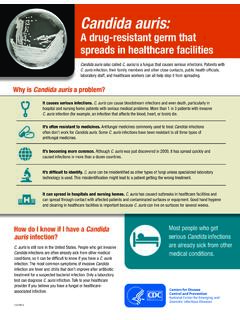
Candida auris
C Candida auris: A drug-resistant germ that spreads in healthcare facilities Candida auris (also called C. auris) is a fungus that causes serious infections.
Download Candida auris

Information
Domain:
Source:
Link to this page:
Documents from same domain
School Chemistry Laboratory Safety Guide
www.cdc.govSchool Chemistry Laboratory Safety Guide. October 2006. U.S. Consumer Safety Product Commission DEPARTMENT OF HEALTH AND HUMAN SERVICES. Centers for Disease Control and Prevention
Biosafety in Microbiological and Biomedical …
www.cdc.goviii. Foreword. Biosafety in Microbiological and Biomedical Laboratories (BMBL) quickly became the cornerstone of biosafety practice and policy in the United States upon first
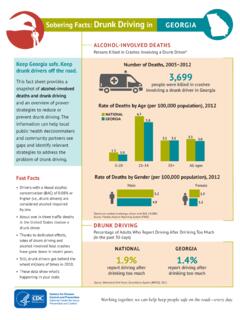
Sobering Facts: Drunk Driving in Georgia
www.cdc.govSobering Facts: Drunk Driving in GEORGIA Keep Georgia safe. Keep drunk drivers off the road. This fact sheet provides a snapshot of alcohol-involved deaths and drunk driving
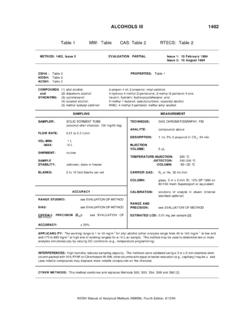
ALCOHOLS III 1402
www.cdc.govALCOHOLS III: METHOD 1402, Issue 2, dated 15 August 1994 - Page 3 of 4 a. Remove and discard back sorbent section of a media blank sampler. b. Inject a known amount of analyte or DE stock solution directly onto front sorbent section
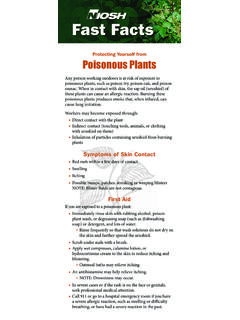
Fast Facts
www.cdc.govAny person working outdoors is at risk of exposure to poisonous plants, such as poison ivy, poison oak, and poison sumac. When in contact with skin, the sap oil (urushiol) of

Trans Fat: The Facts
www.cdc.gov• Read the Nutrition Facts label and ingredient list to compare foods. » Choose products with 0 grams trans fat. » Check the Ingredient List to see if there is any partially hydrogenated oil in the product.

ANTIBIOTIC RESISTANCE THREATS
www.cdc.govApr 23, 2013 · 6. ANTIBIOTIC RESISTANCE THREATS IN THE UNITED STATES, 2013. Executive Summary. Antibiotic Resistance Threats in the United States, 2013. is a snapshot of the complex problem
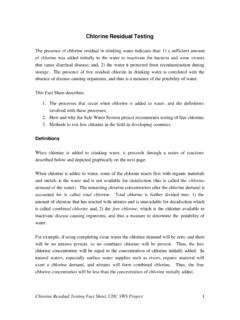
Chlorine Residual Testing
www.cdc.govChlorine Residual Testing Fact Sheet, CDC SWS Project 4 Methods to Test Free Chlorine in the Field in Developing Countries There are three main methods to test free chlorine residual in drinking water in the field
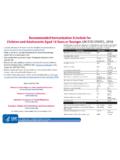
2018 Combined Recommended Immunization …
www.cdc.govRecommended Immunization Schedule for Children and Adolescents Aged 18 Years or Younger, UNITED STATES, 2018 Approved by the Advisory Committee on …
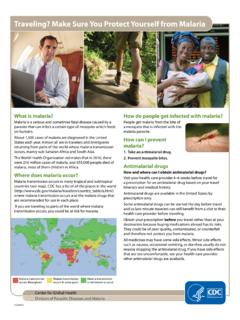
Traveling? Make Sure You Protect Yourself from …
www.cdc.govCS26201 Malaria transmission occurs throughout Malaria transmission occurs in some parts Malaria transmission is not known to occur Center for Global Health
Related documents
Diseases Transmitted through the Food Supply
www.cdc.govDr. Art Liang, Division of Foodborne Waterborne and Environment Diseases, National Center for Emerging and Zoonotic Infectious Diseases, Centers for Disease Control and Prevention (CDC), 1600 Clifton Road, NE., Mailstop G–24, Atlanta, …
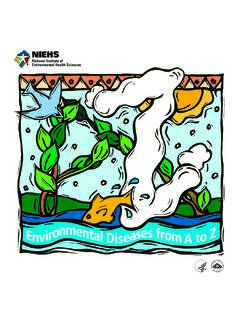
Environmental Diseases: Environmental Diseases From A to …
www.niehs.nih.govWaterborne Diseases Even our clearest streams, rivers, and lakes can contain chemical pollutants. Heavy metals like lead and mercury can produce severe organ damage. Some chemicals can interfere with the development of organs and tissues, causing birth defects. Others can cause normal cells to become cancerous.
Quick Reference - Government of New Jersey
www.nj.govDiseases, Injuries, and Poisonings 609-826-4920 Report within 30 days after diagnosis or treatment l W ork- elatd shm (p ib , probable, and confirmed) l Silicosis l Asbestosis l P n eum o cis, thra dp f l Extrinsic allergic alveolitis l Lead, mercury, cadmium, arsenic toxicity in adults l Wo rk- elatd injuy children (< age 18) l Wo rk- e latdf ...
Water and Waterborne Diseases: A Review
www.unn.edu.ngwaterborne diseases are often transmitted via the fecal-oral route, and this occurs when human faecal material is ingested through drinking contaminated water or eating contaminated food which mainly arises from poor sewage management and improper sanitation. Faecal pollution of drinking-water may be sporadic and ...
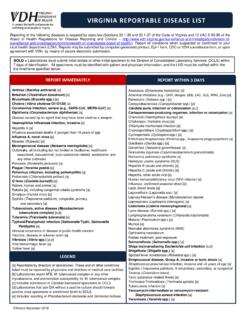
Virginia Reportable Disease List
www.vdh.virginia.govReporting of the following diseases is required by state law (Sections 32.1-36 and 32.1-37 of the Code of Virginia and 12 VAC 5-90-80 of the ... toxic substance-related, waterborne, and …..any other outbreak) Pertussis (Bordetella pertussis)[a] Plague (Yersinia pestis) [a] Poliovirus infection, including poliomyelitis [a] Psittacosis ...
11. Control of communicable diseases and prevention of ...
www.who.intin waterborne and vector-borne diseases (see Box 11.1). Other hazards may leave stand-ing water or pollute, or interrupt drinking-water supplies. High winds, coastal storms, mud slides and even earthquakes can all result in standing water, especially where a “cascade” of physical effects occurs. For instance, in the Andes it is not uncommon for

Wastewater Technology Fact Sheet: Ozone Disinfection
www3.epa.govwaterborne diseases to downstream users and the environment. It is important that wastewater be adequately treated prior to disinfection in order for any disinfectant to be effective. Table 1 lists some common microorganisms found in domestic wastewater and the diseases associated with them. Ozone is produced when oxygen (O 2) molecules are