Chapter 1 Infrared Detector Characterization
does not include multiplexing functions in the infrared focal plane (IRFP). In the mid-1970s attention turned to the photodiodes for passive IR imaging applications. In contrast to photoconductors, photodiodes with their very low power dissipation, inherently high impedance, negligible 1/f noise, and easy
Download Chapter 1 Infrared Detector Characterization

Information
Domain:
Source:
Link to this page:
Documents from same domain

Chapter 1 Introduction to Radiometry - SPIE
spie.org1 Chapter 1 Introduction to Radiometry 1.1 Definitions Consider the following definitions a starting point for our study of radiometry: radio- [<L.radius] a combining form meaning ray, raylike -metry [Gr. -metria < metron] a terminal combining form meaning the process, art, or science of measuring

AND REMOTE SENSING• - SPIE - the international society ...
spie.orgConf . 9998: Remote Sensing for Agriculture, Ecosystems, and Hydrology (Neale, Maltese) p.48 Conf . 9999: Remote Sensing of the Ocean, Sea Ice, Coastal Waters, and Large Water Regions 2011

2012 Remote Sensing - SPIE
spie.orgRemote Sensing Technologies - -Atmospheric Sensing - -Sensors, Systems, and Next-Generation Satellites - Environmental Monitoring and Applications - Earth Surface Sensing Infrared Systems Optical Materials and Technologies - Unmanned/Unattended Sensors - Biological and Chemical Sensing

MARC TRAIN, AMTRAK & METRO SUBWAY ON METRORAIL …
spie.orgMARC is not the recommended method of transportation from Baltimore Washington Airport (BWI) to Baltimore Convention Center – Light Rail is recommended • The MARC …

The Keynote Guide to Planning a Successful Conference
spie.orgAbout Conference Manager: Conference ManagerTM is an online application that will help you take care of the details as such as: usetting conference goals usetting up your registration process usending invitations ubooking transportation ucollecting abstracts and papers
Chapter 4 Airy Functions - SPIE
spie.orgChapter 4 Airy Functions 4.1 Introduction Airy functions are named after the English astronomer George Biddell Airy (1801–1892). Airy’s first mathematical work was on the diffraction phenom-enon, namely, the Airy disk—the image of a point object by a telescope— which is familiar to all of us in optics. The name Airy is connected with many
The concept of modes in optics and photonics
spie.orgThe shape of modes may be changed by passive optical elements (lenses, mirrors, filters), however, the number N of photons per mode cannot by increased. The energy throughput of an optical systems depends on the number of supported modes and the adaptation of the modes between the different sections of the system.

TRANSFER OF COPYRIGHT TO THE SOCIETY OF PHOTO …
spie.orgThis form must be signed by (1) at least one author who is not a U.S. Government employee and (2) the author's employer if the Paper was prepared within the scope of the author’s employment or was commissioned by the employer.

How to Write a Good Scientific Paper - SPIE
spie.orgin general, good science writing does not require creative writing. In particular, writing for a peer-reviewed science or engineering journal requires learning and executing a specific formula for presenting scientific work. This book is all about teaching the style and conventions of writing for a peer-reviewed science journal.
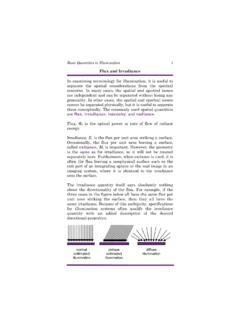
Flux and Irradiance flux irradiance intensity radiance
spie.orgare flux, irradiance, intensity, and radiance. Flux, Φ, is the optical power or rate of flow of radiant energy. Irradiance, E, is the flux per unit area striking a surface. Occasionally, the flux per unit area leaving a surface, called exitance, M, is important. However, the geometry is the same as for irradiance, so it will not be treated
Related documents

New York Mid and Low Back Injury Medical Treatment ...
www.wcb.ny.govNew York Mid and Low Back Injury Medical Treatment Guidelines Second Edition, January 14, 2013 2 and implement effective educational strategies and skills.
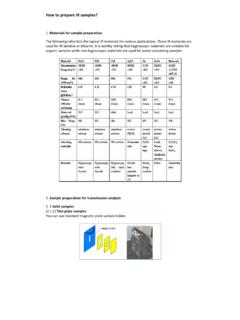
How to prepare IR samples? - Northwestern University
www.nuance.northwestern.eduFor mid‐IR frequency range, KBr, KCl or diamond dust can be used. For far‐infrared testing, high‐density polyethylene (HDPE) or diamond dust is suitable. For near‐ infrared analysis, CsI or KBr can be selected. You can prepare a KBr Pellet as follows: ...

The Fundamentals of Infrared Spectroscopy
www.midac.comMid Infrared 4,500 to 400 cm-1 (2.5 to 50 μm) Far Infrared 400 to 12.5 cm-1 (50 to 800 μm) Using these units, visible light is from 0.36 to 0.75 μm, or 27,778 to 13,333 cm-1. There is a discussion of these units below. In the case of infrared spectroscopy, infrared light passes through a sample and certain
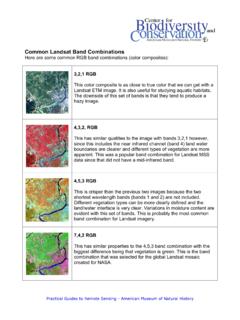
Common Landsat Band Combinations - Middlebury College
geography.middlebury.edu(1.55-1.75 µm, mid-infrared) This band is very sensitive to moisture and is therefore used to monitor vegetation and soil moisture. It is also good at differentiating between clouds and snow. Band 6 (10.40-12.50 µm, thermal infrared) This is a thermal band, which means it can be used to measure surface temperature.
Infrared and Raman Spectroscopy: Principles and Spectral ...
www.chemistry.uoc.grInfrared and Raman spectroscopy involve the study of the interaction of radiation with molecular vibrations but differs in the manner in which photon energy is transferred to the molecule by changing its vibrational state. IR spectroscopy measures transitions between molecular vibrational energy levels as a result of the absorption of mid-IR ...
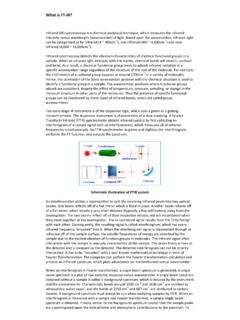
What is FT IR? - Northwestern University
www.nuance.northwestern.eduInfrared (IR) spectroscopy is a chemical analytical technique, which measures the infrared intensity versus wavelength (wavenumber) of light. Based upon the wavenumber, infrared light can be categorized as far infrared (4 ~ 400cm‐1), mid infrared (400 ~ 4,000cm‐1) and near
Fourier Transform Infrared Spectroscopy - Weebly
emanalhajji.weebly.comMar 13, 2016 · Fourier transform infrared spectroscopy (FTIR) is a method used to obtain an infrared spectrum of absorption or emission of a solid, liquid or gas. An FTIR spectrometer simultaneously collects high spectral resolution data over a wide spectral range. 1 Figure 1 shows the typical arrangement of FTIR.

Vibrational Spectroscopy (Infrared, IR-Spect.)
sci.tanta.edu.egVibrational (Infrared, IR) Spectroscopy • It is the technique which is used to identify chemical compounds based on how infrared radiations are absorbed by the compounds' chemical bonds, and interacts with them. ... Mid IR region - 2.5 to 50 μm (4000 – 200 cm-1) 3. Far IR region
Infrared Spectroscopy 1. Introduction
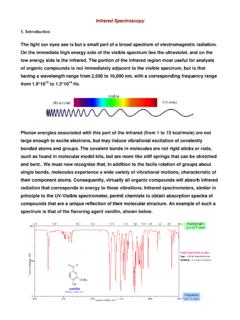
www.ifsc.usp.brThe infrared portion of the electromagnetic spectrum is divided into three regions; the near-, mid- and far- infrared, named for their relation to the visible spectrum. The far-infrared, approximately 400-10 cm-1 (1000–30 μm), lying adjacent to the microwave region, has low energy and may be used for rotational spectroscopy.

Seeking Light from the First Galaxies in the Universe NASA ...
www.jwst.nasa.govinstruments: Near-Infrared Camera (NIRCam), Near-Infrared Spectrograph (NIRSpec), Mid-Infrared Instrument (MIRI), and Near-Infrared Imager and Slitless Spectrograph (NIRISS) with the Fine Guidance Sensor (FGS) WAVELENGTHS: Visible, Near Infrared, Mid Infrared (0.6-28.5 micrometers) TRAVEL DISTANCE: 1 million miles