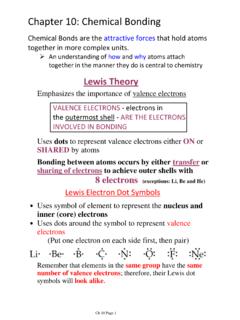
Chapter 10: Chemical Bonding
Valence Shell Electron Pair Repulsion (VSEPR ) Theory: Repulsion between the negative charges on electron groups determines the molecular geometry (shape) of a molecule or polyatomic ion a) NH 3 H H N H •• — — 1st-Determine the Lewis structure of NH 3 Determine the Electron and Molecular Geometry of: 2nd-Count electron "Groups" around ...
Download Chapter 10: Chemical Bonding

Information
Domain:
Source:
Link to this page:
Documents from same domain
Material Safety Data Sheet Sodium Borate …
webs.anokaramsey.eduis made and LabChem Inc. assumes no liability resulting from the use of this MSDS. The user must determine suitability of this The user must determine suitability of this information for his application.

Material Safety Data Sheet Sodium Phosphate …
webs.anokaramsey.eduMaterial Safety Data Sheet Sodium Phosphate Solution, Saturated - 2 - Chronic: Effects may be delayed. Section 4 - First Aid Measures Eyes: Immediately flush eyes with plenty of water for at least 15 minutes, occasionally lifting the upper
Lab Activity H17 Glow Sticks - Anoka-Ramsey Community …
webs.anokaramsey.eduLab Activity H17 Glow Sticks OUTCOMES After completing this lab activity, the student should be able to design an experiment to answer a simple question related to glow sticks gather and interpret the data collected in the experiment
Lab Activity H12 The Baking Soda Volcano Reaction
webs.anokaramsey.eduof baking soda were reacted with vinegar and when 4.0 g were reacted? b) Using the answers from (a) and the theoretical yields calculated in PreLab Question #5, what was the percentage yield when 3.0 g of baking soda were reacted with vinegar and

Experiment 4 Solubility of a Salt - Anoka-Ramsey Community ...
webs.anokaramsey.eduExperiment 4 Solubility of a Salt OUTCOMES After completing this experiment, the student should be able to: measure the temperature at which a solution becomes saturated. construct a solubility curve for a solute. determine the concentration of an unknown solution from its saturation temperature.
MSDS Material Safety Data Sheet
webs.anokaramsey.eduquantity of Silver Nitrate is 1 pound (454 grams) per package. Contact Ricca Chemical Company at 888-467-4222 or visit us on our website at www.riccachemical.com to confirm the hazardous or non-hazardous nature for shipping purposes. 20 liter (5 gal) sizes of the following catalog numbers are
Lab Activity H13 Food Coloring Kinetics
webs.anokaramsey.eduLab Activity H13 Food Coloring Kinetics OUTCOMES After completing this lab activity, the student should be able to: explain how the concentration of a reactant affects the reaction rate. determine the effect of temperature of a reaction mixture on the reaction rate.
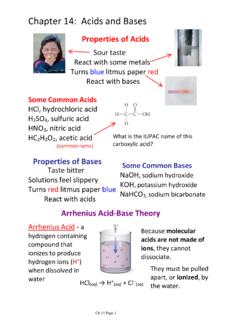
Chapter 14: Acids and Bases
webs.anokaramsey.eduChapter 14: Acids and Bases Ch 14 Page 1 . Arrhenius Base -a hydroxide containing compound that ... Strong and Weak Acids and Bases Ch 14 Page 5 . A VERY SMALL PERCENTAGE (about 1 out of every 10 million) ... Chem 1020 Tro Chapter 14 Lecture Notes Created Date:
Material Safety Data Sheet
webs.anokaramsey.eduMaterial Safety Data Sheet Sodium Hypochlorite, 6% 24 Hour Emergency Phone: CHEMTREC (US) 1-800-424-9300 Date of Preparation: 04/14/10 Revision: 04/14/10
Experiment 3 An Introduction to Functional Groups in ...
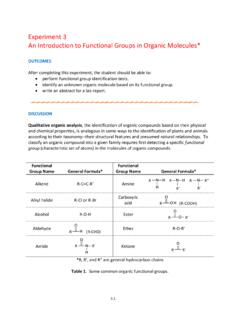
webs.anokaramsey.eduAn Introduction to Functional Groups in Organic Molecules* OUTCOMES After completing this experiment, the student should be able to: perform functional group identification tests. identify an unknown organic molecule based on its functional group. …
Related documents

Lewis Dot Structures and VSEPR - Surry County Public ...
www.surryschools.netMolecular Geometry Diagram Description Example Linear(AX 2) 2 outside atoms 0 lone pairs CO 2 Bent (AX 2) 2 outside atoms 2 lone pairs H 2 O trigonal planar (AX 3, A = boron) 3 outside atoms 0 lone pairs BF 3 Tetrahedral (AX 4) 4 outside atoms 0 lone pairs CH 4 trigonal pyramidal (AX 3) 3 outside atoms 1 lone pair NH 3
Drawing Lewis Structures to Determine Molecular Geometry ...
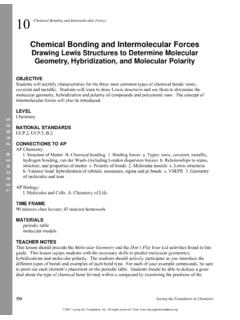
thomaschemistry.weebly.com1. BeH2 Valence electrons: Molecular Geometry: linear; nonpolar; sp; LDF Be = 1 × 2 = 2 H = 2 × 1 = 2 Total: 4 electrons or 2 pair 2. SiBr4 Valence electrons: Molecular Geometry: tetrahedral; nonpolar; sp3; LDF Si = 1 × 4 = 4 Br = 4 × 7 = 28 Total: 32 electrons or 16 pair 3. BF3 Valence electrons: Molecular Geometry: trigonal

CHEMICAL BONDING AND MOLECULAR STRUCTURE
ncert.nic.inCHEMICAL BONDING AND MOLECULAR STRUCTURE 103 When combining atoms share three electron pairs as in the case of two nitrogen atoms in the N 2 molecule and the two carbon atoms in the ethyne molecule, a triple bond is formed. 4.1.3 Lewis Representation of Simple Molecules (the Lewis Structures) The Lewis dot structures pr ovide a pictur e
Worksheet 13 - Molecular Shapes Lewis structures by using ...
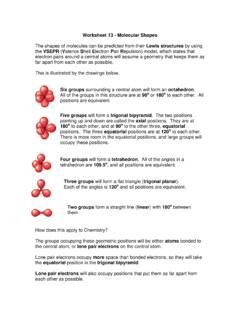
butane.chem.uiuc.eduWorksheet 13 - Molecular Shapes The shapes of molecules can be predicted from their Lewis structures by using the VSEPR (Valence Shell Electron Pair Repulsion) model, which states that electron pairs around a central atoms will assume a geometry that keeps them as far apart from each other as possible. This is illustrated by the drawings below.
CHM151LL: VSEPR and Molecular Geometry Tables
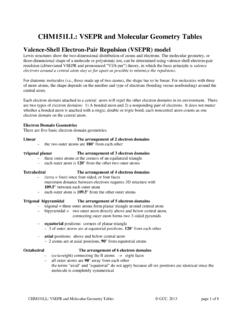
web.gccaz.eduCHM151LL: VSEPR and Molecular Geometry Tables Valence-Shell Electron-Pair Repulsion (VSEPR) model Lewis structures show the two-dimensional distribution of atoms and electrons. The molecular geometry, or three-dimensional shape of a molecule or polyatomic ion, can be determined using valence-shell electron-pair repulsion (abbreviated VSEPR and ...