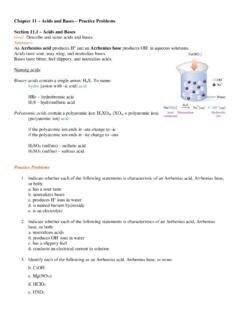
Chapter 11 Acids and Bases Practice Problems Section 11.1 ...
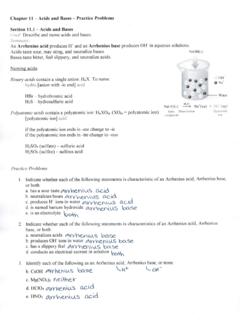
Chapter 11 – Acids and Bases – Practice Problems Section 11.1 – Acids and Bases Goal: Describe and name acids and bases. Summary: An Arrhenius acid produces H+ and an Arrhenius base produces OH-in aqueous solutions. Acids taste sour, may sting, and neutralize bases. Bases taste bitter, feel slippery, and neutralize acids.
Download Chapter 11 Acids and Bases Practice Problems Section 11.1 ...

Information
Domain:
Source:
Link to this page:
Documents from same domain
Chromosome 16: PV92 PCR - Utah State University
ion.chem.usu.eduChromosome 16: PV92 PCR A Bio-Rad Biotechnology Explorer™ Experiment Introduction to PCR—The Polymerase Chain Reaction You are about to perform a procedure known as PCR1—the amplification of a
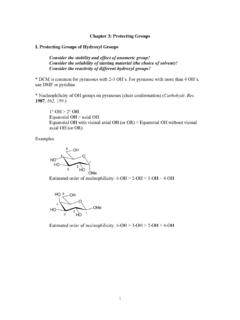
Chapter 3 Protecting Groups - chem.usu.edu
ion.chem.usu.eduChapter 3: Protecting Groups ... relatively strong acid (TFA) to remove * Stable in basic conditions * The reagent, MOMCl, is considered carcinogenic Reagent/Condition Reference MOMCl, NaH in THF or ... Protecting Groups of Amino Groups (i) Masking NH2 (amino) as N3 (azido)
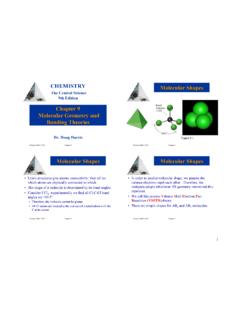
The Central Science 9th Edition - Chemistry Department
ion.chem.usu.edu• count the total number of electron pairs around the central atom, • arrange the electron pairs in one of the above geometries to minimize e − -e − repulsion, and count multiple bonds as one
Introduction to Organic Chemistry: Hydrocarbons
ion.chem.usu.eduOrganic Compounds Organic chemistry is the study of carbon compounds. An organic compound • Always contains carbon and hydrogen atoms • May also contain other nonmetals such as oxygen, nitrogen, phosphorus, or a halogen. • Organic compounds are found in: •Gasoline, medicines, shampoos, plastics, and perfumes •Carbohydrates, fats, and proteins
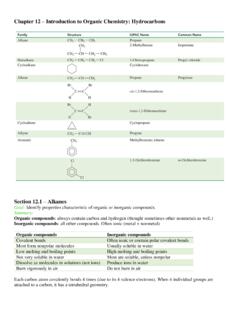
Chapter 12 Introduction to Organic Chemistry: Hydrocarbons
ion.chem.usu.eduChapter 12 – Introduction to Organic Chemistry: Hydrocarbons Section 12.1 – Alkanes Goal: Identify properties characteristic of organic or inorganic compounds. Summary: Organic compounds: always contain carbon and hydrogen (thought sometimes other nonmetals as well.) Inorganic compounds: all other compounds.Often ionic (metal + nonmetal) Organic …
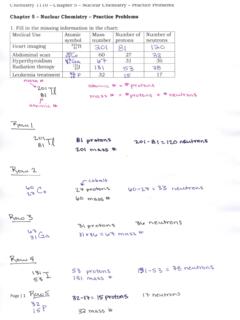
Utah State University Chemistry and Biochemistry | USU
ion.chem.usu.educnermstry 1 1 IU — unapter — Nuclear cnermstry — practice yrot)lerns 32. When a gamma ray is emitted from the nucleus of an atom, the nuclear mass A) increases by two units. B) decreases by one unit. C) increases by one unit. D decreases by two units. emains the same. 33. Radium-226 decays by alpha decay to A) barium-131. B) cobalt-60. C ...
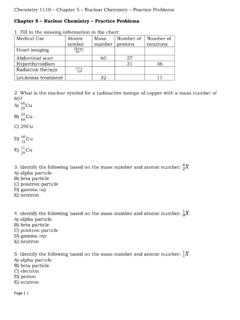
Nuclear Chemistry Practice Problems
ion.chem.usu.eduChemistry 1110 – Chapter 5 – Nuclear Chemistry – Practice Problems Page | 10 47. The half-life of a radioisotope is A) one-half of the time it takes for the radioisotope to completely decay to a nonradioactive isotope. B) the time it takes for the radioisotope to become an isotope with one-half of the atomic
Utah State University Chemistry and Biochemistry | USU
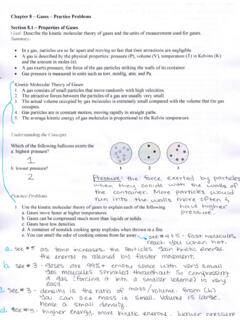
ion.chem.usu.eduExample: A sample of helium gas (He) has a volume 6.8 L and a pressure of 2.5 atm. What is the final volume, ... The volume is compressed to 2.0 L. b. The volume expands to 12 L. 9. A gas at a pressure of 2.0 atm is in a closed container. Indicate the changes (increases, decreases, or does
Utah State University Chemistry and Biochemistry | USU
ion.chem.usu.eduth1S IS a basic solution. !nderstanding the Concepts: Why are the concentrations ofH30 and OH- equal in pure water? One is + What is the meaning and value of Kw at 250C? In an acidic solution how does the concentration of 1-130 compare to the concentration of …
CH3 Practice Key Updates - Utah State University
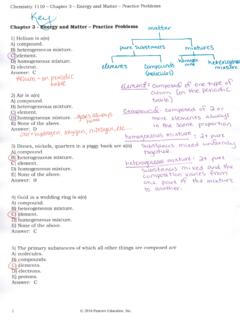
ion.chem.usu.eduChemistry 1 110 — Chapter 3 — Enerw and Matter — 26) 3.25 kcal is the same amount of enerw as Practice Problems A) 3.25 J. B) 0.777 J. C 777 J.
Related documents

Intro to Acids & Bases Worksheet
mlbgsd.k12.pa.usBrønsted -Lowery is different than Arrhenius because an acid or a base does not have to form a H+ or OH-ion. An acid has to donate a proton and a base has to accept a proton.

Intro to Acids & Bases Worksheet
www.mlbgsd.k12.pa.usform a covalent bond. While a Lewis base is a substance that can a pair of to form a covalent bond. All Bronsted-Lowry acids and bases are also Lewis acids and bases, but not necessarily the other way around. H+ + OH-→ H 2 O Hydroxide donates the pair of electrons - Lewis base Hydrogen ion accepts the pair of electrons – Lewis acid
Bcids, Bases and Salts - VAGA Study
vaga.studyChap 3 aCids, Bases and salts page 39 t pdf o v a i o To Purchase Hard Book of From Amazon Click Here. For More Details Whatsapp at 8905629969 ChAptER 2 Bcids, Bases and Salts 3.1 acids Acids are chemical compounds which have sour taste, consist of hydrogen (H), and turn blue litmus solution red. On the basis of their sources,

Notes ACIDS, BASES AND SALTS
nios.ac.in8.2 PROPERTIES OF ACIDS AND BASES Each substance shows some typical or characteristics properties. We can categorize a substance as an acid or a base according to the properties displayed. Let us learn the characteristic properties of acids and bases. 8.2.1 Properties of Acids The following are the characteristic properties of acids: 1. Taste
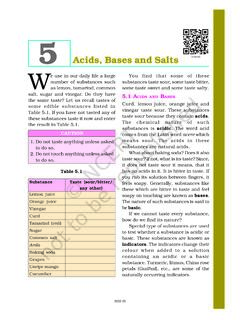
Acids, Bases and Salts W
www.ncert.nic.intoo acidic, it is treated with bases like quick lime (calcium oxide) or slaked lime (calcium hydroxide). If the soil is basic, organic matter (compost) is added to it. Organic matter releases acids which neutralises the basic nature of the soil. Factory wastes The wastes of many factories contain acids. If they are allowed to
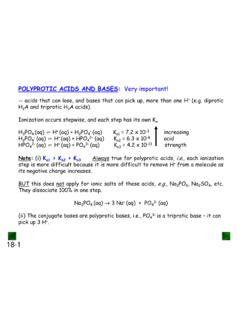
POLYPROTIC ACIDS AND BASES: Very important!
christou.chem.ufl.edu(Other weak bases also known, however.) General equilibrium for a weak base in water This is a “base-dissociation reaction” or “base-ionization reaction” (NOTE: The base doesn’t actually dissociate!) K b = base-dissociation (ionization) constant K b = ([H 2O] is a constant and contained within K b) Question.
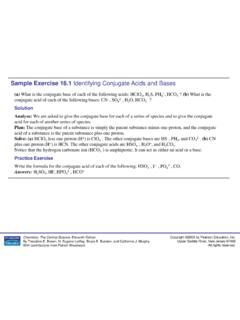
Sample Exercise 16.1 Identifying Conjugate Acids and Bases
www.austincc.eduThe two bases in the equation are CO. 3 2–, the base in the forward reaction as written, and SO. 4 2– the conjugate base of HSO. 4 –. We can find the relative positions of these two bases in Figure 16.4 to determine which is the stronger base. Solve: CO. 3 2– appears lower in the right-hand column in Figure 16.4 and is therefore a ...
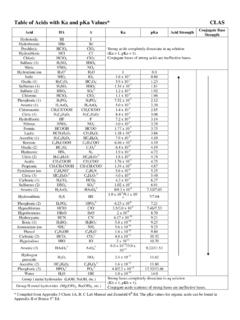
Table of Acids with Ka and pKa Values* CLAS
clas.sa.ucsb.eduStrong bases completely dissociate in aq solution (Kb > 1, pKb < 1). Conjugate acids (cations) of strong bases are ineffective bases. * Compiled from Appendix 5 Chem 1A, B, C Lab Manual and Zumdahl 6th Ed. The pKa values for organic acids can be found in Appendix II of Bruice 5th Ed.

1. HARD AND SOFT ACIDS AND BASES (HSAB)
rbmcollege.ac.incorrelation between various Lewis acids and bases has been achieved . In 1958 this was done by Ahrland , Chatt and Davies by classifying the acids or bases into general categories .Class – “a” and Class- “ b” According to them the two categories of metal ions (Lewis acids)are as follows –
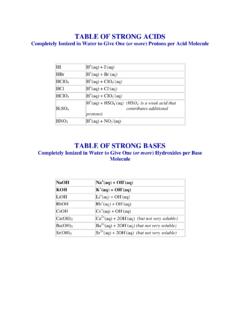
Table of Strong Acids and Bases - Palomar College
www2.palomar.eduTABLE OF STRONG ACIDS Completely Ionized in Water to Give One (or more) Protons per Acid Molecule HI H+ ... -is a weak acid that contributes additional protons) HNO 3 H +(aq) + NO 3-(aq) TABLE OF STRONG BASES Completely Ionized in Water to Give One (or more) Hydroxides per Base Molecule NaOH Na+(aq) + OH-(aq) KOH K+(aq) + OH-(aq)