Chapter 11 Solving Equilibrium Problems for Complex Systems
Aqueous solutions often contain species that interact with one another and water to yield two or more simultaneous equilibria. Ex., for a sparingly soluble salt in water, there are three equilibria. + BaSo4(s) ⇔ Ba 2 + SO. 4-2 SO + O 4-2 H 3 + ⇔HSO. 4 - +H 2. O-2H. 2. O +⇔ H. 3. O + OH
Download Chapter 11 Solving Equilibrium Problems for Complex Systems

Information
Domain:
Source:
Link to this page:
Documents from same domain
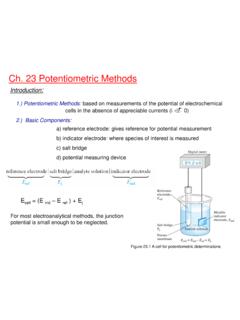
Ch. 23 Potentiometric Methods - İYTE Ana Sayfa
web.iyte.edu.trCu 2+: o E ind = E Cu – (0.0592/2) pCu -Problems • Electrode of the first kind is not very popular because… – metallic indicator electrodes are not very selective and respond not only to their own cations but also to other more easily reduced cations.

Chapter 24 Electrogravimetry and Coulometry
web.iyte.edu.trH+ is electrolyzed to deposit Cu(s) on a Pt cathode and to liberate O 2 at a Pt anode. Calculate the voltage needed for electrolysis. If the resistance of this cell is 0.44 ohm. Estimate the voltage needed to maintain a current of 2.0 A. Assume that the anode overpotential is 1.28 V and there is

Chapter 8: Sampling, Standardization, and Calibration
web.iyte.edu.trA chemical analysis uses only a small fraction of the available sample, the process of sampling is a very important operation. Knowing how much sample to collect and how to further subdivide the collected sample to obtain a laboratory sample is vital in the analytical process. Statistical methods are used to aid in the selection of a representative
Chapter 4: Calculations Used in Analytical Chemistry
web.iyte.edu.trFor very dilute solutions, parts per million (ppm) is a convenient way to ... aqueous lead nitrate to produce 1 mole of solid lead iodide and 2 moles of ... Figure 4-2 Flow diagram for making stoichiometric calculations. •4.1, 4.4, 4.7-4.15 (odd)

Chapter 12: Gravimetric Methods of Analysis
web.iyte.edu.tr12A-1 Properties of Precipitates and Precipitating Reagents A gravimetric precipitating agent should react specifically or at least selectively with the analyte and give precipitates that is: 1. Enough particle size for retaining on filter paper 2. High purity (free of contaminants) 3. Low solubility that no significant loss of the analyte occurs during filtration
Chapter 5: Errors in Chemical Analyses
web.iyte.edu.trinterfere with the measurement process. Errors inherent in a method are often difficult to detect and hence, these errors are usually the most difficult to identify and correct.

Principles of Neutralization Titrations
web.iyte.edu.trequivalence point), the solution consists of a series of buffers. The pH of each buffer can be calculated from the analytical concentrations of the conjugate base or acid and the concentrations of the weak acid or base that remains. 3. At the equivalence point, the solution contains only the conjugate of the weak acid or

Chapter 7: Statistical Analysis Data Treatment and Evaluation
web.iyte.edu.trThe critical value of z is 1.64 so that 95% of the area is to the left of z crit and 5% of the area is to the right. (c) One-tailed test for H a: < 0. The critical value is again 1.64 so that 5% of the area lies to the left of -z crit. Figure 7-2 Rejection regions for the 95% confidence level.
Related documents

I. Multiple Choice Questions (Type-I) 1. Which of the ...
cdn1.byjus.comNCERT Exemplar Solutions of Class 12 Chemistry Chapter 2 Solutions. 11. In comparison to a 0.01 M solution of glucose, the depression in freezing point . of a 0.01 M MgCl2 . solution is _____. ... Decreasing order of osmotic pressure for 0.01 M aqueous solutions of . barium chloride, potassium chloride, acetic acid and sucrose is .
Chem 1220 Recitation Activity ... - Chapter 1 | Dr. Fus
www.drfus.comDr.$Fus$ $ CHEM$1220$ $!!]!!!!!]!!!!!]!!!).! $!]!!

CHAPTER 3: PHASE EQUILIBRIA - Washington University in St ...
classes.engineering.wustl.eduCHAPTER 3: PHASE EQUILIBRIA 3.1 Introduction ... solutions. [ ] 1 AH2O HAAP HAMatm ... The distribution of a species A between gas and aqueous phases, in say a cloud, can be expressed as 3 3 AA A A moles of Ain solution per m of air H P L HRTL moles of Ain air per m of air P RT == (27)
Chapter 6 Oxidation-Reduction Reactions
preparatorychemistry.comTo get a review of the most important topics in the chapter, fill in the blanks in the Key Ideas section. Work all of the selected problems at the end of the chapter, and check your answers with the solutions provided in this chapter of the study guide. Ask for help if you need it. Web Resources Internet: Balancing Equations for Redox Reactions

Chapter 14 Solutions and Their Behavior - Texas A&M …
www.chem.tamu.eduChapter 14 Solutions and Their Behavior PRACTICING SKILLS Concentration 1. For 2.56 g of succinic acid in 500. mL of water: The molality of the solution: Molality = #mole solute/kg solvent: With a density of water of 1.00 g/cm3, 500. mL = 0.500 kg Molality = 0.0217 mol 0.500 kg = 0.0434 molal The mole fraction of succinic acid in the solution:
Physicochemical properties of drugs - Pharmaceutical Press
www.pharmpress.com58 Essentials of Pharmaceutical Chemistry acidity constant Ka and is expressed mathematically as Ka D TH3OCUTA U HA (3.2) (taking TH2OUto be effectively constant for dilute solutions). From Eq. (3.2) it can be seen that, since Ka is a simple ratio, the higher the numerical value of Ka the stronger will be the acid. As stated in Chapter 1, however, the strength of most acids (and …
Pharmaceutical Compounding and Dispensing Sample Chapter
www.pharmpress.com(see Chapter 5, page 70). 4 Prepare a suitable label (see Chapter 5, page 91). 5 Weigh all solids. 6 Identify the soluble solids and calculate the quantity of vehicle required to fully dissolve the solids. If more than one solid is to be dissolved, Box 6.1 Advantages and disadvantages of solutions as dosage forms Advantages Disadvantages

Chapter 10 Solutions - WebAssign
www.webassign.netChapter 10 Solutions 10-1 1. Distinguish between the terms solute and solvent. Give an example of a solution and identify each component. The solvent is usually the substance in a solution that is in the greatest amount.

Chapter 4 Reactions in Aqueous Solutions
www1.udel.edu4.1 General Properties of Aqueous Solutions •Solution - a homogeneous mixture –Solute: the component that is dissolved –Solvent: the component that does the dissolving Generally, the component present in the greatest quantity is considered to be the solvent. Aqueous solutions are those in which water is the solvent.