
Chapter 11: Stoichiometry
The chemical equation does not directly tell you anything about the masses of the reactants and products. However, by converting the known mole quantities to mass, the mass relationships become obvious. Recall that moles are converted to mass by multiplying by the molar mass. The masses of the reactants are as follows. 4 mol Fe × 55.85 g Fe ...
Download Chapter 11: Stoichiometry

Information
Domain:
Source:
Link to this page:
Documents from same domain
Operational Amplifiers: Basics and Design Aspects
www.mcvts.netComparator ... The objective of this tutorial is to provide students with a means of ... An operational amplifier circuit can be analyzed with the use of a well ...

Chapter 8: Covalent Bonding
www.mcvts.netIonic Polar Covalent Nonpolar Covalent Bond Character ... Spread several paper towels across your desk or lab work area. Put on lab gloves. Place a paper cup ... 242 Chapter 8 • Covalent Bonding Single Covalent Bonds When only one pair of electrons is shared, such as in a hydrogen

Chapter 10: The Mole - Middlesex County Vocational and ...
www.mcvts.net322 Chapter 10 • The Mole Converting Between Moles and Particles Suppose you buy three-and-one-half dozen roses and want to know ... Particles to moles Now suppose you want to find out how many moles are represented by a certain number of representative particles.

Chapter 21: Hydrocarbons
www.mcvts.net©Steve Starr/CORBIS. Hydrocarbon Compounds Chapter 21 • Hydrocarbons 743 SStart-Up Activitiestart-Up Activities Hydrocarbon Compounds ... thick layers of mudlike deposits on the ocean floor. Heat from Earth’s interior and the tremendous pressure of overlying sediments trans-formed this mud into oil-rich shale and natural gas. In certain ...

Genocide: A Comprehensive Introduction
www.mcvts.netColonial and imperial genocides 40 ... Spanish America 70 The United States and Canada 72 Other genocidal strategies 75 ... 5.1 A supporter of Stalin and Lenin carries their portraits in Red Square 136 6.1 Ruins of a gas chamber and crematorium complex at Auschwitz-Birkenau 153
Operational Amplifiers: Basics and Design Aspects
www.mcvts.netoperational amplifiers is the very high gain achieved at the output. In general, gain is calculated as Vgain = Vout/Vin, a ratio of the output voltage to the input voltage. An op-amp amplifies the difference between one input and the other, while neither individual input is itself amplified. The output is positive if the non-inverting input is more

Limiting Reactant Practice Answers
www.mcvts.netTitle: HW - limiting reactant practice answers
Honors Chemistry Extra Stoichiometry Problems
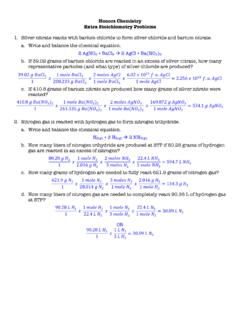
www.mcvts.netExtra Stoichiometry Problems 1. Silver nitrate reacts with barium chloride to form silver chloride and barium nitrate. a. Write and balance the chemical equation. 2 AgNO 3 + BaCl 2! 2 AgCl + Ba(NO 3) 2 b. If 39.02 grams of barium chloride are reacted in …

Extra Practice Mixed Gas Law Problems Answers
www.mcvts.netMixed Extra Gas Law Practice Problems (Ideal Gas, Dalton’s Law of Partial Pressures, Graham’s Law) 1. Dry ice is carbon dioxide in the solid state. 1.28 grams of dry ice is placed in a 5.00 L chamber that is maintained at 35.1oC. What is the pressure in the chamber after all of the dry ice has sublimed? !"=!"# 1.28!!!!"!

Buoyancy Problem Set
www.mcvts.netBuoyancy Problem Set 1) A stone weighs 105 lb in air. When submerged in water, it weighs 67.0 lb. Find the volume and specific gravity of the stone. (Specific gravity of an object: ratio object density to water density) 2) A standard basketball (mass = 624 grams; 24.3 cm in diameter) is held fully under water. Calculate the buoyant force and ...
Related documents
Chapter 4: Chemical and Solution Stoichiometry
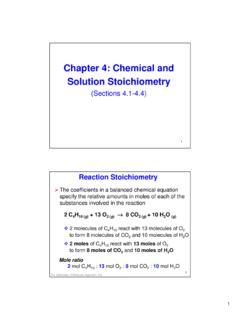
webhost.bridgew.edu3 Stoichiometry and Chemical Reactions The most common stoichiometric problem will present you with a certain mass of a reactant and then ask the amount or mass of product that can be formed. This is called mass-to-mass stoichiometry problem 5 Predicting Amounts from Stoichiometry – Cont. 1. You cannot convert mass (g) of one substance ...

Chapter 3 Stoichiometry - Home - Chemistry
www2.chemistry.msu.eduStoichiometry Anatomy of a Chemical Equation Reactants appear on the left side of the equation. CH 4 (g) ... Stoichiometry Atomic mass unit and the mole • amu definition: 12C = 12 amu. ... Mole Relationships • One mole of atoms, ions, or molecules contains
Chemical Engineering Kinetics - Tufts University
sites.tufts.eduBRIEF REVIEW OF REACTOR ARCHETYPES | 3 1 BRIEF REVIEW OF REACTOR ARCHETYPES 1.1 THE MASS BALANCE The key equation governing processes on the reactor level is the mass balance. In order to inherently account for the proper stoichiometry, this is most typically written as a mole balance.
Chapter 3. Stoichiometry: Mole-Mass Relationships in ...
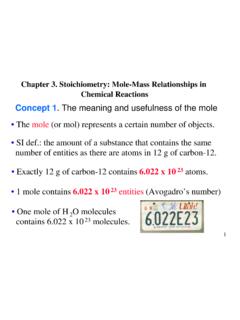
www.uh.eduChapter 3. Stoichiometry: Mole-Mass Relationships in Chemical Reactions 1 • The mole (or mol) represents a certain number of objects. • SI def.: the amount of a substance that contains the same number of entities as there are atoms in 12 g of carbon-12. • Exactly 12 g of carbon-12 contains 6.022 x 10 23 atoms. • One mole of H 2 O molecules
Chapter 4 Moles and Chemical Reactions Stoichiometry
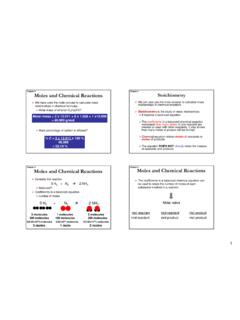
people.uwec.eduMoles and Chemical Reactions We have used the mole concept to calculate mass relationships in chemical formulas Molar mass of ethanol (C 2H5OH)? Mass percentage of carbon in ethanol? Chapter 4 Molar mass = 2 x 12.011 + 6 x 1.008 + 1 x15.999 = 46.069 g/mol % C = 2 x 12.011 x 100 % 46.069 = 52.14 % Stoichiometry

Molecular Formula: Example
www.chem.tamu.edufrom chemical reactions ... 1 mole 2 moles 1 mole 2 moles ... Since we know the molar mass of each substance we can also establish the mass relationships: CH 4 + 2O 2 → CO 2 + 2H 2O 1 mole 2 moles 1 mole 2 moles x 16.0 g/mol 32.0 g/mol 44.0 …

Stoichiometry: Calculations with Chemical Formulas and ...
faculty.ksu.edu.saChapter 3 Stoichiometry: Calculations with Chemical Formulas and Equations John D. Bookstaver ... Decomposition Reactions •Examples: –CaCO 3 (s) CaO (s) + CO 2 (g) –2 KClO 3 (s) 2 KCl (s) + O 2 (g) –2 NaN 3 (s) ... Mole Relationships •One mole of atoms, ions, or molecules contains ...
Determination of % by Mass of NaHCO in Alka-Seltzer Tablets
www.chem.tamu.eduStoichiometry refers to the quantitative relationships between the amounts (moles) of reactants ... a chemical reaction. Analysis of stoichiometry involves other fundamental chemical topics such as balancing chemical reactions, which involves the correct stoichiometric ... is produced per one mole of NaHCO 3 consumed. From the mass of CO 2 ...
Related search queries
Chemical, Stoichiometry, 3 Stoichiometry, Chemical reactions, Mass, Mass stoichiometry, Mole, Mole Relationships, Kinetics, 3. Stoichiometry: Mole-Mass Relationships in, 3. Stoichiometry: Mole-Mass Relationships in Chemical Reactions, Chemical Reactions Stoichiometry, Mass relationships in chemical, Molecular Formula, Mass relationships, Reactions, Relationships