Chapter 13: The Five Forces Behind Human Evolution
Chapter 13: The Five Forces Behind Human Evolution Introduction Five different forces have influenced human evolution: natural selection, random genetic drift, mutation, population mating structure, and culture. All evolutionary biologists agree on the first three of these forces, although there have been disputes at times about the
Download Chapter 13: The Five Forces Behind Human Evolution

Information
Domain:
Source:
Link to this page:
Documents from same domain

•Nature and nurture combine forces in prenatal …
psych.colorado.edu1 Prenatal Development •Nature and nurture combine forces in prenatal development. •Much of development is generated by the fetus itself. Conception

SAS Output for Repeated Measures - University of …
psych.colorado.eduQMIN SAS Output for Repeated Measures - 3 Next we want to do a repeated measures analysis of variance. Here, drug is the independent variable (often called a “between subjects factor” in repeated measures) and

Psychology 3102: Introduction to Behavioral …
psych.colorado.eduPsychology 3102: Introduction to Behavioral Genetics (Carey) Problem Set: Heritability and Environmentability Two basic equations are required to calculate heritability and environmentability. The first equation is h2 + e2 = 1 where h2 is the heritability and e2 is the environmentability. This equation simply states that the total …

Chapter 18: Quantitative Genetics I – Important …
psych.colorado.eduChapter 18: Quantitative Genetics I – Important Concepts Introduction In the chapter on Mendel and Morgan, we saw how the transmission of genes from one generation to another follows a precise mathematical formula. The traits discussed in that chapter, however, were discrete traits—peas are either yellow or green, someone either has a …

Functional magnetic resonance imaging: Basic …
psych.colorado.eduFunctional magnetic resonance imaging (fMRI) has quickly become the preferred technique for imaging normal brain activity, especially in the typically developing child. This technique takes advantage of specific magnetic properties and physiological

Piaget’s Theory - University of Colorado Boulder
psych.colorado.edu1 Piaget’s Theory •The first “cognitive” theory, developed by Jean Piaget beginning about 1920. •Piaget observed and described children at
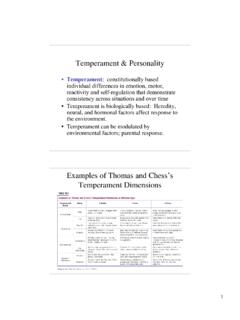
Temperament & Personality
psych.colorado.edu1 Temperament & Personality •Temperament: constitutionally based individual differences in emotion, motor, reactivity and self-regulation that demonstrate consistency across situations and over time

Positive and N egative Affectivity and T heir R elation to ...
psych.colorado.eduPositive and N egative Affectivity and T heir R elation ... (N A ) and Positive A ffectivity (PA ). N egative A ffect is a general factor of subjective distress, and subsum es a broad range of negative m ood states, including fear, anxiety, hostility, scorn, and disgust. M ood states related to de-
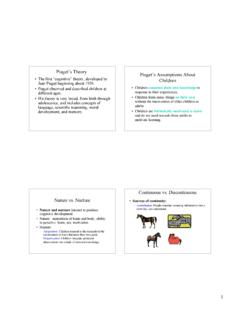
Piaget’s Theory Piaget’s Assumptions About Children
psych.colorado.edu3 Piaget’s Stages • Sensorimotor stage (birth to 2 years) •Preoperational stage (2 to 7 years) –Knowledge is represented by language, mental imagery,

Making Working Memory Work: A Computational Model of ...
psych.colorado.eduLETTER Communicated by Peter Dayan Making Working Memory Work: A Computational Model of Learning in the Prefrontal Cortex and Basal Ganglia Randall C. O Reilly
Related documents

to Conducting Retirement Ceremonies
goatlocker.orgFlags at ceremonial behind Retiree/Official Party Enclosure (6) RETIREMENT CEREMONY SCRIPT Master of Ceremony (MOC), Welcoming Remarks MOC “Ladies and Gentlemen, Please stand for the arrival of the official party, the parading of the colors, National Anthem, and remain
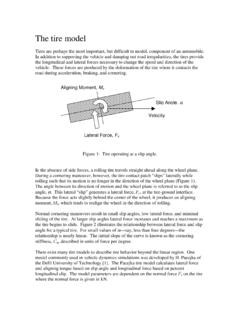
The tire model - Stanford University
www-cdr.stanford.eduBecause the force acts slightly behind the center of the wheel, it produces an aligning moment, Mz, which tends to realign the wheel in the direction of rolling. Normal cornering maneuvers result in small slip angles, low lateral force, and minimal sliding of the tire. At larger slip angles lateral force increases and reaches a maximum as

Behind-the-Wheel Guide: A Handbook for Parents and ...
www.dol.wa.govTask Force Members David E. Kinnunen Office of Superintendent of Public Instruction John Harvey Regional TSE Coordinator, ESD 101 Syd Muzzy ... TSE and behind-the-wheel, which is the actual driving of the vehicle, will be referred to as BTW. As a parent of a beginning driver, you play an important role before, ...
BIDEN-SANDERS UNITY TASK FORCE RECOMMENDATIONS …
joebiden.comBIDEN-SANDERS UNITY TASK FORCE RECOMMENDATIONS COMBATING THE CLIMATE CRISIS AND PURSUING ENVIRONMENTAL JUSTICE Climate change is a global emergency. We have no time to waste in taking action to protect ... no one behind. We will help rebuild our economy from the COVID-19 pandemic and President

A review of the concepts behind anchoring columns, as ...
www.aisc.orgA review of the concepts behind anchoring columns, as further explained in AISC Steel Design Guide 1. ANChOR RODS AND BASE PLATES typically ... the force couple from the column to the foundation through a combination of bearing of the base plate and tension in some of the anchor rods. For column bases subjected to
inclusive development
www.un.orgLeaving no one behind: the imperative of ... III.4 Labour force participation, by disability status in selected countries and areas, latest available data since 2000 74
27 HAND AND POWER TOOLS - IHSA
www.ihsa.caForce should be exerted on the fixed rather than the adjustable jaw. HandTools Use The misuseof hand tools is a common cause of injury in ... • Look behind and above before swinging the hammer. • Never use a hammer to strike another hammer. • Discard any hammer with dents, cracks, chips, or

Salesforce CPQ
resources.docs.salesforce.comDec 20, 2021 · CPQ managed package more than two releases behind the then-current generally available version of the managed package. For more information, see CPQ Legacy Version Retirement . Note: Installing into a Sandbox org is unavailable from AppExchange. 1. From your installation link, click Continue. 2.
FinTech: The Force of Creative Disruption*
rbidocs.rbi.org.inNov 11, 2020 · cybersecurity risks, leaving behind digitally illiterate and unconnected consumers. Thus, while the role of regulation is undisputed for the financial system as such, it assumes greater importance for newer . RBI Bulletin November 2020 ... FinTech: The Force of Creative Disruption. 4 ` ...