
Chapter 14. CHEMICAL EQUILIBRIUM
14.1 THE CONCEPT OF EQUILIBRIUM AND THE EQUILIBRIUM CONSTANT Many chemical reactions do not go to completion but instead attain a state of chemical equilibrium. Chemical equilibrium: A state in which the rates of the forward and reverse reactions are equal and the concentrations of the reactants and products remain constant. ⇒ Equilibrium is ...
Download Chapter 14. CHEMICAL EQUILIBRIUM

Information
Domain:
Source:
Link to this page:
Documents from same domain
Chapter 14. CHEMICAL EQUILIBRIUM
web.gccaz.eduChapter 14. CHEMICAL EQUILIBRIUM 14.1 THE CONCEPT OF EQUILIBRIUM AND THE EQUILIBRIUM CONSTANT Many chemical reactions do not go to completion but instead attain a ...
Density: Accuracy and Precision
web.gccaz.eduGCC CHM 151LL: Density: Accuracy, and Precision © GCC, 2008 page 4 of 5 glassware. ... 1. Obtain a set of 4 brass slugs and 1 aluminum slug. 2.
Chapter 7 Practice Worksheet: Covalent Bonds and Molecular ...
web.gccaz.eduChapter 7 Worksheet Spring 2007 page 1 of 5 Chapter 7 Practice Worksheet: Covalent Bonds and Molecular Structure 1) How are ionic bonds and covalent bonds different? ... f. Mg(OH) 2 ___ ionic and covalent _____ 4) Define electronegativity. Electronegativity is the ability for an atom in a molecule to attract electrons to itself. ...

Balancing Equations Worksheet KEY
web.gccaz.eduBalancing Equations Worksheet KEY 1. Zn (s) + 2 AgNO 3 (aq) ⇒ Zn(NO 3) 2 (aq) + 2 Ag (s) 2. N 2 (g) + 3 H 2 (g) ⇒ 2 NH 3 (g) 3. NaCl (aq) + AgC 2H 3O 2 (aq) ⇒ NaC 2H 3O 2 (aq) + AgCl (s) 4. 3 Mg(OH) 2 (aq) + 2 H 3PO 4 (aq) ⇒ 6 H 2O (l) + Mg 3(PO 4 ) 2 (aq) 5. 2 HNO 3 (aq) + Ni (s) ⇒ Ni(NO 3) 2 (aq) + H 2 (g) 6. Ba(HCO 3) 2 (s) ⇒ BaCO 3 (s) + H 2O (g) + CO
Chapter 13 Stoichiometry - Glendale Community College
web.gccaz.eduChapter 13 – Stoichiometry Stoichiometry (STOY-key-OM-etry) problems are based on quantitative relationships between the different substances involved in a chemical reaction.

Intermolecular and Ionic Forces - web.gccaz.edu
web.gccaz.eduIntermolecular and Ionic Forces ... general, intermolecular forces are much weaker than the ionic and covalent bonds that hold together the atoms and ions in a compound. ... compared in this lab. The alkane used in this activity is pentane, CH 3 CH 2 CH 2 CH 2 CH 3. Alcohols are

Marine Biology: Study Guide - web.gccaz.edu
web.gccaz.eduBIO145: Marine Biology 3 Study Guide Chapter 10 An Introduction to Ecology Ecology is the scientific study of the interactions between organisms and their environment that determine the distribution and abundance of organisms.

CHM 130LL: Electrolytes - Welcome to web.gccaz.edu
web.gccaz.edumainly in body fluids outside the cells. Human body fluids have almost the ... CHM 130LL: Electrolytes Lab . GCC CHM 130LL Spring 2016 page 2 of 7 Understanding ... This makes it possible to identify which substance is in which well (ex: A3 or C2). In your data table (on the next page), ...
Polymers and Plastics - web.gccaz.edu
web.gccaz.edua chemical feedstock for polymer manufacturing Polymer: ... • Now back to polymers and plastics Given these monomers predict the structure of the polymer Ethylene Vinyl chloride ... recycle numbers are these plastics? • Plastic comes from oil – so less recycling means

CHM 130 Predicting Products Worksheet
web.gccaz.eduCHM 130 Predicting Products Worksheet Circle the appropriate reaction type for each, complete the reaction with products (remember to check charges for ionic compounds), include states, and finally balance each reaction.
Related documents

A.P. Chemistry Practice Test - Ch. 13: Equilibrium ...
ap.kmacgill.com1) At equilibrium, _____. A)the rates of the forward and reverse reactions are equal B)the rate constants of the forward and reverse reactions are equal C)all chemical reactions have ceased D)the value of the equilibrium constant is 1 E)the limiting reagent has been consumed
Lecture 2 Adiabatic Flame Temperature and Chemical …
cefrc.princeton.eduChemical equilibrium and complete combustion are valid in the limit of infinitely fast reaction rates only, which will seldom be valid in combustion systems. We will consider finite rate chemical kinetics in a later lecture. 2.-18. Only for hydrogen diffusion flames complete chemical equilibrium is a good
Chemical Equilibrium Part 1 - Department of Chemistry
www.chem.uci.educhemical equilibrium simultaneously. Limiting Reagents Was all the H 2 and O 2 in the balloon converted to water? It depends on the initial amounts of the two gases Suppose:It depends on the initial amounts of the two gases. Suppose: 2 H 2 (g) + O 2 (g) →2H 2 O(g) Before candle: 0.75 atm 0.75 atm After candle: 00atm 038atm

Chemical Engineering Thermodynamics II - CPP
www.cpp.eduExample 6.1-2: Time to reach 90% conversion in a batch reactor 6-5 6.2 Chemical Reaction and Gibbs Energy 6-6 6.3 The Condition of Equilibrium for a Chemical Reaction 6-9 6.4Calculation of Equilibrium Constant from Data 6-11 Example 6.4-1: …
Chem 111 Chemical Equilibrium Worksheet Answer Keys
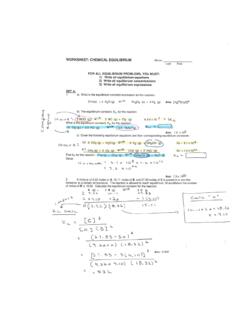
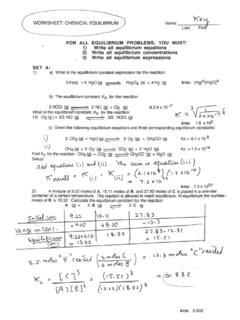
www.cerritos.eduWORKSHEET: CHEMICAL EQUILIBRIUM Name Last Ans: First FOR ALL EQUILIBRIUM PROBLEMS, YOU MUST: 1) Write all equilibrium equations 2) Write all equilibrium concentrations 3) Write all equilibrium expressions SET A: a) What is the equilibrium Constant expression for the reaction: 3 Fe(S) + 4 H20 (g) (s) + 4 H2 (g)
Radiological and Chemical Properties of Uranium
www.nrc.govEquilibrium • Equilibrium occurs when a fixed ratio exists between the activity of a parent radionuclide and that of its radioactive decay product(s). • When equilibrium exists, the activity of the decay product(s) is decreasing according to the half-life of the parent. • There are two types of equilibrium: secular equilibriumThere are two types of equilibrium: secular equilibrium

Type 1 - Calculating Keq Given Equilibrium Concentrations
colgurchemistry.comA chemical system can be thought of as being either: 1. At Equilibrium or 2. Not At Equilibrium (Initial) A system which is not at equilibrium will move spontaneously to a position of being at equilibrium. In Type 1 calculations, all species in the system are at equilibrium already, so there will be no changes in concentration.
Worksheet Chemical Equilibrium Key - Cerritos College
www.cerritos.eduWORKSHEET: CHEMICAL EQUILIBRIUM FOR ALL EQUILIBRIUM PROBLEMS, YOU MUST: 1) Write all equlllbrlum equations 2) Write all equlllbrlum concentrations 3) Wrlte all equlllbrlum expressions SET A: a) What is the equilibrium constant expression for the reaction: 3Fe(s) Ans: (H214/IH20)4 b) The equilibrium cmstant, Kc, for the reaction:

5.9 10 -3 - Glendale Community College
web.gccaz.eduCHM152 Equilibrium Worksheet Key 1 Equilibrium Worksheet Key 1. 2NH 3 (g) N 2 (g) + 3H 2 (g) At 500 K, the following concentrations were measured: