
Chapter 14 Intermolecular Forces
Clark, Smith (CC-BY-SA 4.0) GCC CHM 130 Chapter 14: IMF page 1 + - + - Chapter 14 – Intermolecular Forces 14.1 Types of Intermolecular Forces What is the difference between a bond and an intermolecular force? • Bonds: between atoms. This is the force that holds atoms together within a
Download Chapter 14 Intermolecular Forces

Information
Domain:
Source:
Link to this page:
Documents from same domain

Chapter 14. CHEMICAL EQUILIBRIUM
web.gccaz.eduChapter 14. CHEMICAL EQUILIBRIUM 14.1 THE CONCEPT OF EQUILIBRIUM AND THE EQUILIBRIUM CONSTANT Many chemical reactions do not go to completion but instead attain a ...
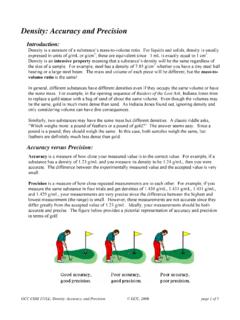
Density: Accuracy and Precision
web.gccaz.eduGCC CHM 151LL: Density: Accuracy, and Precision © GCC, 2008 page 4 of 5 glassware. ... 1. Obtain a set of 4 brass slugs and 1 aluminum slug. 2.
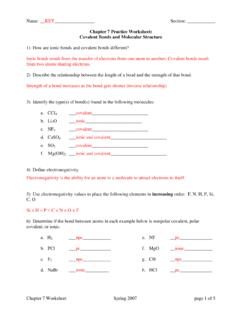
Chapter 7 Practice Worksheet: Covalent Bonds and Molecular ...
web.gccaz.eduChapter 7 Worksheet Spring 2007 page 1 of 5 Chapter 7 Practice Worksheet: Covalent Bonds and Molecular Structure 1) How are ionic bonds and covalent bonds different? ... f. Mg(OH) 2 ___ ionic and covalent _____ 4) Define electronegativity. Electronegativity is the ability for an atom in a molecule to attract electrons to itself. ...

Balancing Equations Worksheet KEY
web.gccaz.eduBalancing Equations Worksheet KEY 1. Zn (s) + 2 AgNO 3 (aq) ⇒ Zn(NO 3) 2 (aq) + 2 Ag (s) 2. N 2 (g) + 3 H 2 (g) ⇒ 2 NH 3 (g) 3. NaCl (aq) + AgC 2H 3O 2 (aq) ⇒ NaC 2H 3O 2 (aq) + AgCl (s) 4. 3 Mg(OH) 2 (aq) + 2 H 3PO 4 (aq) ⇒ 6 H 2O (l) + Mg 3(PO 4 ) 2 (aq) 5. 2 HNO 3 (aq) + Ni (s) ⇒ Ni(NO 3) 2 (aq) + H 2 (g) 6. Ba(HCO 3) 2 (s) ⇒ BaCO 3 (s) + H 2O (g) + CO
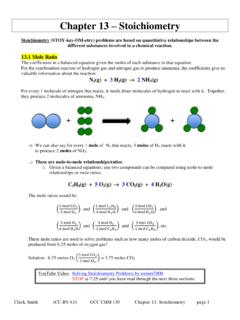
Chapter 13 Stoichiometry - Glendale Community College
web.gccaz.eduChapter 13 – Stoichiometry Stoichiometry (STOY-key-OM-etry) problems are based on quantitative relationships between the different substances involved in a chemical reaction.

Intermolecular and Ionic Forces - web.gccaz.edu
web.gccaz.eduIntermolecular and Ionic Forces ... general, intermolecular forces are much weaker than the ionic and covalent bonds that hold together the atoms and ions in a compound. ... compared in this lab. The alkane used in this activity is pentane, CH 3 CH 2 CH 2 CH 2 CH 3. Alcohols are

Marine Biology: Study Guide - web.gccaz.edu
web.gccaz.eduBIO145: Marine Biology 3 Study Guide Chapter 10 An Introduction to Ecology Ecology is the scientific study of the interactions between organisms and their environment that determine the distribution and abundance of organisms.

CHM 130LL: Electrolytes - Welcome to web.gccaz.edu
web.gccaz.edumainly in body fluids outside the cells. Human body fluids have almost the ... CHM 130LL: Electrolytes Lab . GCC CHM 130LL Spring 2016 page 2 of 7 Understanding ... This makes it possible to identify which substance is in which well (ex: A3 or C2). In your data table (on the next page), ...

Polymers and Plastics - web.gccaz.edu
web.gccaz.edua chemical feedstock for polymer manufacturing Polymer: ... • Now back to polymers and plastics Given these monomers predict the structure of the polymer Ethylene Vinyl chloride ... recycle numbers are these plastics? • Plastic comes from oil – so less recycling means

CHM 130 Predicting Products Worksheet
web.gccaz.eduCHM 130 Predicting Products Worksheet Circle the appropriate reaction type for each, complete the reaction with products (remember to check charges for ionic compounds), include states, and finally balance each reaction.
Related documents
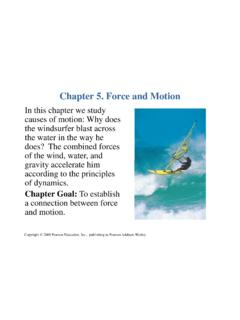
Chapter 5. Force and Motion - Physics & Astronomy
physics.gsu.eduChapter 5. Force and Motion In this chapter we study causes of motion: Why does the windsurfer blast across the water in the way he does? The combined forces ... Major Forces: 1. Weight – gravitational force 2. Spring Force 3. Tension Force 4. Normal Force 5. Friction w mg=== r r T sp rrrr F kx==== n rrrr fk
Chapter 27 – Magnetic Field and Magnetic Forces
physics.ucf.edu1) A moving charge or collection of moving charges (e.g. electric current) produces a magnetic field. (Chap. 28). 2) A second current or charge responds to the magnetic field and experiences a magnetic force. (Chap. 27). 1. Magnetism Permanent magnets: exert forces on each other as well as on unmagnetized Fe pieces.

CHAPTER 1. SOIL PHYSICAL PROPERTIES
lawr.ucdavis.eduStructural stability or resistance of soil to disintegrative forces (rain, cultivation, soil swelling), depends on type of organic matter and its changing from low to high C/N as a result of microbial breakdown of OM: ... SSC107-Fall 2000 Chapter 1, Page - 18 - ...
Chapter 2 Review of Forces and Moments
www.brown.edu2.1 Forces In this chapter we review the basic concepts of forces, and force laws. Most of this material is identical to material covered in EN030, and is provided here as a review. There are a few additional sections – for example forces exerted by a damper or dashpot, an inerter, and interatomic forces are discussed in Section 2.1.7.
Water Pressure and Pressure Forces
www.pearsonhighered.com16 Water Pressure and Pressure Forces Chap. 2 14.00 0 0 10 10 20 30 40 60 50 70 −10.33 20 30 40 50 60 70 80 Atmospheric pressure Absolute …

Chapter Overview Chapter 1 – Notification and Orders
api.army.milChapter Overview Chapter 1 – Notification and Orders: Discusses the preparation and types of orders used to mobilize/employ/deploy military and civilian personnel (includes installation/unit requirements and procedures for extensions, and sources of manpower. Chapter 2 – Mobilization of the Force: Discusses procedures for mobilizing Reserve

8.6 Drag Forces in Fluids - MIT OpenCourseWare
ocw.mit.edu1 . F A. ρ. v. 2 drag = C. D. (8.6.1) 2 The coefficient . C. D . is called the . drag coefficient, a dimensionless number that is a property of the object. Table 8.1 lists the drag coefficient for some simple shapes, (each of these objects has a Reynolds number of order 10. 4 ). The above model for air drag does n

CHAPTER 1 - PRINCIPLES OF FLIGHT
air.flyingway.commagnitude by its length. When an object is being acted upon by two or more forces, the combined effect of these forces may be represented by a resultant vector. After the vectors have been resolved, the resultant may be measured to determine the direction and magnitude of the combined forces. [Figure 1-7] Figure 1-7.— Basic Aerodynamic Vectors.

Chapter 4 Forces I
www2.tntech.eduChapter 4 Forces I 4.1 The Important Stuff 4.1.1 Newton’s First Law With Newton’s Laws we begin the study of how motion occurs in the real world. The study of the causes of motion is called dynamics, or mechanics. The relation between force and acceleration was given by Isaac Newton in his three laws of motion, which form the