
Chapter 15: Chemical Equilibrium
Chapter 15: Chemical Equilibrium Key topics: Equilibrium Constant Calculating Equilibrium Concentrations The Concept of Equilibrium Consider the reaction A ⌦ k1 k1 B At equilibrium there is no net change in [A] or [B], namely d[A] dt =0= d[B] dt But A molecules can react to form B, and B molecules can
Download Chapter 15: Chemical Equilibrium

Information
Domain:
Source:
Link to this page:
Documents from same domain

Important Probability Distributions
personal.utdallas.eduImportant Distributions... Certain probability distributions occur with such regular-ityin real-life applications thatthey havebeen given their

INFRARED SPECTROSCOPY (IR)
personal.utdallas.eduInfrared Spectroscopy (IR) ... vs. intensity of the transmission (or absorption). Frequencies appear in the x-axis in units of inverse centimeters (wavenumbers), and intensities are ... the low polarity of the triple bond associated with those alkynes. Terminal alkynes, that is to say those where the triple bond is at the end of ...

FIBER OPTIC COMMUNICATIONS
personal.utdallas.eduTransmission over fiber is limited by the attenuation and dispersion. Multimode fibers may experience Multimode dispersion: The delayed rays cause pulse spreading Chromatic dispersion: Individual wavelengths may travel at different speeds. Dispersion creates an inherent operational limit defined as EE4367 Telecom.
Introduction to Operations Management
personal.utdallas.eduutdallas.edu/~metin 4 Operations Management Operations management: The management of the efficient transformation of inputs into outputs to effectively satisfy customers. The active role of operations: – Inputs become Outputs after some Transformation (Process or Operation) – Food processing example:

Vacuum System Overview: Pressure, Mass-Flow and …
personal.utdallas.educalled molecular flow and has the units of molecules/second. Mass flow is written as: N’ = MQ/(N0kBT) in kg/s. While molecular flow is written as: N* = Q/k ber (6.022x1026 molecules) and M is the m nserved quantity, the amount of mass flowing into the vacuum system is always the sa that “flowing by diffusion. D s them from regi
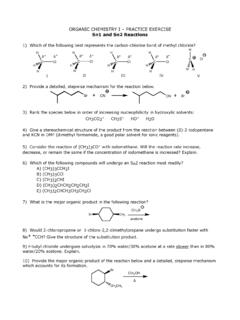
ORGANIC CHEMISTRY I – PRACTICE EXERCISE Sn1 and Sn2 …
personal.utdallas.eduORGANIC CHEMISTRY I – PRACTICE EXERCISE Sn1 and Sn2 Reactions 1) Which of the following best represents the carbon-chlorine bond of methyl chloride? C H C l H H H C H C H Cl H H C H Cl H H C H l H d +d-d d d+ d+ d d-IV V 2) Provide a detailed, stepwise mechanism for the reaction below. Br+CN CN+Br

Digital Transmission (Line Coding)
personal.utdallas.edu3N/4 combinations have akak+1 =0 and only N/4 combinations have non zero akak+1. Because of the bipolar rule, the bit sequence 11 can only be encoded by two consecutive pulse of opposite polarities. This means the product akak+1 = -1 for the N/4 combinations. EE4367 Telecom. Switching & Transmission
Fast Fourier Transform MATLAB Implementation
personal.utdallas.eduTime‐Frequency Analysis • A signal has one or more frequencies in it, and can be viewed from two different standpoints: Time domain and Frequency domain Time Domian (Banded Wren Song) 0 1 A mplitude Time Domian (Banded Wren Song) 1 2 Power Frequency Domain 0 2 4 6 8 x 10 4-1 Sample Number 0 200 400 600 800 1000 1200 0 Frequency (Hz)

Software Project Management Plan
personal.utdallas.eduPage 5 of 14 1.2ProjectDeliverables # Phase Deliverables Due Date Initial Structuring Preliminary Project Management Plan 09 - 02 - 2010 Phase 1 Interim Revised Software Project Management Plan Meeting Minutes Interim System Requirements Specifications (Iteration 1) Interim Software Requirements Specifications (Iteration 1) Slide-show depicting:

S-parameter Simulation and Optimization
personal.utdallas.edu• Yield can be a factor in topology (sensitivity) • Use the fewest components (cost + efficient) • Sweep or tune component values to see S-parameters • Optimization: use to meet S-parameter specs (goals) NOTE: For a mixer, match S11 @ RF and In the lab, you will S22 @ IF. optimize the match for the amplifier.
Related documents
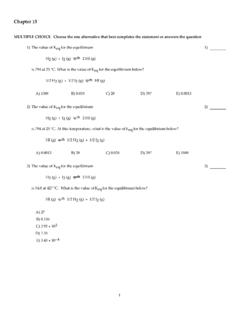
Chapter 15 Practice Questions
alpha.chem.umb.edu4) Consider the following chemical reaction: H2 (g) + I2 (g) 2HI (g) At equilibrium in a particular experiment, the concentrations of H2, I2, and HI were 0.15 M, 0.033 M, and 0.55 M, respectively. The value of Keq for this reaction is _____. A) 61 B) 9.0 × 10⁻³ C) 23 D) 111 E) 6.1 4)

Chapter 11 Density of States, Fermi Energy and Energy Bands
homepages.wmich.edu11-3 ! p k (11.6) Knowing the momentum p = mv, the possible energy states of a free electron is obtained m k m p E mv 2 2 2 1 2 2 ! (11.7) which is called the dispersion relation (energy or frequency-wavevector relation). Effective Mass In reality, an electron in a crystal …

CHAPTER 13 Chemical Equilibrium
www2.tku.edu.twc) The value of the equilibrium constant for a given reaction mixture is the same regardless of the direction from which equilibrium is attained. d) A system moves spontaneously toward a state of equilibrium. e) The equilibrium constant is independent of temperature. ANS: e) The equilibrium constant is independent of temperature. PAGE: 13.1,2 2.
Basic Principles and Calculations in Chemical Engineering
ptgmedia.pearsoncmg.com8.6 Multicomponent Vapor-Liquid Equilibrium 466 PART IV ENERGY 487 CHAPTER 9 ENERGY BALANCES 489 9.1 Terminology Associated with Energy Balances 491 9.2 Types of Energy to Be Included in Energy Balances 496 9.3 Energy Balances without Reaction 530 CHAPTER 10 ENERGY BALANCES: HOW TO ACCOUNT FOR CHEMICAL REACTION 597

Chapter 14. CHEMICAL EQUILIBRIUM
web.gccaz.eduChapter 14 Equilibrium Notes page 1 of 6 Chapter 14. CHEMICAL EQUILIBRIUM 14.1 THE CONCEPT OF EQUILIBRIUM AND THE EQUILIBRIUM CONSTANT Many chemical reactions do not go to completion but instead attain a state of chemical equilibrium. Chemical equilibrium: A state in which the rates of the forward and reverse reactions ...

Chapter 8, Acid-base equilibria
www.bu.eduThis equation is called the autoionization of water and its equilibrium constant is known as the water autoionization constant Kw. At 25°C it is equal to Kw =@H3O+D@OH-D=1.0μ10-14 Now, we have seen that the equilibrium constant of a sum of two reactions is the product of the equilibrium constants of the summed reactions.

Chemical Engineering Thermodynamics II - CPP
www.cpp.eduChapter 6: Chemical Equilibrium 6.1 Introduction 6-1 Example 6.1-1: Extent of reaction and fractional conversion 6-2 Example 6.1-2: Time to reach 90% conversion in a batch reactor 6-5 6.2 Chemical Reaction and Gibbs Energy 6-6 6.3 The Condition of Equilibrium for a …