Chapter 3 Basic Plasma Physics - NASA
Electric propulsion achieves high specific impulse by the acceleration of charged particles to high velocity. The charged particles are produced by ionization of a propellant gas, which creates both ions and electrons and forms what is called a plasma. Plasma is then a collection of the various charged
Download Chapter 3 Basic Plasma Physics - NASA

Information
Domain:
Source:
Link to this page:
Documents from same domain
Fundamentals of Electric Propulsion: Ion and Hall Thrusters
descanso.jpl.nasa.govFundamentals of Electric Propulsion: Ion and Hall Thrusters March 2008 The research described in this publication was carried out at the Jet Propulsion Laboratory, California Institute of Technology, under a contract with the National Aeronautics and Space Administration.

Chapter 1 Synthetic Aperture Radars (SAR) Imaging Basics
descanso.jpl.nasa.govSAR Imaging Basics 5 This is also a good time to point out that there are two different meanings for the term range in radar imaging.The first is the so -called slant range and refers to the range along the radar line-of-sight, as shown in Fig. 1-3. Slant ranges are measured along the line connecting the radar and the object being imaged, often

Chapter 4 Cryogenic Refrigeration Systems
descanso.jpl.nasa.govJul 29, 1980 · Cryogenic Refrigeration Systems 161 failures in the drive units of the refrigerators. The compressors that supplied high-pressure helium gas to the antenna-mounted Cryodynes® often contaminated the helium with the lubricant used in the compressor. The expression “oil carry-over” was used often when reporting Cryodyne® warm-ups (failures).

Chapter 3 Spacecraft Design Guidelines - NASA
descanso.jpl.nasa.govGuidelines, Excluding Solar Arrays), 3.2.3 (Internal ESD Design Guidelines), ... Limiting the charge storing material or charging capacity is a useful ... (VDA) metallization on multilayer insulation (MLI) thermal blankets is insufficient to provide adequate shielding for both EMC and internal charging. Layers of aluminum foil mounted to the ...
Related documents
Chapter 8 Introduction to Magnetic Fields
web.mit.eduSince electric current consists of a collection of charged particles in motion, when placed in a magnetic field, a current-carrying wire will also experience a magnetic force. FB G Consider a long straight wire suspended in the region between the two magnetic poles. The magnetic field points out the page and is represented with dots (•).
Chapter 27 – Magnetic Field and Magnetic Forces
physics.ucf.edu5. Applications of Motion of Charged Particles Velocity selector Source of charged particles - Particles of a specific speed can be selected from the beam using an arrangement of E and B fields. - Fm (magnetic) for + charge towards right (q v B). - FE (electric) for + charge to left (q E). - Fnet = 0 if Fm = F E-qE + q v B = 0 v = E/B

Synchrotron Radiation - NASA
asd.gsfc.nasa.govMagnetic field We now split v into components parallel and perpendicular to the uniform magnetic field, v k and v⊥ respectively. The pitch angle θ of the particle’s path is given by tanθ = v⊥/v k, that is, θ is the angle between the vectors v and B. Since v k × B = 0, v k = constant. The acceleration is perpendicular to the magnetic ...

Class IX Chemistry Chapter 4: Structure of the Atom
jsuniltutorial.weebly.comIn the absence of external magnetic or electric field these rays travel in straight line. Cathode rays are called cathode rays because they are emitted by the negative electrode, or cathode, in a vacuum tube. In 1897, an English physicist Sir J.J. Thomson showed that the rays were made up of a stream of negatively charged particles.

Chapter 2 Motion of Charged Particles in Fields
ocw.mit.eduMotion of Charged Particles in Fields Plasmas are complicated because motions of electrons and ions are determined by the electric and magnetic fields but also change the fields by the currents they carry. For now we shall ignore the second part of the problem and assume that Fields are Prescribed.
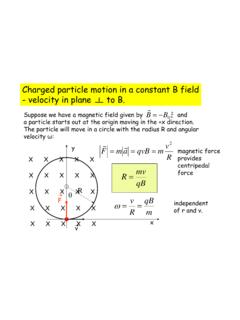
Charged particle motion in a constant B field - velocity ...
www.phys.hawaii.eduElectric/Magnetic Velocity Selector A charged particle enters a region with perpendicular electric and magnetic fields. The electric and magnetic forces will cancel if the velocity is just right. Particles with this velocity will go through undeflected. Others will be deflected. E m F qE F qv B r r r r r = =− =− × sin qE qv B qv B 1 r rr ...
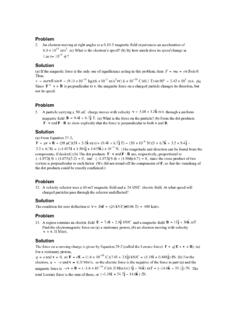
Problem - University of California, San Diego
courses.physics.ucsd.edu12.A velocity selector uses a 60-mT magnetic field and a 24 kN/C electric field. At what speed will charged particles pass through the selector undeflected? Solution The condition for zero deflection is v= E=B = (24 kN/C)=(0.06 T) = 400 km/s. Problem 13.A region contains an electric field E = 7.4î + 2.8ˆ j kN/C and a magnetic field B = 15ˆ j ...
Lecture 5 Motion of a charged particle in a magnetic field
www.tcm.phy.cam.ac.ukWhat is effect of a static electromagnetic field on a charged particle? Classically, in electric and magnetic field, particles experience a Lorentz force: F = q (E + v × B) q denotes charge (notation: q = −e for electron). Velocity-dependent force qv × B very different from that derived from scalar potential, and programme for ...

chap26 - Physics & Astronomy
physics.gsu.edu3/22/2016 4 © 2013 Pearson Education, Inc. For charged particles, what is the quantity q/m called? A. Linear charge density. B. Charge-to-mass ratio. C. Charged mass ...