Chapter 3 Protecting Groups - USU
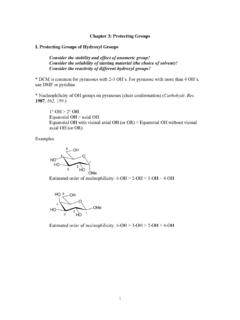
1 Chapter 3: Protecting Groups I. Protecting Groups of Hydroxyl Groups Consider the stability and effect of anomeric group! Consider the solubility of starting material (the choice of solvent)!
Download Chapter 3 Protecting Groups - USU

Information
Domain:
Source:
Link to this page:
Documents from same domain
Chromosome 16: PV92 PCR - Utah State University
ion.chem.usu.eduChromosome 16: PV92 PCR A Bio-Rad Biotechnology Explorer™ Experiment Introduction to PCR—The Polymerase Chain Reaction You are about to perform a procedure known as PCR1—the amplification of a
The Central Science 9th Edition - Chemistry Department
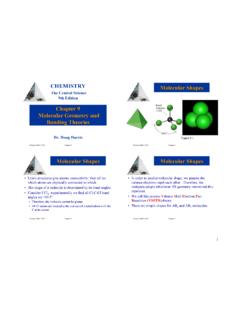
ion.chem.usu.edu• count the total number of electron pairs around the central atom, • arrange the electron pairs in one of the above geometries to minimize e − -e − repulsion, and count multiple bonds as one
Introduction to Organic Chemistry: Hydrocarbons
ion.chem.usu.eduOrganic Compounds Organic chemistry is the study of carbon compounds. An organic compound • Always contains carbon and hydrogen atoms • May also contain other nonmetals such as oxygen, nitrogen, phosphorus, or a halogen. • Organic compounds are found in: •Gasoline, medicines, shampoos, plastics, and perfumes •Carbohydrates, fats, and proteins
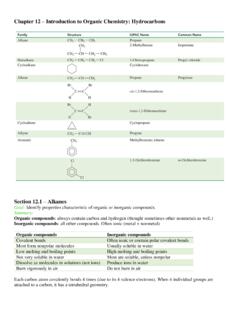
Chapter 12 Introduction to Organic Chemistry: Hydrocarbons
ion.chem.usu.eduChapter 12 – Introduction to Organic Chemistry: Hydrocarbons Section 12.1 – Alkanes Goal: Identify properties characteristic of organic or inorganic compounds. Summary: Organic compounds: always contain carbon and hydrogen (thought sometimes other nonmetals as well.) Inorganic compounds: all other compounds.Often ionic (metal + nonmetal) Organic …
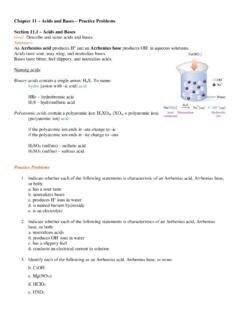
Chapter 11 Acids and Bases Practice Problems Section 11.1 ...
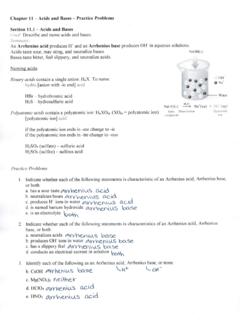
ion.chem.usu.eduSection 11.1 – Acids and Bases Goal: Describe and name acids and bases. Summary: An Arrhenius acid produces H+ and an Arrhenius base produces OH-in aqueous solutions. Acids taste sour, may sting, and neutralize bases. Bases taste bitter, feel slippery, and neutralize acids. Naming acids: Binary acids contain a single anion: H n X. To name:
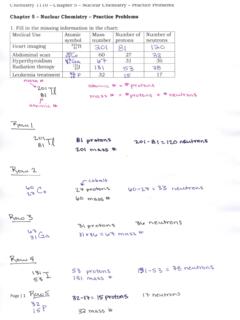
Utah State University Chemistry and Biochemistry | USU
ion.chem.usu.educnermstry 1 1 IU — unapter — Nuclear cnermstry — practice yrot)lerns 32. When a gamma ray is emitted from the nucleus of an atom, the nuclear mass A) increases by two units. B) decreases by one unit. C) increases by one unit. D decreases by two units. emains the same. 33. Radium-226 decays by alpha decay to A) barium-131. B) cobalt-60. C ...
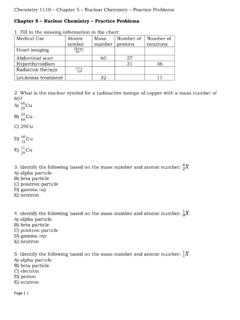
Nuclear Chemistry Practice Problems
ion.chem.usu.eduChemistry 1110 – Chapter 5 – Nuclear Chemistry – Practice Problems Page | 10 47. The half-life of a radioisotope is A) one-half of the time it takes for the radioisotope to completely decay to a nonradioactive isotope. B) the time it takes for the radioisotope to become an isotope with one-half of the atomic
Utah State University Chemistry and Biochemistry | USU
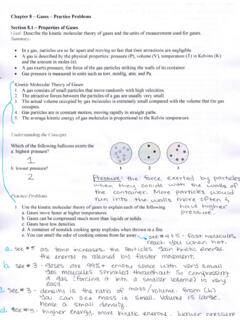
ion.chem.usu.eduExample: A sample of helium gas (He) has a volume 6.8 L and a pressure of 2.5 atm. What is the final volume, ... The volume is compressed to 2.0 L. b. The volume expands to 12 L. 9. A gas at a pressure of 2.0 atm is in a closed container. Indicate the changes (increases, decreases, or does
Utah State University Chemistry and Biochemistry | USU
ion.chem.usu.eduth1S IS a basic solution. !nderstanding the Concepts: Why are the concentrations ofH30 and OH- equal in pure water? One is + What is the meaning and value of Kw at 250C? In an acidic solution how does the concentration of 1-130 compare to the concentration of …
CH3 Practice Key Updates - Utah State University
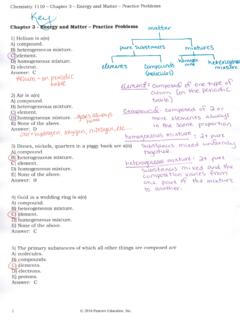
ion.chem.usu.eduChemistry 1 110 — Chapter 3 — Enerw and Matter — 26) 3.25 kcal is the same amount of enerw as Practice Problems A) 3.25 J. B) 0.777 J. C 777 J.
Related documents
Carbohydrate Counting Handbook
district.schoolnutritionandfitness.comcarbohydrates listed is for the particular serving size listed. Also keep the following information in mind when reading food labels: “Sugars” reflect both added sugars and those that naturally occur in foods. It is important to look at the total amount of carbohydrate rather than the source.

5. Carbohydrates - ESPEN
espen.info5. Carbohydrates METHODS Literature Search Medline search, Pub-Med search. Timeframe: publications from 1983 to February 2004. Type of publications: e.g. originalpapers,meta-analyses

37491 Dog P01 16 07/24/06 4:47 PM Page 1 YOUR DOG’S ...
www.nap.eduabsorbable carbohydrates, including glucose and fructose, can be directly absorbed and do not need to be digested by enzymes. Digestible carbohydrates are read-ily broken down by intestinal tract enzymes. Fermentable carbohydrates include certain starches and dietary fibers that pass undigested through the small intes-