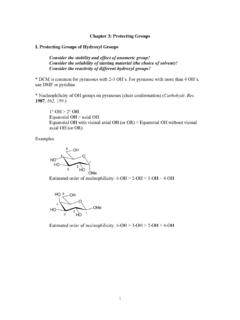
Chapter 3 Protecting Groups - USU
14 (v) Benzylidene Common reagents for protection: PhCHO or PhCH(OMe)2 and acids (TsOH, PPTS, ZnCl2 etc) with removal of water Common reagents for deprotection: acids (TsOH, TFA, HCl etc) with addition of water * Can be selectively converted into Bn or Bz Examples: O HO OMe HO O O Ph NBS, CCl4 BaCO3, reflux O HO OMe HO Br BzO O HO OMe HO NBS ...
Download Chapter 3 Protecting Groups - USU

Information
Domain:
Source:
Link to this page:
Documents from same domain
Chromosome 16: PV92 PCR - Utah State University
ion.chem.usu.eduChromosome 16: PV92 PCR A Bio-Rad Biotechnology Explorer™ Experiment Introduction to PCR—The Polymerase Chain Reaction You are about to perform a procedure known as PCR1—the amplification of a
The Central Science 9th Edition - Chemistry Department
ion.chem.usu.edu• count the total number of electron pairs around the central atom, • arrange the electron pairs in one of the above geometries to minimize e − -e − repulsion, and count multiple bonds as one
Introduction to Organic Chemistry: Hydrocarbons
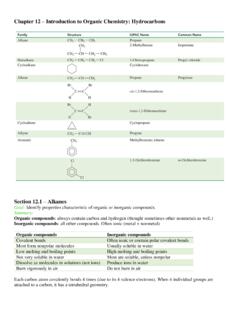
ion.chem.usu.eduOrganic Compounds Organic chemistry is the study of carbon compounds. An organic compound • Always contains carbon and hydrogen atoms • May also contain other nonmetals such as oxygen, nitrogen, phosphorus, or a halogen. • Organic compounds are found in: •Gasoline, medicines, shampoos, plastics, and perfumes •Carbohydrates, fats, and proteins
Chapter 12 Introduction to Organic Chemistry: Hydrocarbons
ion.chem.usu.eduChapter 12 – Introduction to Organic Chemistry: Hydrocarbons Section 12.1 – Alkanes Goal: Identify properties characteristic of organic or inorganic compounds. Summary: Organic compounds: always contain carbon and hydrogen (thought sometimes other nonmetals as well.) Inorganic compounds: all other compounds.Often ionic (metal + nonmetal) Organic …
Chapter 11 Acids and Bases Practice Problems Section 11.1 ...
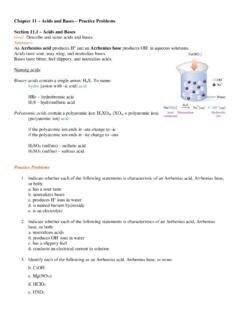
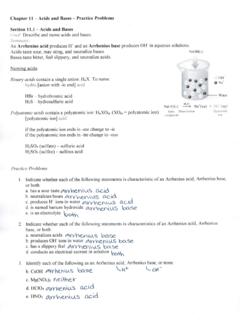
ion.chem.usu.eduSection 11.1 – Acids and Bases Goal: Describe and name acids and bases. Summary: An Arrhenius acid produces H+ and an Arrhenius base produces OH-in aqueous solutions. Acids taste sour, may sting, and neutralize bases. Bases taste bitter, feel slippery, and neutralize acids. Naming acids: Binary acids contain a single anion: H n X. To name:
Utah State University Chemistry and Biochemistry | USU
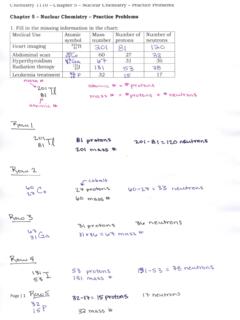
ion.chem.usu.educnermstry 1 1 IU — unapter — Nuclear cnermstry — practice yrot)lerns 32. When a gamma ray is emitted from the nucleus of an atom, the nuclear mass A) increases by two units. B) decreases by one unit. C) increases by one unit. D decreases by two units. emains the same. 33. Radium-226 decays by alpha decay to A) barium-131. B) cobalt-60. C ...
Nuclear Chemistry Practice Problems
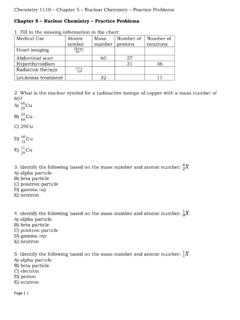
ion.chem.usu.eduChemistry 1110 – Chapter 5 – Nuclear Chemistry – Practice Problems Page | 10 47. The half-life of a radioisotope is A) one-half of the time it takes for the radioisotope to completely decay to a nonradioactive isotope. B) the time it takes for the radioisotope to become an isotope with one-half of the atomic
Utah State University Chemistry and Biochemistry | USU
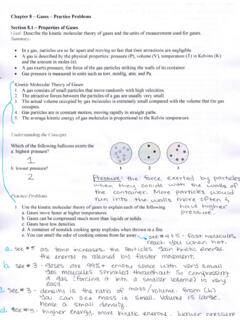
ion.chem.usu.eduExample: A sample of helium gas (He) has a volume 6.8 L and a pressure of 2.5 atm. What is the final volume, ... The volume is compressed to 2.0 L. b. The volume expands to 12 L. 9. A gas at a pressure of 2.0 atm is in a closed container. Indicate the changes (increases, decreases, or does
Utah State University Chemistry and Biochemistry | USU
ion.chem.usu.eduth1S IS a basic solution. !nderstanding the Concepts: Why are the concentrations ofH30 and OH- equal in pure water? One is + What is the meaning and value of Kw at 250C? In an acidic solution how does the concentration of 1-130 compare to the concentration of …
CH3 Practice Key Updates - Utah State University
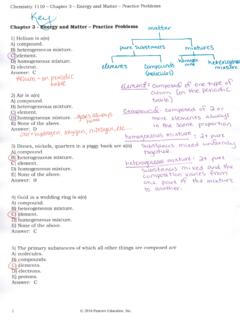
ion.chem.usu.eduChemistry 1 110 — Chapter 3 — Enerw and Matter — 26) 3.25 kcal is the same amount of enerw as Practice Problems A) 3.25 J. B) 0.777 J. C 777 J.
Related documents

Chapter 8, Acid-base equilibria - Boston University
www.bu.eduKw =1.μ10-14 =x2 and so the concentration of H3O + and OH-are each 1μ10-7 M at 25°C. Now, as we will see in a moment, strong acids can have H3O+ concentrations of 1 M or more. This means that H3O + varies over many powers of 10 (orders of magnitude), and so it is convenient to measure [H3O +] on a logarithmic scale. Also, for weak acids and ...
Synthesis of Carboxylic Acids
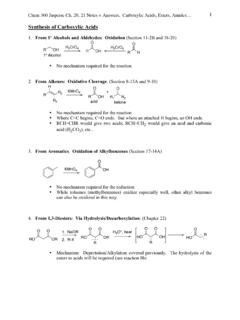
web.mnstate.eduChem 360 Jasperse Ch. 20, 21 Notes + Answers. Carboxylic Acids, Esters, Amides… 4 Reactions of Carboxylic Acids 9. Reaction as a proton Acid (Section 20-4, 20-5) R O O OH-+ H-X (proton acid) NaOH (or other bases, including amines) Na carboxylate salt (basic) • Mechanism: Required (deprotonation) • Reverse Mechanism: Required (protonation)
Chapter 22. Nucleic Acids - latech.edu
www.chem.latech.eduChapter 22. Nucleic Acids 22.1 Types of Nucleic Acids 22.2 Nucleotides: Building Blocks of Nucleic Acids ... 22.13 Nucleic Acids and Viruses 22.14 Recombinant DNA and Genetic Engineering ... nucleotide bases appear in the nucleic acid is the coding for the information carried in the molecule. In other words, the nucleotide bases serve as a sort
CHAPTER 14 Acids and Bases - Tamkang University
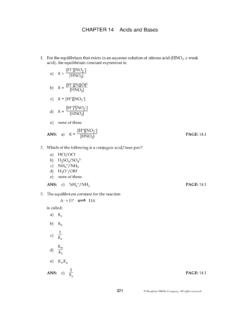
www2.tku.edu.twCHAPTER 14 Acids and Bases 326 © Houghton Mifflin Company.All rights reserved. 18. The pH of a solution at 25°C in which [OH–] = 3.4 × 10⁻⁵ M is: a) 4.5 b) 10 ...

Chapter 17: Alcohols and Phenols - Vanderbilt University
as.vanderbilt.edu43 84 Electronic factors that influence acidity: inductive and resonance effect CH 3CH 2OH FCH 2CH 2OH F 2CHCH 2OH F 3CCH 2OH (F 3C) 3CCH 2OH pK a ~ 16.0 14.4 13.3 12.4 5.4 F 3C CO F 3C F 3C X OH X= -H -Cl -Br -NO 2-CH 3-OCH 3-NH 2 pK a …
POLYPROTIC ACIDS AND BASES: Very important!
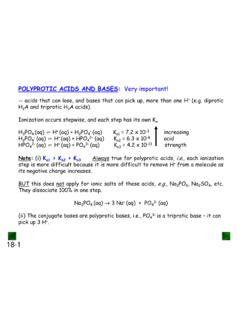
christou.chem.ufl.edu18-9 NOTE: (i) pK b = -log K b (ii) just like pK a, strength of base increases with decreasing pK b (See Table 18.6) The bigger is K b, the more OH-is generated. The smaller is pK b, the more OH-is generated. base formula K b pK b Diethylamine NHEt 2 8.6 x 10⁻⁴ 3.07 Methylamine NH 2Me 4.4 x 10⁻⁴ 3.36 Ammonia NH

C 9 BIOMOLECULES
www.ncert.nic.in2 14 COOH Fatty acid (Palmitic acid) Glycerol Triglyceride (R 1, R 2 and R 3 are fatty acids) Nitrogen bases OH OH O Adenine HO P OCH 2 OH O Adenylic acid Nucleotide OH OH HOCH 2 O Adenine OH OH HOCH 2 O Uracil Adenosine Uridine Nucleosides OH OH HOCH 2 O OH OH HO OH CH OH 2 O C 6 H 12 O 6 (Glucose) 5 H 10 O 5 (Ribose) Sugars (Carbohydrates ...

Chapter 10: Molecular Biology of the Gene
www.scarsdaleschools.k12.ny.usa uniform diameter. This would not be possible if the bases paired with themselves. False, DNA replication is semiconservative. Each of the new DNA molecules would consist of one radioactively labeled strand and one unlabeled strand. Complementary base pairing REEC7833_08_C10_PRF.indd 67 29/10/14 10:36 AM

CHAPTER 19 – CHEMICAL HANDLING AND STORAGE
www.sifacilities.si.edu7. If acids and bases must be stored together in the same cabinet, place each in separate secondary containers (non-reactive trays) on opposite sides of the cabinet to minimize intermingling in case of a spill or drip (in other words, do not store all the acids on one shelf, and all the bases on the shelf below).