
Chapter 4
4.1.3. Left and right derivatives. We can use left and right limits to define one-sided derivatives, for example at the endpoint of an interval, but for the most part we will consider only two-sided derivatives defined at an interior point of the domain of a function. De nition 4.13. Suppose f: [a,b] → R. Then f is right-differentiable at ...
Download Chapter 4

Information
Domain:
Source:
Link to this page:
Documents from same domain

LECTURE 5 - UC Davis Mathematics
www.math.ucdavis.eduLECTURE 5. STOCHASTIC PROCESSES 133 We say that random variables X 1;X 2;:::X n: !R are jointly continuous if there is a joint probability density function p(x
A concise introduction to quantum probability, …
www.math.ucdavis.eduA concise introduction to quantum probability, quantum mechanics, and ... precepts of quantum mechanics are sometimes called ... This article is a concise introduction to quantum probability theory, quantum mechanics, and quan-tum computation for the mathematically prepared
An introduction to quantum probability, quantum …
www.math.ucdavis.eduAn introduction to quantum probability, quantum mechanics, and quantum computation Greg Kuperberg∗ UC Davis (Dated: October 8, 2007) Quantum mechanics is one of the most surprising

Linear Algebra in Twenty Five Lectures
www.math.ucdavis.eduThese linear algebra lecture notes are designed to be presented as twenty ve, fty minute lectures suitable for sophomores likely to use the material for applications but still requiring a solid foundation in this fundamental branch
What is Linear Algebra? - University of California, …
www.math.ucdavis.eduWhat is Linear Algebra? In this course, we’ll learn about three main topics: Linear Systems, Vec-tor Spaces, and Linear Transformations. Along the way we’ll learn about
Twenty problems in probability - UC Davis …
www.math.ucdavis.eduTwenty problems in probability This section is a selection of famous probability puzzles, job interview questions (most high- tech companies ask their applicants math questions) and math competition problems.
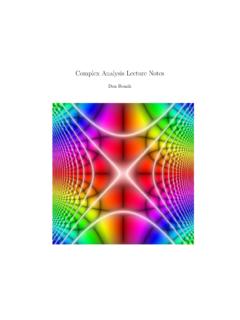
Complex Analysis Lecture Notes - UC Davis Mathematics
www.math.ucdavis.edu\entropy"), and lots of applications to things that seem unrelated to complex numbers, for example: Solving cubic equations that have only real roots (historically, this was the
David Cherney, Tom Denton, Rohit Thomas and Andrew …
www.math.ucdavis.eduLinear algebra is the study of vectors and linear functions. In broad terms, vectors are things you can add and linear functions are functions of vectors that respect vector addition.
Power Series - UC Davis Mathematics :: Home
www.math.ucdavis.eduThe power series in Definition 6.1 is a formal expression, since we have not said anything about its convergence. By changing variables x→ ( x−c ), we can assume
LECTURE NOTES ON APPLIED MATHEMATICS
www.math.ucdavis.eduLECTURE 1 Introduction The source of all great mathematics is the special case, the con-crete example. It is frequent in mathematics that every instance
Related documents
3.3 Derivatives of Composite Functions: The Chain Rule
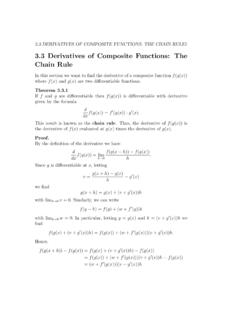
faculty.atu.eduTheorem 3.3.1 If f and g are di erentiable then f(g(x)) is di erentiable with derivative given by the formula d dx f(g(x)) = f 0(g(x)) g (x): This result is known as the chain rule. Thus, the derivative of f(g(x)) is the derivative of f(x) evaluated at g(x) times the derivative of g(x): Proof. By the de nition of the derivative we have d dx f(g ...
1 Basics of Series and Complex Numbers
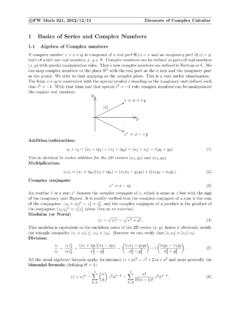
people.math.wisc.edu2. Calculate (1 + i)=(2 + i3). 3. Show that the nal formula for division follows from the de nition of multiplication (as it should): if z= z 1=z 2 then z 1 = zz 2, solve for <(z) and =(z). 1.2 Limits and Derivatives The modulus allows the de nition of distance and limit. The distance between two complex numbers zand ais the modulus of their di ...
Joint Distribution - Example - Duke University
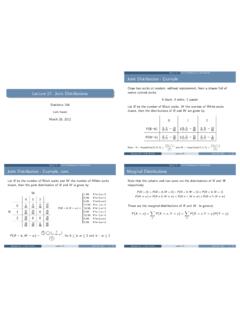
www2.stat.duke.eduDepending on which range de nition you choose it makes life easier when evaluating the marginal densities. f X(x) = Z 1 1 f(x;y) dy = Z 3 x 0 2 9 dy = 2 9 (3 x) for x 2(0;3) f Y (y) = Z 1 1 f(x;y) dy = Z 3 y 0 2 9 dx = 2 9 (3 y) for y 2(0;3) Are X and Y independent? Statistics 104 (Colin Rundel) Lecture 17 March 26, 2012 19 / 32

1 Inner products and norms - Princeton University
www.princeton.eduand interior of sets. If you need a refresher, please refer to [1, Appendix A]. 3.1 Partial derivatives, Jacobians, and Hessians De nition 7. Let f: Rn!R. The partial derivative of fwith respect to x i is de ned as @f @x i = lim: @.1.. 1 A:

Inner product - Michigan State University
users.math.msu.edubetween two vectors, de ned as the length of their di erence. De nition 3 (Distance) Let V, ( ; ) be a inner product space, and kkbe its associated norm. The distance between u and v 2V is given by dist(u;v) = ku vk: Example: The Euclidean distance between to points x and y 2IR3 is kx yk= p (x1 y1)2 + (x2 y2)2 + (x3 y3)2: Slide 8 ...

Integrating an Absolute Value - University of Alaska system
www.math.uaa.alaska.edujx3 5x2 + 6xjdx = applying the de nition of absolute value Z 2 0 x3 5x2 + 6x dx+ Z 3 2 (x3 5x2 + 6x) dx+ Z 4 3 x3 5x2 + 6x dx = using anti-derivative 1 4 x4 5 3 x3 + 3x2 2 0 + 1 4 x4 + 5 3 x3 3x2 3 2 + 1 4 x4 5 3 x3 + 3x2 4 3 = 8 3 + 5 12 + 37 12 = 74 12: Created Date:

Functionals and the Functional Derivative
cds.cern.chtives. This is achieved by a suitable de nition. The de nition of the functional derivative (also called variational derivative) is dF [f + ] d =0 =: dx 1 F [f] f(x 1) (x 1) . (A.15) This de nition implies that the left-hand side can be brought into the form on the right-hand side, i.e. the form of a linear functional with kernel F [f]/ f acting on
Calculus Note Intro Derivative - Berkeley City College
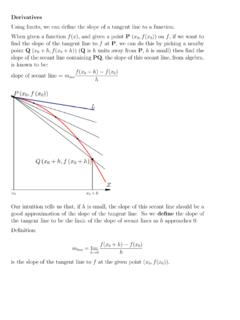
www.berkeleycitycollege.eduTo nd the derivative of fat 0, we need to use the de nition: f0(0) = lim h!0 j0 + hjj 0j h = lim h!0 jhj h From previous examples we already knew that this limit does not exist, since lim h!0 jhj h = 1 while lim h!0+ jhj h = 1. If we look at the graph of the jxjfunction we see that there’s a sharp corner at x= 0. E.g. f(x) = 3 p xis non-di ...

Lecture 1 : Inverse functions One-to-one Functions A ...
www3.nd.eduThis is a sound de nition of a function, precisely because each value of y in the domain of f 1 has exactly one x in A associated to it by the rule y = f(x). Example If f(x) = x 3 + 1, use the equivalence of equations given above nd f 1 (9) and f 1 (28).