Transcription of Chapter 4
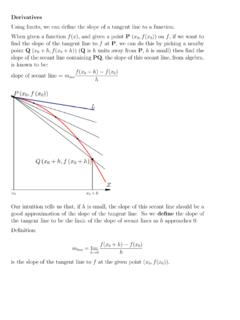
1 Chapter4 Differentiable FunctionsA differentiable function is a function that can be approximated locally by a The derivativeDe nition thatf: (a, b) Randa < c < b. Thenfis differentiableatcwith derivativef (c) iflimh 0[f(c+h) f(c)h]=f (c).The domain off is the set of pointsc (a, b) for which this limit exists. If thelimit exists for everyc (a, b) then we say thatfis differentiable on (a, b).Graphically, this definition says that the derivative offatcis the slope of thetangent line toy=f(x) atc, which is the limit ash 0 of the slopes of the linesthrough (c, f(c)) and (c+h, f(c+h)).We can also writef (c) = limx c[f(x) f(c)x c],since ifx=c+h, the conditions 0<|x c|< and 0<|h|< in the definitionsof the limits are equivalent. The ratiof(x) f(c)x cis undefined (0/0) atx=c, but it doesn t have to be defined in order for the limitasx cto continuity, differentiability is a local property.
2 That is, the differentiabilityof a functionfatcand the value of the derivative, if it exists, depend only thevalues offin a arbitrarily small neighborhood ofc. In particular iff:A R39404. Differentiable FunctionswhereA R, then we can define the differentiability offat any interior pointc Asince there is an open interval (a, b) Awithc (a, b). Examples of us give a number of examples that illus-trate differentiable and non-differentiable functionf:R Rdefined byf(x) =x2is differentiable onRwith derivativef (x) = 2xsincelimh 0[(c+h)2 c2h]= limh 0h(2c+h)h= limh 0(2c+h) = that in computing the derivative, we first cancel byh, which is valid sinceh = 0 in the definition of the limit, and then seth= 0 to evaluate the limit. Thisprocedure would be inconsistent if we didn t use functionf:R Rdefined byf(x) ={x2ifx >0,0 ifx differentiable onRwith derivativef (x) ={2xifx >0,0 ifx >0, the derivative isf (x) = 2xas above, and forx <0, we havef (x) = 0,f (0) = limh 0f(h) right limit islimh 0+f(h)h= limh 0h= 0,and the left limit islimh 0 f(h)h= the left and right limits exist and are equal, so does the limitlimh 0[f(h) f(0)h]= 0,andfis differentiable at 0 withf (0) = , we consider some examples of non-differentiability at discontinuities, cor-ners, and functionf.}}
3 R Rdefined byf(x) ={1/xifx = 0,0ifx= 0, The derivative41is differentiable atx = 0 with derivativef (x) = 1/x2sincelimh 0[f(c+h) f(c)h]= limh 0[1/(c+h) 1/ch]= limh 0[c (c+h)hc(c+h)]= limh 01c(c+h)= ,fis not differentiable at 0 since the limitlimh 0[f(h) f(0)h]= limh 0[1/h 0h]= limh 01h2does not sign functionf(x) = sgnx, defined in , is differ-entiable atx = 0 withf (x) = 0, since in that casef(x+h) f(x) = 0 for allsufficiently smallh. The sign function is not differentiable at 0 sincelimh 0[sgnh sgn 0h]= limh 0sgnhhandsgnhh={1/hifh >0 1/hifh <0is unbounded in every neighborhood of 0, so its limit does not absolute value functionf(x) =|x|is differentiable atx = 0with derivativef (x) = sgnx. It is not differentiable at 0, however, sincelimh 0f(h) f(0)h= limh 0|h|h= limh 0sgnhdoes not functionf:R Rdefined byf(x) =x1=3is differentiable atx = 0 withf (x) =13x2= prove this, we use the identity for the difference of cubes,a3 b3= (a b)(a2+ab+b2),424.}}
4 Differentiable Functions 1 1 plot of the functiony=x2sin(1=x) and a detail near the originwith the parabolasy= x2shown in get forc = 0 thatlimh 0[f(c+h) f(c)h]= limh 0(c+h)1=3 c1=3h= limh 0(c+h) ch[(c+h)2=3+ (c+h)1=3c1=3+c2=3]= limh 01(c+h)2=3+ (c+h)1=3c1=3+c2=3=13c2= ,fis not differentiable at 0, sincelimh 0f(h) f(0)h= limh 01h2=3,which does not , we consider some examples of highly oscillatory :R Rbyf(x) ={xsin(1/x) ifx = 0,0ifx= follows from the product and chain rules proved below thatfis differentiable atx = 0 with derivativef (x) = sin1x ,fis not differentiable at 0, sincelimh 0f(h) f(0)h= limh 0sin1h,which does not The derivative43 Example :R Rbyf(x) ={x2sin(1/x) ifx = 0,0ifx= differentiable onR. (See Figure1.) It follows from the product and chainrules proved below thatfis differentiable atx = 0 with derivativef (x) = 2xsin1x ,fis differentiable at 0 withf (0) = 0, sincelimh 0f(h) f(0)h= limh 0hsin1h= this example, limx 0f (x) does not exist, so althoughfis differentiable onR,its derivativef is not continuous at Derivatives as linear way to view to writef(c+h) =f(c) +f (c)h+r(h)as the sum of a linear approximationf(c)+f (c)hoff(c+h) and a remainderr(h).}}
5 In general, the remainder also depends onc, but we don t show this explicitly sincewe re regardingcas we prove in the following proposition, the differentiability offatcis equiv-alent to the conditionlimh 0r(h)h= is, the remainderr(h) approaches 0 faster thanh, so the linear terms inhprovide a leading order approximation tof(c+h) whenhis small. We also writethis condition on the remainder asr(h) =o(h) ash 0,pronounced ris little-oh ofhash 0. Graphically, this condition means that the graph offnearcis close the linethrough the point (c, f(c)) with slopef (c). Analytically, it means that the functionh7 f(c+h) f(c)is approximated nearcby the linear functionh7 f (c) ,f (c) may be interpreted as a scaling factor by which a differentiable functionfshrinks or stretches lengths |f (c)|<1, thenfshrinks the length of a small interval aboutcby (ap-proximately) this factor; if|f (c)|>1, thenfstretches the length of an intervalby (approximately) this factor; iff (c)>0, thenfpreserves the orientation ofthe interval, meaning that it maps the left endpoint to the left endpoint of theimage and the right endpoint to the right endpoints.
6 Iff (c)<0, thenfreversesthe orientation of the interval, meaning that it maps the left endpoint to the rightendpoint of the image and can use this description as a definition of the Differentiable FunctionsProposition thatf: (a, b) R. Thenfis differentiable atc (a, b) if and only if there exists a constantA Rand a functionr: (a c, b c) Rsuch thatf(c+h) =f(c) +Ah+r(h),limh 0r(h)h= that case,A=f (c). suppose thatfis differentiable atc, as in , and definer(h) =f(c+h) f(c) f (c) 0r(h)h= limh 0[f(c+h) f(c)h f (c)]= , suppose thatf(c+h) =f(c) +Ah+r(h) wherer(h)/h 0 ash 0[f(c+h) f(c)h]= limh 0[A+r(h)h]=A,which proves thatfis differentiable atcwithf (c) =A. Example (x) =x2,(c+h)2=c2+ 2ch+h2,andr(h) =h2, which goes to zero at a quadratic rate ash (x) = 1/x,1c+h=1c 1c2h+r(h),forc = 0, where the quadratically small remainder isr(h) =h2c2(c+h).
7 Left and right can use left and right limits to defineone-sided derivatives, for example at the endpoint of an interval, but for the mostpart we will consider only two-sided derivatives defined at an interior point of thedomain of a nition : [a, b] R. Thenfis right-differentiable ata c < bwith right derivativef (c+) iflimh 0+[f(c+h) f(c)h]=f (c+)exists, andfis left-differentiable ata < c bwith left derivativef (c ) iflimh 0 [f(c+h) f(c)h]= limh 0+[f(c) f(c h)h]=f (c ).A function is differentiable ata < c < bif and only if the left and rightderivatives exist atcand are Properties of the derivative45 Example : [0,1] Ris defined byf(x) =x2, thenf (0+) = 0,f (1 ) = left and right derivatives remain the same iffis extended to a functiondefined on a larger domain, sayf(x) = x2if 0 x 1,0ifx >1,1/xifx < this extended function we havef (1+) = 0, which is not equal tof (1 ), andf (0 ) does not exist, so it is not differentiable at 0 or absolute value functionf(x) =|x|in left andright differentiable at 0 with left and right derivativesf (0+) = 1,f (0 ) = are not equal, andfis not differentiable at Properties of the derivativeIn this section, we prove some basic properties of differentiable Differentiability and we discuss the relation betweendifferentiability and.
8 (a, b) Ris differentiable at atc (a, b), thenfiscontinuous differentiable atc, thenlimh 0f(c+h) f(c) = limh 0[f(c+h) f(c)h h]= limh 0[f(c+h) f(c)h] limh 0h=f (c) 0= 0,which implies thatfis continuous atc. For example, the sign function in a jump discontinuity at 0so it cannot be differentiable at 0. The converse does not hold, and a continuousfunction needn t be differentiable. The functions in , , but not differentiable at 0. a function that iscontinuous onRbut not differentiable , the function is differentiable onR, but the derivativef is notcontinuous at 0. Thus, while a functionfhas to be continuous to be differentiable,iffis differentiable its derivativef needn t be continuous. This leads to thefollowing Differentiable FunctionsDe nition functionf: (a, b) Ris continuously differentiable on (a, b),writtenf C1(a, b), if it is differentiable on (a, b) andf : (a, b) Ris example, the functionf(x) =x2with derivativef (x) = 2xis continuouslydifferentiable on any interval (a, b).
9 As , functions thatare differentiable but not continuously differentiable may still behave in ratherpathological ways. On the other hand, continuously differentiable functions, whosetangent lines vary continuously, are relatively Algebraic properties of the , we state the linearity ofthe derivative and the product and quotient , g: (a, b) Rare differentiable atc (a, b) andk R, thenkf,f+g, andfgare differentiable atcwith(kf) (c) =kf (c),(f+g) (c) =f (c) +g (c),(fg) (c) =f (c)g(c) +f(c)g (c).Furthermore, ifg(c) = 0, thenf/gis differentiable atcwith(fg) (c) =f (c)g(c) f(c)g (c)g2(c). first two properties follow immediately from the linearity of limitsstated in For the product rule, we write(fg) (c) = limh 0[f(c+h)g(c+h) f(c)g(c)h]= limh 0[(f(c+h) f(c))g(c+h) +f(c) (g(c+h) g(c))h]= limh 0[f(c+h) f(c)h]limh 0g(c+h) +f(c) limh 0[g(c+h) g(c)h]=f (c)g(c) +f(c)g (c),where we have used the properties of limits in ,which implies thatgis continuous atc.
10 The quotient rule follows by a similarargument, or by combining the product rule with the chain rule, which implies that(1/g) = g /g2. (See ) Example have 1 = 0 andx = 1. Repeated application of the productrule implies thatxnis differentiable onRfor everyn Nwith(xn) =nxn , we can prove this result by induction: The formula holds forn= that it holds for somen N, we get from the product rule that(xn+1) = (x xn) = 1 xn+x nxn 1= (n+ 1)xn,and the result follows. It follows by linearity that every polynomial function isdifferentiable onR, and from the quotient rule that every rational function is dif-ferentiable at every point where its denominator is nonzero. The derivatives aregiven by their usual Properties of the The chain chain rule states the differentiability of a composi-tion of functions.