
Chapter – 4 Convective Mass Transfer
2 In the study of convective heat transfer, the heat flux is connected to heat transfer coefficient as ( ) Q A =q = h t s −t m----- (4.1) The analogous situation in mass transfer is handled by an equation of the form
Download Chapter – 4 Convective Mass Transfer

Information
Domain:
Source:
Link to this page:
Documents from same domain
FLOW IN PIPES - kau
www.kau.edu.saFLOW IN PIPES Fluid flow in circular and noncircular pipes is commonly encountered in practice. The hot and cold water that we use in our homes is pumped through pipes. Water in a city is distributed by extensive piping net-

5Word Formation Processes - kau.edu.sa
www.kau.edu.sa1 Word Formation Processes Chapter 6 Introduction Spangler and his electric suction sweeper Spangler-spanglering–spanglered– spanglerish–spanglarism

Chemical Equilibrium - kau
www.kau.edu.saChemical Equilibrium Chapter 14 ... Chemical Kinetics and Chemical Equilibrium A + 2B AB 2 k f k r ... c system proceeds from left to right to reach equilibrium 14.4.

Molecular Identification of Fungi - kau
www.kau.edu.sathe Mucoro-, Kickxello-, Zoopago- and Entomophthoromycotina, whose phylo-genetic relationships are not fully understood yet. In the phylogenetic tree shown

e-Commerce and e-Business - kau
www.kau.edu.saThe e-ASEAN Task Force and the UNDP Asia Pacific Development Information ... e-Commerce and e-Business ... TABLE OF CONTENTS
General Design Considerations - kau
www.kau.edu.sa3 b- Site layout and plant layout Site layout The process units and ancillary buildings should be laid out to give the most economical flow …
PRESSURE AND FLUID STATICS T - kau
www.kau.edu.saPRESSURE AND FLUID STATICS This chapter deals with forces applied by fluids at rest or in rigid-body motion. The fluid property responsible for those forces is pressure, which is a normal force exerted by a fluid per unit area.
Thermodynamics An Engineering Approach - kau
www.kau.edu.saI—3C An office worker claims that a cup of cold coffee on his table warmed up to 800C by picking up energy from the 1-5C Kg-mass is the mass unit in the SI system whereas kg-force is a force unit.
Determination of Trace Elements in Cow's Milk in …
www.kau.edu.saDetermination of Trace Elements in Cow's… 135 and (b) respectively. Similar curves were also drawn for Zn, Cd, and Pb but they are not shown here. The calibration curves obtained for Zn, Cd, and Pb were fairly linear. The results of the present study for five trace elements in milk samples

Academic Writing: A Handbook for International …
www.kau.edu.saThe third edition of this popular course builds on the success of the earlier editions and responds to suggestions from both students and teachers. Plagiarism has become a major concern in higher education, and a special
Related documents
Chapter 4 - Student
pages.mtu.eduIn Chapter 4, the following problem modules explain the heat transfer processes involved in fuel cell vehicles and in the processes for producing fuel for fuel cells. 4.1-1 Heat Loss through a Stainless Steel Bipolar Plate
Chapter 4 Heat Review - Mr. Palmarin's Class Website
palmarin.weebly.com2H 2 + O 2 2H 2O 11. Calculate the quantity of heat required to change 50g of ice at -10°C into steam at 120°C.(This is 5 steps). 12. Calculate the quantity of heat required to change 100g of steam at 130°C into ice at -10°C? (This is 5 steps).
Chapter 4 Convection - MIT PAOC
paoc.mit.edu74 CHAPTER 4. CONVECTION Figure 4.1: Solar radiation warms the earth’s surface, triggering convection which carries heat vertically to the emission level from which, because the atmosphere above this level is transparent in …
Chapter 10 Temperature and Heat - Doane College
physics.doane.eduChapter 10 Temperature and Heat OVERVIEW Heat is a form of energy. As this energy moves from one object to another, we may detect physical changes in both the object losing heat energy and the object gaining heat energy. This chapter deals with many of these basic changes and the rules used to describe them.
Chapter 10 Temperature And Heat - Doane College
physics.doane.eduPhysics Including Human Applications 217 Chapter 10 Temperature And Heat GOALS When you have mastered the contents of this chapter, you will be able to achieve the
CHAPTER 4 THERMAL EFFECTIVENESS OF A …
shodhganga.inflibnet.ac.in55 CHAPTER 4 THERMAL EFFECTIVENESS OF A SPIRAL PLATE HEAT EXCHANGER 4.1 INTRODUCTION This chapter discusses the study of thermal effectiveness of the
CHAPTER 4 DESIGN FUNDAMENTALS OF SHELL …
web.iitd.ac.inCHAPTER 4 DESIGN FUNDAMENTALS OF SHELL-AND-TUBE HEAT EXCHANGERS 4.1 INTRODUCTION The thermal design of heat exchangers is directed to …
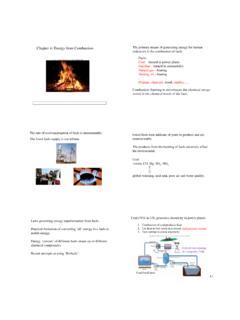
Chapter 4: Energy from Combustion The primary …
web.mnstate.eduChapter 4: Energy from Combustion The primary means of generating energy for human endeavors is the combustion of fuels. Fuels: Coal -burned in power plants ... 4.1 Heat is a consequence of motion at the molecular level; temperature is a measure of the average speed of that motion.
Chapter 4
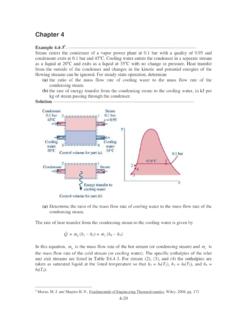
www.cpp.edu4-29 Chapter 4 Example 4.4-36. Steam enters the condenser of a vapor power plant at 0.1 bar with a quality of 0.95 and condensate exits at 0.1 bar and 45oC. Cooling water enters the condenser in a separate stream as a liquid at 20oC and exits as a liquid at 35oC with no change in pressure.Heat transfer
Chapter 5
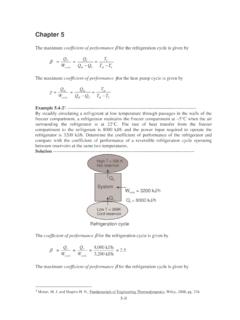
www.cpp.edu5-9 Chapter 5 The maximum coefficient of performance b for the refrigeration cycle is given by b C= CC cycle Q W = H C Q Q-Q H C T T-T The maximum coefficient of performance gfor the heat pump cycle is given by g = H H cycle Q W = H C Q Q-Q H C T T-T Example 5.4-23. By steadily circulating a refrigerant at low temperature through …
Related search queries
Chapter 4, Student, Heat, Chapter 4 Heat Review, Chapter 4 Convection, CHAPTER 4. CONVECTION, Chapter 10 Temperature And Heat, Chapter, CHAPTER 4 THERMAL EFFECTIVENESS OF A, CHAPTER 4 THERMAL EFFECTIVENESS OF A SPIRAL, CHAPTER 4 DESIGN FUNDAMENTALS OF SHELL, CHAPTER 4 DESIGN FUNDAMENTALS OF SHELL-AND, Chapter 4: Energy from Combustion The primary