
Chapter 4: Generating Functions - Auckland
processes, because many stochastic processes are formed from the sum of a sequence of repeating steps: for example, the Gambler’s Ruin from Section 2.7. The name probability generating function also gives us another clue to the role of the PGF. The PGF can be used to generate all the probabilities of the distribution.
Download Chapter 4: Generating Functions - Auckland

Information
Domain:
Source:
Link to this page:
Documents from same domain

Computer Organisation and Architecture
www.stat.auckland.ac.nzComputer Organisation and Architecture David J. Scott Department of Statistics, University of Auckland Computer Organisation and Architecture – p.1/
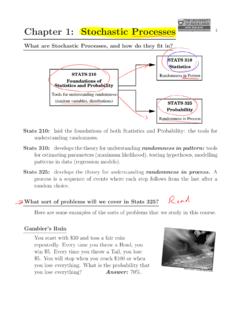
Chapter 1: Stochastic Processes - The University of …
www.stat.auckland.ac.nzChapter 1: Stochastic Processes 4 What are Stochastic Processes, and how do they fit in? STATS 310 Statistics STATS 325 Probability Randomness in Pattern

Time Series Analysis - The University of Auckland
www.stat.auckland.ac.nztime series are related in simple ways to series which are stationary. Two im- ... time spans for stationary series.) ... The theory which underlies time series analysis is quite technical in nature. In spite of this, a good deal of intuition can …
Statistics 120 Good and Bad Graphs - Department of Statistics
www.stat.auckland.ac.nzStatistics 120 Good and Bad Graphs •First •Prev •Next •Last •Go Back •Full Screen •Close •Quit The Plan • In this lecture we will try to set down some basic rules for drawing good graphs. • We will do this by showing that violating the rules produces bad graphs.

SUBJECT MATTER KNOWLEDGE FOR TEACHING
www.stat.auckland.ac.nzupon teachers’ subject matter knowledge involved in the practice of teaching. Findings regarding the knowledge required for teaching correlation coefficient are highlighted, including its computation, interpretation, sensitivity, estimation, and

The Wilcoxon Rank-Sum Test - Department of Statistics
www.stat.auckland.ac.nz1 The Wilcoxon Rank-Sum Test The Wilcoxon rank-sum test is a nonparametric alternative to the two-sample t-test which is based solely on the order in which the observations from the two samples fall. We will use the following as a running example.
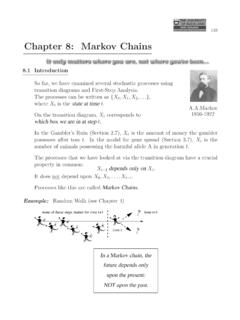
Chapter 8: Markov Chains - Auckland
www.stat.auckland.ac.nzThe matrix describing the Markov chain is called the transition matrix. It is the most important tool for analysing Markov chains. Transition Matrix list all states X t list all states z }| {X t+1 insert probabilities p ij rows add to 1 rows add to 1 The transition matrix is …
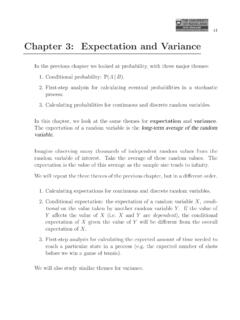
Chapter 3: Expectation and Variance
www.stat.auckland.ac.nz3. Calculating probabilities for continuous and discrete random variables. In this chapter, we look at the same themes for expectation and variance. The expectation of a random variable is the long-term average of the random variable. Imagine observing many thousands of independent random values from the random variable of interest.
Chapter 1: What is Statistics? D - Auckland
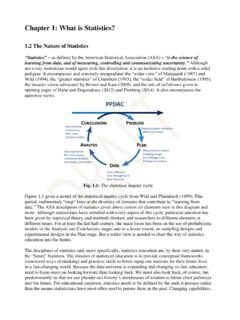
www.stat.auckland.ac.nzChapter 1: What is Statistics? 1.2 The Nature of Statistics “Statistics” as defined by the American Statistical Association (ASA) “is the science of learning from data, and of measuring, controlling and communicating uncertainty.

Chapter 3: Expectation and Variance
www.stat.auckland.ac.nzexpectation is the value of this average as the sample size tends to infinity. We will repeat the three themes of the previous chapter, but in a different order. 1. Calculating expectations for continuous and discrete random variables. 2. Conditional expectation: the expectation of a random variable X, condi-
Related documents
Iterative Methods for Sparse Linear Systems Second Edition
www-users.cse.umn.edu13.4.3 V-cycles and W-cycles . . . . . . . . . . . . . . . 443 13.4.4 Full Multigrid . . . . . . . . . . . . . . . . . . . 447 13.5 Analysis for the two-grid cycle ...

Radiation Detection and Measurement
depts.washington.eduPoisson PDF •Radioactive decay and detection are Poisson random processes –Observation time is short compared to the half-life of the source •probability of radioactive decays (i.e., p) remains constant •probability of a given nucleus undergoing decay is small •Variance –Variance = mean = pN = x •Standard deviation
SCHOOL OF ENGINEERING & BUILT ENVIRONMENT …
www.gcu.ac.ukThe Poisson Distribution 15. Continuous Probability Distributions 16. The Normal Distribution 17. Using Statistical Tables to Calculate Normal Probabilities ... Therefore, decision processes must be able to deal with the problems of uncertainty. Uncertainty creates risk and this risk must be analysed. Both qualitative and quantitative

The Poisson process - University of Strathclyde
personal.strath.ac.ukTheorem 3.8 (Superposition) . Consider two independent Poisson processes, one with rate λ and the other with rate µ. The combined process (counting arrivals from both processes) is a Poisson process with rate λ+µ. Proof. This follows from independence and the definition of the Poisson process, using the fact that

Basic PECVD Plasma Processes (SiH based)
nanolab.berkeley.eduYoungs modulus, Poisson ratio and substrate and film thickness change in wafer bow, radius of scan where : film stress 2 2 3(1). ( ). = = = ∆ = = = − ∆ = E υ t substrate t film r film substrate E t t r σ υ σ ∆, r, and thicknesses must be measured in the same unit, e.g. cm or µm

QUESTION BANK MA 2261 - PROBABILITY AND RANDOM …
ksrce.ac.inMA 2261 - PROBABILITY AND RANDOM PROCESSES . UNIT – I –RANDOM VARIABLES 2 MARKS . 1. Define Random variable. A random variable is a function that assigns a real number to each outcome in the sample space ... If X is a poisson variate suchthat P(X = 2) = 9P(X = 4) +90 P(X = 6),Find the variance ...