
Chapter 4 Heat
4.1 WHAT IS HEAT? 77 CHAPTER 4: HEAT Heat and temperature What is heat? Heat is a form of energy caused by the motion of atoms and molecules.* Heat is the sum of the kinetic energy of each atom in a sample. This means that a bucket of hot water has more heat
Download Chapter 4 Heat

Information
Domain:
Source:
Link to this page:
Documents from same domain
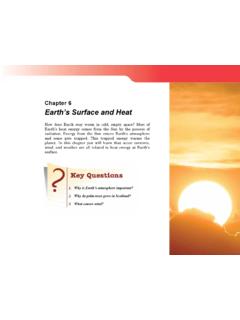
Chapter 6 Earth’s Surface and Heat
www.tclauset.org6.1 EARTH IS JUST RIGHT 115 CHAPTER 6: EARTH’S SURFACE AND HEAT Energy and motion The Sun’s energy Almost all of the heat energy on Earth’s surface comes from the Sun. Hot spots like volcanoes and hot springs add some heat, but not as much as the Sun. At the same time that the Su n adds heat to

Chapter 5 Density and Buoyancy - tclauset.org
www.tclauset.orgChapter 5 Density and Buoyancy You read about heat in Chapter 4. In this chapter, you’ll learn a little more about heat and learn about two new concepts—

Chapter 8 - Plate Tectonics - Quiz Questions (#1- …
www.tclauset.orgChapter 8 - Plate Tectonics - Quiz Questions (#1- #6) Front - Question Back - Answer Q1-1: Who was Alfred Wegener? f o l d A1-1: German climatologist who wrote 1915 book, Origins of the Continents and Oceans, and hypothesized that Earth's continents were once

Chapter 13 Natural Hazards - tclauset.org
www.tclauset.orgChapter 13 Natural Hazards Two great energy sources drive Earth’s processes. Energy from the Sun drives the external energy system, while energy from Earth’s hot core drives the internal energy system. Most natural hazards are related to one of these two energy systems.

Chapter 16 Biomes - tclauset.org
www.tclauset.orgChapter 16 Biomes In Chapter 6, you learned about seasons, wind, ocean currents, and weather patterns. All of these elements work together to produce different clim ates in different parts of the
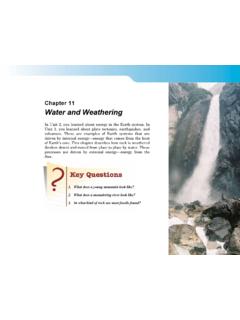
Chapter 11 Water and Weathering - tclauset.org
www.tclauset.org11.1 WEATHERING 233 CHAPTER 11: WATER AND ENERGY Physical weathering Weathering How is a large mountain broken down into tiny grai ns of sand? The process of breaking down rock is called weathering (Figure 11.3). Physical weathering Physical forces may break or chip rocks …
Related documents
Chapter 4 - Student
pages.mtu.eduIn Chapter 4, the following problem modules explain the heat transfer processes involved in fuel cell vehicles and in the processes for producing fuel for fuel cells. 4.1-1 Heat Loss through a Stainless Steel Bipolar Plate
Chapter 4 Heat Review - Mr. Palmarin's Class Website
palmarin.weebly.com2H 2 + O 2 2H 2O 11. Calculate the quantity of heat required to change 50g of ice at -10°C into steam at 120°C.(This is 5 steps). 12. Calculate the quantity of heat required to change 100g of steam at 130°C into ice at -10°C? (This is 5 steps).
Chapter 4 Convection - MIT PAOC
paoc.mit.edu74 CHAPTER 4. CONVECTION Figure 4.1: Solar radiation warms the earth’s surface, triggering convection which carries heat vertically to the emission level from which, because the atmosphere above this level is transparent in …
Chapter 10 Temperature and Heat - Doane College
physics.doane.eduChapter 10 Temperature and Heat OVERVIEW Heat is a form of energy. As this energy moves from one object to another, we may detect physical changes in both the object losing heat energy and the object gaining heat energy. This chapter deals with many of these basic changes and the rules used to describe them.
Chapter 10 Temperature And Heat - Doane College
physics.doane.eduPhysics Including Human Applications 217 Chapter 10 Temperature And Heat GOALS When you have mastered the contents of this chapter, you will be able to achieve the
CHAPTER 4 THERMAL EFFECTIVENESS OF A …
shodhganga.inflibnet.ac.in55 CHAPTER 4 THERMAL EFFECTIVENESS OF A SPIRAL PLATE HEAT EXCHANGER 4.1 INTRODUCTION This chapter discusses the study of thermal effectiveness of the
CHAPTER 4 DESIGN FUNDAMENTALS OF SHELL …
web.iitd.ac.inCHAPTER 4 DESIGN FUNDAMENTALS OF SHELL-AND-TUBE HEAT EXCHANGERS 4.1 INTRODUCTION The thermal design of heat exchangers is directed to …
Chapter 4: Energy from Combustion The primary …
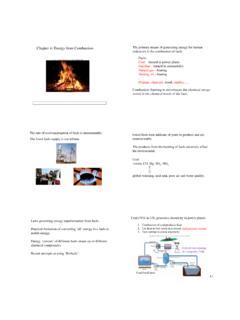
web.mnstate.eduChapter 4: Energy from Combustion The primary means of generating energy for human endeavors is the combustion of fuels. Fuels: Coal -burned in power plants ... 4.1 Heat is a consequence of motion at the molecular level; temperature is a measure of the average speed of that motion.
Chapter 4
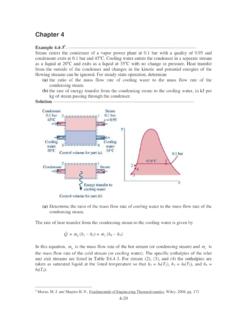
www.cpp.edu4-29 Chapter 4 Example 4.4-36. Steam enters the condenser of a vapor power plant at 0.1 bar with a quality of 0.95 and condensate exits at 0.1 bar and 45oC. Cooling water enters the condenser in a separate stream as a liquid at 20oC and exits as a liquid at 35oC with no change in pressure.Heat transfer
Chapter 5
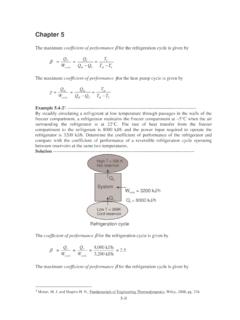
www.cpp.edu5-9 Chapter 5 The maximum coefficient of performance b for the refrigeration cycle is given by b C= CC cycle Q W = H C Q Q-Q H C T T-T The maximum coefficient of performance gfor the heat pump cycle is given by g = H H cycle Q W = H C Q Q-Q H C T T-T Example 5.4-23. By steadily circulating a refrigerant at low temperature through …
Related search queries
Chapter 4, Student, Heat, Chapter 4 Heat Review, Chapter 4 Convection, CHAPTER 4. CONVECTION, Chapter 10 Temperature And Heat, Chapter, CHAPTER 4 THERMAL EFFECTIVENESS OF A, CHAPTER 4 THERMAL EFFECTIVENESS OF A SPIRAL, CHAPTER 4 DESIGN FUNDAMENTALS OF SHELL, CHAPTER 4 DESIGN FUNDAMENTALS OF SHELL-AND, Chapter 4: Energy from Combustion The primary