
Chapter 4. Multiple Choice Concept Tests: The Force ...
102 Chapter 4. Multiple Choice Concept Tests: The Force Concept Inventory (FCI) I. CHAPTER OVERVIE W In the early 1980s, McDermott, 1 Viennot, 2 and other physics education researchers 3, 4 found that each student comes into a physics course not as a blank sl ate but brings into the classroom a system of common sense beliefs and …
Download Chapter 4. Multiple Choice Concept Tests: The Force ...

Information
Domain:
Source:
Link to this page:
Documents from same domain
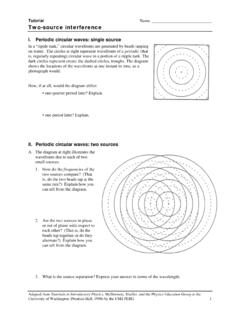
Tutorial Name Two-source interference - UMD …
www.physics.umd.eduTutorial Name Two-source interference Adapted from Tutorials in Introductory Physics, McDermott, Shaffer, and the Physics Education Group at the
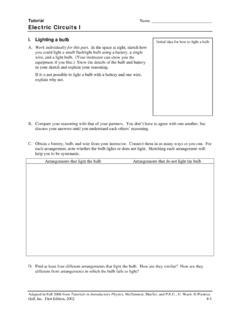
Tutorial Electric Circuits I - UMD Physics
www.physics.umd.eduTutorial: Electric Circuits I Adapted in Fall 2006 from Tutorials in Introductory Physics, McDermott, Shaffer, and P.E.G., U. Wash. © Prentice Hall, Inc. First Edition, 2002.

Introduction to Quantum Mechanics - D. Griffiths
www.physics.umd.eduTitle: Introduction to Quantum Mechanics - D. Griffiths.djvu Author: hsgsj Created Date: 11/28/2009 9:22:59 PM

Lecture 5 (Feb. 6) - UMD Department of Physics
www.physics.umd.eduLecture 5 (Feb. 6) • Pressure in liquids and gases • Measuring and using pressure • Archimedes’ principle (float or sink?)

Principles of Modern Physics - UMD Department of Physics
www.physics.umd.eduPrinciples of Modern Physics . Fall 2014 . Description: This 3 credits course is designed primarily for engineering and physical sciences students. The lectures will cover main topics on the fundamentals of modern physics, according to the schedule below. ...

Principles of Modern Physics
www.physics.umd.eduPhysics 420 . Principles of Modern Physics . Fall 2012 . Description: This 3 credits course is designed primarily for engineering students. The lectures will cover selected materials from the text on the fundamentals of modern physics, according to the schedule below.

E, D, B & H: What do they all mean? - UMD Physics
www.physics.umd.eduE~, D~, B~ & H~: What do they all mean? W. T. Hill, III Department of Physics and The Institute for Physical Science and Technology University of Maryland, College Park, Maryland 20742

IEEE TRANSACTIONS ON APPLIED ... - UMD Physics
www.physics.umd.edu2 IEEE TRANSACTIONS ON APPLIED SUPERCONDUCTIVITY Fig. 2. Optical microscope images of resonator (light grey is metallization, black is sapphire substrate, dark grey is ). White squares in the (a) image indicate position of elements defining the type of coupling. Top square repre-

IEEE TRANSACTIONS ON APPLIED ... - UMD Physics
www.physics.umd.edu2 IEEE TRANSACTIONS ON APPLIED SUPERCONDUCTIVITY Fig. 1. Optical images of four resonators measured (gray/white is aluminum metal and black is sapphire substrate). Circle 1 labels the current anti-node and voltage node of resonators and Circle 2 labels one of the two current nodes and

Foundations of the international system of units (SI)
www.physics.umd.eduFoundations of the international system of units (SI) ROBERT A. NELSON Robert A. Nelson teaches physics and computer programming at By ram Hills High School where he has been a …
Related documents
Chapter 4 - Student
pages.mtu.eduIn Chapter 4, the following problem modules explain the heat transfer processes involved in fuel cell vehicles and in the processes for producing fuel for fuel cells. 4.1-1 Heat Loss through a Stainless Steel Bipolar Plate
Chapter 4 Heat Review - Mr. Palmarin's Class Website
palmarin.weebly.com2H 2 + O 2 2H 2O 11. Calculate the quantity of heat required to change 50g of ice at -10°C into steam at 120°C.(This is 5 steps). 12. Calculate the quantity of heat required to change 100g of steam at 130°C into ice at -10°C? (This is 5 steps).
Chapter 4 Convection - MIT PAOC
paoc.mit.edu74 CHAPTER 4. CONVECTION Figure 4.1: Solar radiation warms the earth’s surface, triggering convection which carries heat vertically to the emission level from which, because the atmosphere above this level is transparent in …
Chapter 10 Temperature and Heat - Doane College
physics.doane.eduChapter 10 Temperature and Heat OVERVIEW Heat is a form of energy. As this energy moves from one object to another, we may detect physical changes in both the object losing heat energy and the object gaining heat energy. This chapter deals with many of these basic changes and the rules used to describe them.
Chapter 10 Temperature And Heat - Doane College
physics.doane.eduPhysics Including Human Applications 217 Chapter 10 Temperature And Heat GOALS When you have mastered the contents of this chapter, you will be able to achieve the
CHAPTER 4 THERMAL EFFECTIVENESS OF A …
shodhganga.inflibnet.ac.in55 CHAPTER 4 THERMAL EFFECTIVENESS OF A SPIRAL PLATE HEAT EXCHANGER 4.1 INTRODUCTION This chapter discusses the study of thermal effectiveness of the
CHAPTER 4 DESIGN FUNDAMENTALS OF SHELL …
web.iitd.ac.inCHAPTER 4 DESIGN FUNDAMENTALS OF SHELL-AND-TUBE HEAT EXCHANGERS 4.1 INTRODUCTION The thermal design of heat exchangers is directed to …
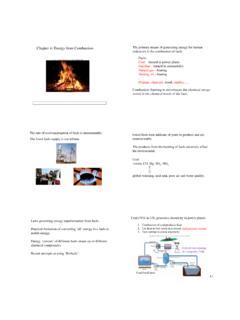
Chapter 4: Energy from Combustion The primary …
web.mnstate.eduChapter 4: Energy from Combustion The primary means of generating energy for human endeavors is the combustion of fuels. Fuels: Coal -burned in power plants ... 4.1 Heat is a consequence of motion at the molecular level; temperature is a measure of the average speed of that motion.
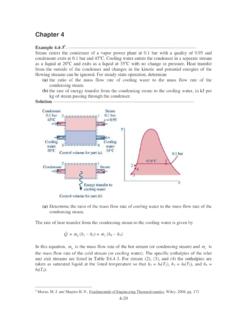
Chapter 4
www.cpp.edu4-29 Chapter 4 Example 4.4-36. Steam enters the condenser of a vapor power plant at 0.1 bar with a quality of 0.95 and condensate exits at 0.1 bar and 45oC. Cooling water enters the condenser in a separate stream as a liquid at 20oC and exits as a liquid at 35oC with no change in pressure.Heat transfer
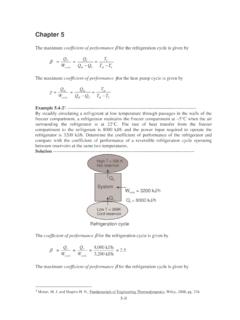
Chapter 5
www.cpp.edu5-9 Chapter 5 The maximum coefficient of performance b for the refrigeration cycle is given by b C= CC cycle Q W = H C Q Q-Q H C T T-T The maximum coefficient of performance gfor the heat pump cycle is given by g = H H cycle Q W = H C Q Q-Q H C T T-T Example 5.4-23. By steadily circulating a refrigerant at low temperature through …
Related search queries
Chapter 4, Student, Heat, Chapter 4 Heat Review, Chapter 4 Convection, CHAPTER 4. CONVECTION, Chapter 10 Temperature And Heat, Chapter, CHAPTER 4 THERMAL EFFECTIVENESS OF A, CHAPTER 4 THERMAL EFFECTIVENESS OF A SPIRAL, CHAPTER 4 DESIGN FUNDAMENTALS OF SHELL, CHAPTER 4 DESIGN FUNDAMENTALS OF SHELL-AND, Chapter 4: Energy from Combustion The primary