
Chapter 5 Capacitance and Dielectrics
Figure 5.2.3 Charged particles interacting inside the two plates of a capacitor. Each plate contains twelve charges interacting via Coulomb force, where one plate contains positive charges and the other contains negative charges. Because of their mutual repulsion, the particles in each plate are compelled to maximize the distance
Download Chapter 5 Capacitance and Dielectrics

Information
Domain:
Source:
Link to this page:
Documents from same domain

Wireless Communications and Networks
web.mit.edu4 MIT Physical layer •The physical layer plays a very important role in wireless network because it has severe limitation on transmissions Uplink with respect to downlink

The Aleph - MIT
web.mit.eduThe Aleph by Jorge Luis Borges O God! ... He read me many other stanzas, each of which also won his own approval and elicited his lengthy explications.

Finite Element Method
web.mit.eduRobert Cook, Finite Element Modeling For Stress Analysis, John Wiley & Sons, 1995 Introduction to Finite Element Method, http://210.17.155.47 (in Korean)
Finite Element Analysis
web.mit.eduFinite Element Analysis David Roylance Department of Materials Science and Engineering Massachusetts Institute of Technology Cambridge, MA 02139 February 28, …

TECHNICAL & SERVICE MANUAL - MIT
web.mit.eduwhen wiring electrical shock can cause severe personal injury or death. only a qualified, experienced electrician should attempt to wire this system.

Chapter 21 Rigid Body Dynamics: Rotation and …
web.mit.eduChapter 21 Rigid Body Dynamics: Rotation and ... patience to the establishment of the laws of rotation of the solid ... general treatment of mechanics, ...
5.33 Lecture Notes: Introduction To Polymer …
web.mit.edu5.33 Lecture Notes: Introduction To Polymer Chemistry Polymer: A large molecule (macromolecule) built up by repetitive bonding (covalent) of smaller molecules (monomers) • Generally not a well defined structure, or molecular weight.

UNDERSTANDING, FINDING, & ELIMINATING …
web.mit.edua Senior Member of the Institute of Electrical and Electronic Engineers. CEDIA EST016 UNDERSTANDING, ... GROUNDING, AC POWER, AND SAFETY ...
PRESENTED AT THE 2004 AMERICAN CONTROL …
web.mit.eduPRESENTED AT THE 2004 AMERICAN CONTROL CONFERENCE 1 Internal and External Op-Amp Compensation: A Control-Centric Tutorial ... circuit operational …

Frank and Lillian Gilbreth and the Manufacture and ...
web.mit.eduFrank and Lillian Gilbreth and the Manufacture ... time study, despite its ... publicizing micro-motion study as an advance over time study and as an
Related documents

Gauss’ Law - University of Tennessee
www.phys.utk.eduNumber per unit area (e.g., 10 particles/cm2) Number passing through an area of interest. Physics 231 Lecture 2-4 Fall 2008 Electric Flux The electric flux is defined to be ... Solid Uniformly Charged Sphere A charge Q is uniformly distributed throughout the volume of an insulating

The Atomic Model
d1yqpar94jqbqm.cloudfront.netcharged material, like dough in a bun. The (-) charged electrons are ... Rutherford discovered protons and the nucleus. He showed that atoms have (+) particles in the center, and are mostly empty space. He called these (+) particles protons. He called the center of atoms the nucleus. Rutherford’s Experiment Radioactive material ...
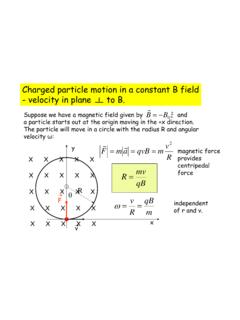
Charged particle motion in a constant B field - velocity ...
www.phys.hawaii.eduA charged particle enters a region with perpendicular electric and magnetic fields. The electric and magnetic forces will cancel if the velocity is just right. Particles with this velocity will go through undeflected. Others will be deflected. E m F qE F qv B r r r r r = =− =− × sin qE qv B qv B 1 r rr rr = θ= B E v r r r =
Lecture 5 Motion of a charged particle in a magnetic field
www.tcm.phy.cam.ac.ukWhat is effect of a static electromagnetic field on a charged particle? Classically, in electric and magnetic field, particles experience a Lorentz force: F = q (E + v × B) q denotes charge (notation: q = −e for electron). Velocity-dependent force qv × B very different from that derived from scalar potential, and programme for ...
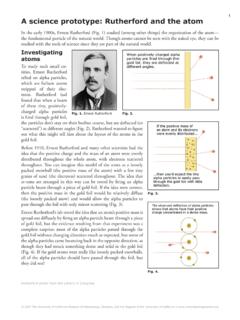
A science prototype: Rutherford and the atom
undsci.berkeley.educharged alpha particles is fired through gold foil, the particles don’t stay on their beeline course, but are deflected (or “scattered”) at different angles (Fig. 2). Rutherford wanted to figure out what this might tell him about the layout of the atoms in the gold foil.