
Chapter 8 Microbiological Control - Biomanufacturing
As with food production, microbiological control is a key issue in pharmaceutical manufacturing. This is particularly true in the case of biopharmaceuticals and bioprocessing, which use various organic materials to create a range of products. Microbiological control is …
Download Chapter 8 Microbiological Control - Biomanufacturing

Information
Domain:
Source:
Link to this page:
Documents from same domain
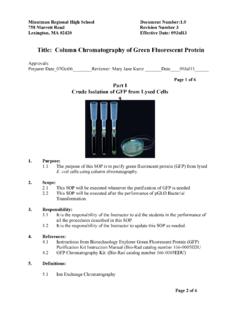
Title: Column Chromatography of Green …
biomanufacturing.orgTitle: Column Chromatography of Green Fluorescent Protein ... 4.1 Instructions from Biotechnology Explorer Green Fluorescent Protein ... (Bio-Rad catalog number 166 ...
Overview Development and Manufacturing of …
biomanufacturing.org2 Development and Manufacturing of Parenteral Drug Products Unit Overview Development and Manufacturing of Injectable (Parenteral) Drug Products From discovering the active ingredient to manufacturing the finished product, the production of

Chapter 11 Downstream Processing - Biomanufacturing
biomanufacturing.orgTable 11-1: Commonly employed downstream processing methods (adapted from Kemp and O’Neil 2003) Processing Method Attributes Benefits Limitations Clarification: (often considered part of the upstream processing train) Sedimentation- based Clarification continuous centrifugation capable of handling very large harvest volumes open process-

Chapter 14 Sterile Filtration, Filling, and Lyophilization ...
biomanufacturing.orgcontainers (pharmaceutical container/closure). This operation exposes the sterile product to the environment, equipment, and manipulative technique of the operators until it can be sealed in the dose container; therefore, this operation is performed with a minimum exposure

Chapter 13 Formulation Development of Parenteral Products
biomanufacturing.org4 Chapter 13 – Formulation of Parenteral Products Introduction to Parenteral Products Basic theory Parenteral (para enteron—beside the intestine) administration is the introduction into the body of nutrition, medications, or other substances other than by the alimentary canal.

Introduction to TFF - Biomanufacturing
biomanufacturing.orgtests to establish a baseline for the device performance. 7. Equilibrate system with the sample buffer (it helps remove air from the system, adjust system temperature and prevent possible precipitation or denaturation of biomolecules resulting from contact with flushing solution). 8. Process the Product (concentration and /or diafiltration, or

Chapter 15 Inspection, Labeling, and Packaging
biomanufacturing.orginspection without impacting overall batch quality. The American National Standards Institute/American Society for Quality Control (ANSI/ASQC) Z1.4-2008, Sampling Procedures and Tables for Inspection by Attributes is the primary reference used for setting AQL levels. Table 15-1. Sample AQL table based on ANSI/ASQC, Z1.4-2008 Batch Size Sample Size
Chapter 10 Upstream Processing - Biomanufacturing
biomanufacturing.orguse of airflow booths and following cleaning protocol explain the in-process controls for assessing media components illustrate the major types of bioreactors and associated instruments used for upstream biomanufacturing evaluate situations in order to make appropriate aseptic decisions
Chapter 10 Upstream Processing - Biomanufacturing
biomanufacturing.orguse of airflow booths and following cleaning protocol • explain the in-process controls for assessing media components • illustrate the major types of bioreactors and associated instruments used for upstream biomanufacturing • evaluate situations in order to make appropriate aseptic decisions
Chapter 11 Downstream Processing - Biomanufacturing
biomanufacturing.org424 Chapter 11 - Downstream Processing Objectives This chapter provides an overview of downstream processing. After completing this chapter, students will be able to: Describe the general elements of the downstream purification process for a typical monoclonal antibody-based therapeutic, starting with the bioreactor harvest pool and
Related documents
Microbiological Best Laboratory Practices, USP <1117 ...
microbiologynetwork.comcontrol, method development, process and product design, and product stability are a few of the objectives. The United States Pharmacopeia (USP), other global pharmacopeias and some parallel industry specific compendia offer some standardized test methodologies and material specifications relating to microbiological quality and control. However
Quality Control Analytical Methods: Microbial Limit Tests ...
www.arlok.comQuality Control TABLe 1. United States Pharmacopeia (Chapter <1111>) Acceptance Criteria for Microbiological Quality of Nonsterile Dosage Forms.11 TAMC TYMC ABSeNCe OF SPeCIFIeD ROUTe OF (CFU/G, (CFU/G, MICROORGANISM(S) ADMINISTRATION CFU/ML) CFU/ML) (1 G, 1 ML)a Oral (non-aqueous) 10³ 10² Escherichia coli
Accreditation for Microbiological Laboratories
www.eurachem.orgmicrobiological testing with appropriate information on how to fulfil the requirements of ISO/IEC 17025, giving detailed guidance on such requirements for those undertaking the examination of materials, products and substances. The guidance is applicable to the performance of all objective measurements, whether routine, nonroutine, or as -

<62> Microbiological Examination Of Nonsterile Products ...
www.uspnf.comUSP 31 Microbiological Tests / 〈62〉 Microbiological Examination3 containing respectively 0.1g, 0.01g, and 0.001g (or 0.1mL, Pseudomonas aeruginosa 0.01mL, and 0.001mL) of the product to be examined. Incubate at 30° to 35° for 24 to 48 hours. Subculture each of the cultures on aSample Preparation and Pre-Incubation—Prepare a sample

Module 08 USP 1115 Bioburden Control of Non-Sterile …
latam-edu.usp.orgthe effectiveness of microbiological controls and in early detection of potential problems within the manufacturing areas. The microbial methods and practices utilized for aseptic facilities may be utilized; however the contamination recovery rates defined in <1116> Microbiological Control and Monitoring of Aseptic Processing Environments are
Biosafety in Microbiological and Biomedical Laboratories ...
www.cdc.goviv Biosafety in Microbiological and Biomedical Laboratories We hope you find the sixth edition of Biosafety in Microbiological and Biomedical Laboratories complete, timely, and most of all, easy to use. Thank you for your patience and understanding during the long and comprehensive revision process.
Prevention and Control of Microbiological Contamination in ...
croplife.orgThe “Prevention and Control of Microbiological Contamination in Crop Protection Products” booklet makes recommendations about best practices to prevent and control Product Integrity incidents caused by microbial contamination. The technical information contained in this booklet is provided to CropLife

Compendium of Microbiological Criteria for Food
www.foodstandards.gov.auverify that the food safety control system or elements of it are working as intended. The microbiological criteria used by food regulatory agencies generally include: food safety criteria: microbiological criteria that are applied to determine the safety of a food lot. Food safety criteria are included in the Australia New Zealand Food Standards

876 1223 Validation of Alternative Microbiological Methods ...
www.triphasepharmasolutions.com876 〈1223〉 Validation of Alternative Microbiological Methods / General Information USP 35 Limit of Detection by the receiving unit, and the transfer waiver, which is an appropriately justified omission of the transfer process. The