
CHAPTER 8. RANDOMIZED COMPLETE BLOCK DESIGN WITH …
MSEB is the mean square of design-B with degrees of freedom dfB. If RE>1, design A is more efficient. If RE<1, the converse is true. If a randomized complete block design (say, design-A) is used, one may want to estimate the relative efficiency compared with a completely randomized design (say, design-B).
Download CHAPTER 8. RANDOMIZED COMPLETE BLOCK DESIGN WITH …

Information
Domain:
Source:
Link to this page:
Documents from same domain
P(Z Cumulative Probabilities of the Standard …
pages.stat.wisc.eduCumulative Probabilities of the Standard Normal Distribution N(0, 1) Left-sided area Left-sided area Left-sided area Left-sided area Left-sided area Left-sided area
Classification and regression trees
pages.stat.wisc.eduOverview Classification and regression trees Wei-Yin Loh Classificationandregressiontreesaremachine-learningmethodsforconstructing predictionmodelsfromdata ...
BASIC CALCULUS REFRESHER - pages.stat.wisc.edu
pages.stat.wisc.edu3 y = x y = x2 Notice that the line has the generic equation y = f (x) = mx + b, where b is the Y-intercept (in this example, b = +3), and m is the slope of the line (in this example, m = +2). In general, the slope of any line is defined as the ratio of “height change” y to “length change” x, that is, m = y
Solutions to Homework 5 Statistics 302 Professor Larget
pages.stat.wisc.eduSolutions to Homework 5 Statistics 302 Professor Larget Textbook Exercises 4.79 Divorce Opinions and Gender In Data 4.4 on page 227, we introduce the results of a May 2010 Gallup poll of 1029 US adults. When asked if they view divorce as \morally acceptable", 71% of the men and 67% of the women in the sample responded yes. In the test for a di ...
Using lme4: Mixed-Effects Modeling in R
pages.stat.wisc.eduDe nition of linear mixed-e ects models A mixed-e ects model incorporates two vector-valued random variables: the response, Y, and the random e ects, B. We observe the value, y, of Y. We do not observe the value of B. In a linear mixed-e ects model the conditional distribution, YjB, and the marginal distribution, B, are independent,
Applications of Fourier Transform to Imaging Analysis
pages.stat.wisc.eduCallosum (CC) data are used to demonstrate the advantages of our method over previous methods. The possibilities of applications of this method to image analysis is discussed. 1 Introduction Fourier transform (FT) is named in the honor of Joseph Fourier (1768-1830), one of greatest names in the history of mathematics and physics.
Solutions to Homework 1 Statistics 302 Professor Larget
pages.stat.wisc.eduselected. Other options are possible: for example, we could number the plants from 1 to 30000 and randomly select 30 numbers between 1 and 30000. (b) Answers will vary for this question, but the procedure should be explained and the three numbers which were obtained should be listed. Here is the start of one sample. Row Plant #94 #180 #83 # 81 ...
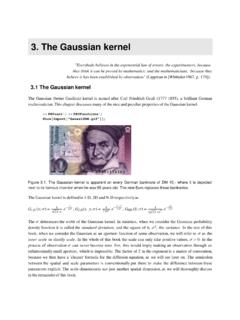
3. The Gaussian kernel
pages.stat.wisc.eduThe Gaussian kernel is defined in 1-D, 2D and N-D respectively as ... process of observation s can never become zero. For, this would imply making an observation through an infinitesimally small aperture, which is impossible. The factor of 2 in the exponent is a matter of convention,
Practice Exam Questions; Statistics 301; Professor Wardrop
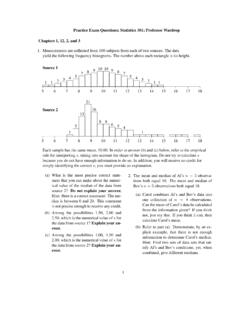
pages.stat.wisc.edu13. A sample space has three possible outcomes, B, C, and D. It is known that P(C) = P(D). The operation of the chance mechanism is simulated 10,000 times (runs). The sorted frequencies of the three outcomes (B, C, and D) are: 2322, 2360, and 5318. (a) What is your approximation of P(B)? To receive credit you must explain your an-swer.
Power and Sample Size Determination
pages.stat.wisc.eduPower and Sample Size Determination Bret Hanlon and Bret Larget Department of Statistics University of Wisconsin|Madison November 3{8, 2011 Power 1 / 31 Experimental Design To this point in the semester, we have largely focused on methods to analyze the data that we have with little regard to the decisions on how to gather the data.
Related documents

Chest Tube and Drainage Management - - RN.org®
www.rn.orgThe original design of the float valve at the top of this chamber permitted uncontrolled vacuum levels to accumulate in the ... It must be a completely closed system; any venting to the atmosphere will disrupt the system's selfgenerated ... patients were randomized to resume vacuum or to stay on gravity water seal drainage ...

Chapter 3: Two-Level Factorial Design
cdnm.statease.comThe simplest factorial design involves two factors, each at two levels. The top part of Figure 3-1 shows the layout of this two-by-two design, which forms the square “X-space” on the left. The equivalent one-factor-at-a-time (OFAT) experiment is shown at the upper right. Figure 3-1: Two-level factorial versus one-factor-at-a-time (OFAT)
Randomized Block Analysis of Variance - NCSS
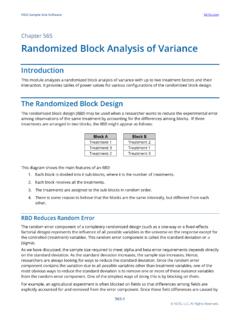
ncss-wpengine.netdna-ssl.comThe randomized block design is often confused with a single-factor repeated measures design because the analysis of each is similar. However, the randomization pattern is different. In a randomized block design, the treatments are applied in random order within each block. In a repeated measures design, however, the treatments are usually

Tests for Homogeneity of Variance
www.math.montana.eduThe design was completely randomized. Dose % 1 5 1 1 1 3 1 5 1 2 1 6 1 1 1 3 Dose % 2 13 2 13 2 6 2 7 2 11 2 4 2 14 2 12 Dose % 3 12 3 16 3 9 3 18 3 16 3 7 3 14 3 13 Dose % 4 17 4 13 4 16 4 19 4 26 4 15 4 23 4 27 Dose % 5 22 5 30 5 27 5 32 5 32 5 43 5 29 5 26 The sample variances s2 i are s2 1 = s 2 2 = s 2 3 = s 2 4 = s 2 5 = Thus, the weights ...
Section 1.3, Data Collection and Experimental Design
www.math.utah.edu{ A completely randomized designassigns subjects to di erent treatment groups through random assignment. { A randomized block design is sometimes used to make sure that subjects with cer-tain characteristics are assigned to each treatment. For example, when testing a certain