
Chapter 9: Phase Diagrams
Rothery rules ) suggesting high mutual solubility. Simple solution system (e.g., Ni-Cu solution) • Ni and Cu are totally miscible in all proportions. Chapter 9 - 8 Unary Systems Single component system Consider 2 metals: Cu has melting T = 1085 oC Ni has melting T = 1453 oC (at standard P = 1 atm) 1085 oC Cu solid liquid T
Download Chapter 9: Phase Diagrams

Information
Domain:
Source:
Link to this page:
Documents from same domain

Chapter 2. Atomic Structure and Interatomic Bonding
web.eng.fiu.eduChapter 2. Atomic Structure and Interatomic Bonding Interatomic Bonding –Bonding forces and energies –Primary interatomic bonds –Secondary bonding –Molecules Bonding Forces and Energies • Considering the interaction between two isolated atoms as they are brought into close proximity from an infinite separation. • At larger distances ...
Chapter 4 : ERP Implementation Methodologies and Strategies
web.eng.fiu.eduimplementation, and are kept at the forefront of the strategy. It is crucial that management executives and project stakehold-ers establish expectations for the project. Their role is to ensure ... • Budget • Funding CHAPTER 4 Dunaway – ERP …

Mechanical Vibrations FUNDAMENTALS OF VIBRATION
web.eng.fiu.edu• Joseph Sauveur (1653–1716) coined the word “acoustics” for the science of sound. • Sir Isaac Newton (1642–1727) his law of motion is routinely used to derive the equations of motion of a vibrating body. • Brook Taylor (1685–1731), obtained the natural frequency of vibration observed by Galilei and Mersenne.
Practice Problems for FE Fluid Mechanics
web.eng.fiu.eduExample 30 Inthepipesystemdepictedbelow,thedischargeinpipeABis100 m3/sec. Branch 1 is 500 m long, and it has a diameter of 2 m and a friction factor of 0.018. Branch 2 has a length of 400 m, diameter of 3 m, and a friction factor of 0.02.

OVERVIEW OF HEURISTIC OPTIMIZATION
web.eng.fiu.eduOPTIMIZATION (Eberhart Kennedy -1995) A robust stochastic optimization technique inspired by the social behavior of swarms of insects or flocks of birds –maximize “food”. Apply the concept of social interaction to problem solving. Developed in 1995 by James Kennedy (social-psychologist) and Russell Eberhart (electrical engineer).
Chapter 16: Composite Materials
web.eng.fiu.edustrength of a ceramic • structure materials for aircraft engine: low densities, strong, stiff, abrasion and impact resistant and corrosion resistant. Chapter 16 - 2 ... Composite Hybrid Materials, The Macmillan Company, New York, 1981.] • Stacked and bonded fiber-reinforced sheets
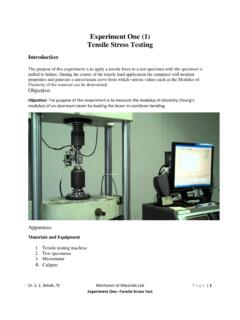
Experiment One (1) Tensile Stress Testing
web.eng.fiu.eduor Pa). In Equation (3.3-2), å is the strain measured in in/in (m/m) in the direction of the applied load. Since strain is dimensionless, the elastic modulus is measured in units of psi (Pa). It is important to realize that Equations above is valid only for uniaxial tension and is a special case of a generalized set of relations known as Hooke ...
Milliequivalents, Millimoles, and Milliosmoles
web.eng.fiu.eduStep 2: Calculate equivalent weight Equiv weight = molecular weight KCl divided by valence Since valence of KCl = 1, Equiv weight = 74.5/ 1 Step 3: 1 mEq KCl = 1/1000 x 74.5 g = 0.0745 g = 74.5 mg Step 4: 4 mEq KCl = 74.5mg x 4 = 298 mg/ml OR using the equation listed before: mg/ml = mEq/ml * atomic, molecular or formula weight valence ...

Experiment Two (2) Torsional testing of Circular Shafts
web.eng.fiu.eduDetermination of Modulus of Rigidity, Shear Modulus G and Torsional Stress for Steel and Aluminum. A. Using the reading of above to calculate the shear modulus and torsional stress for Steel, Aluminum and Brass, by using the following formulas. Compare the experimental results with theoretical values. Θ = [180*T*L/(π*J*G)] (eq. 1) τ= T*C/J ...
Related documents

WRITING CHEMICAL EQUATIONS
chymist.comThe rules governing the solubility of common salts are given below: THE SOLUBILITY RULES 1. All sodium, potassium, and ammonium salts are soluble in water. 2. The nitrates, chlorates, and acetates of all metals are soluble in water. Silver acetate is sparingly soluble. 3. The chlorides, bromides, and iodides of all metals except lead, silver ...

Table Solubility - University of Texas at Austin
www.chemprep.cm.utexas.eduThis is the solubility table that is available for use within ALEKS. Feel free to have this table with you when you take the assessment or when you are in learning mode in ALEKS. Even so, you will save a lot of time (now and later in UT Chem classes) if you commit these two solubility rules to memory: • Compounds with Group 1 cations and NH 4

4.1Writing and Balancing Chemical Equations
web.ung.eduExceptionsto these solubility rules include • halides of Ag+,Hg 2 2+, and Pb 2+ • sulfates of Ag+, Ba2+, Ca2+,Hg 2 2+, Pb2+, and Sr2+ Insoluble compoundscontain • carbonate(CO3 2−), chromate (CrO 3 2−), phosphate (PO4 3−), and sulfide (S 2−) ions • hydroxide ion (OH−) Exceptionsto these insolubility rules include • compounds ...
Chapter 10: Chemical Bonding
webs.anokaramsey.eduRules for Writing Lewis Structures for Covalent Compounds Ch 10 Page 5 . C, N, O and F ALWAYS have 8 electrons surrounding them in their ... Molecular Polarity and Solubility Ch 10 Page 16 . Title Chapter 10 Author: tablet11 Subject: Chem 1020 Tro Chapter 10 Lecture Notes
The Carbonyl Group - Angelo State University
www.angelo.eduwater-soluble; water solubility decreases as the size of the molecule increases. R C R' O H O R' C R O H 19 Physical Properties of Aldehydes and Ketones Name Molecular weight Boiling point Solubility in water butane 58 g/mol 0°C Insoluble propanal 58 g/mol 49°C Soluble acetone 58 g/mol 56°C Soluble 1-propanol 60 g/mol 97°C Soluble Boiling ...
CHAPTER 4: IMPERFECTIONS IN SOLIDS
www3.nd.eduRange of Solubility in Substitutional Solid Solutions Substitutional Solid Solutions can • exist over a limited composition range – limited solubility; • exist over the whole composition range – full solubility. HUME ROTHERY RULES: basic conditions for appreciable solubility 1. Atomic Sizes: should not differ by more than 14%; 2.