
CHAPTER10 Light – Reflection and Refraction
Light – Reflection and Refraction 163 The reflecting surface of a spherical mirror is by and large spherical. The surface, then, has a circular outline. The diameter of the reflecting surface of spherical mirror is called its aperture. In Fig.10.2, distance MN represents the aperture. We shall consider in our discussion only
Download CHAPTER10 Light – Reflection and Refraction

Information
Domain:
Source:
Link to this page:
Documents from same domain
ntse exam notification - National Council Of …
ncert.nic.inExamination: The tentative pattern of written examination will be as follows: Stage-I & Il : examination at the State/UT level will comprise of three papers i.e.
14 Effects Electric Current and Its - National …
ncert.nic.in76 EXEMPLAR PROBLEMS 3. Three bulbs A, B, C are connected in a circuit as shown in Figure 14.2. When the switch is ‘ON’ (a) bulb C will glow first. (b) bulb B and C will glow simulaneously and bulb A will
SEMICONDUCTOR AND SIMPLE CIRCUITSnot to be …
ncert.nic.in469 Semiconductor Electronics: Materials, Devices and Simple Circuits semiconductors. However , after 1990, a few semiconductor devices using organic semiconductors and semiconducting polymers have been
ENVIRONMENTAL CHEMISTRY - National Council …
ncert.nic.in400 CHEMISTRY (c) Hydrocarbons: Hydrocarbons are composed of hydrogen and carbon only and are formed by incomplete combustion of fuel …
LAWS OF MOTION
ncert.nic.inLAWS OF MOTION 91 In practice, the ball does come to a stop after moving a finite distance on the horizontal plane, because of the opposing force of friction which
DESIGN OF THE QUESTION PAPER Mathematics …
ncert.nic.inDESIGN OF THE QUESTION PAPER, SET-I 207 (A) 18 5 (B) 17 5 (C) 17 8 (D) 1 7. In the adjoining figure, PA and PB are tangents from a point P to a circle with centre O.
CHAPTER 10
ncert.nic.in(A) Main Concepts and Results Circle, radius, diameter , chord, segment, cyclic quadrilateral. • Equal chords of a circle (or of congruent circles) subtend equal angles at the
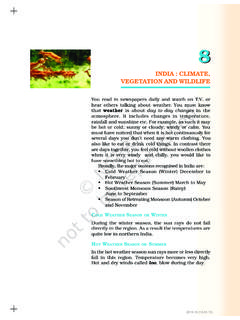
INDIA : CLIMATE, VEGETATION AND WILDLIFE
ncert.nic.inINDIA : CLIMATE, VEGETATION AND WILDLIFE 59 year. Therefore, they always appear gr een and are called evergreen forest as you may notice in Figure
Objectives Polymers - National Council of …
ncert.nic.in427 Polymers C:\Chemistry-12\Unit-15.pmd 28.02.07 Polymers can also be classified on the basis of mode of polymerisation into two sub groups.
TEXTBOOK IN GEOGRAPHY FOR CLASS IX
ncert.nic.inFOREWORD The National Curriculum Framework, (NCF) 2005, recommends that children’s life at school must be linked to their life outside the school. This principle
Related documents
Reflection and Refraction Solutions - Physics 11
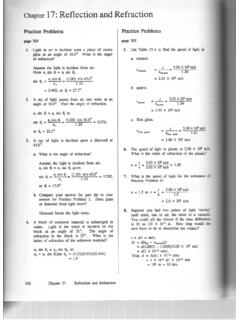
physics11witherrol.yolasite.comThe index of refracüon for a diamond for red light, 656 nm, is 2.410, while that for blue light, 434 nm, is 2.450. white light is incident on the diamond at 30.00. Find the angles of refraction for these two colors. (1.00) sin nA sin = sin 9a, SO sin = For red light (sin 30.00) sin = = 0.207 2410 12.00 Chapter 17 Reflection and Refraction

NCERT Exemplar for Class 10 Science Chapter 10 Light ...
cdn1.byjus.comNCERT Exemplar for Class 10 Science Chapter 10 Light-Reflection and Refraction Soln: Answer is b)B Explanation: Light bends towards normal when it passes from air to glass. Light bends away from normal when it passes from glass to air. This is appropriately shown in figure b). 15. You are given water, mustard oil, glycerine and kerosene.
CBSE Class 10 Science Chapter 10 Light Reflection and ...
cdn1.byjus.comLight – Reflection and Refraction Notes Visible light or light is an electromagnetic radiation found on the electromagnetic spectrum which enables us to see light. Objects reflect some colours of the spectrum when light falls on them. Learn in detail about light and discover other interesting concepts by exploring Class 10 notes for chapter 10

Topic 3 Waves - Physics Resources
faisalj.webs.comTotal Internal Reflection: Consider a ray of light passing from glass to air. If the ray is along the normal then it will not refract. When the angle of incidence is small; we get a weak internally reflected ray (light grey) and strong refracted ray (dark grey). As we increase the angle of incidence, the angle of refraction also increases.

Chap 6 RefleCtion and RefRaCtion page 157 ChAptER 6
vaga.studyReflection and Refraction 6.1 light Light is that form of energy which produces the sensation of sight. Light energy travels through vacuum well as different transparent media in the form of electromagnetic waves. In vacuum as well as in air, light travels with a constant speed of 31# 081ms-. Light travels from one point to other along a ...

CHAPTER10 Light – Reflection and Refraction
www.ncert.nic.in4. Figure 10.1 shows a ray of light as it travels from medium A to medium B. Refractive index of the medium B relative to medium A is (a) 3/ 2 (b) 2/ 3 (c) 1/ 2 (d) 2 Light – Reflection and Refraction CHAPTER10 Fig. 10.1
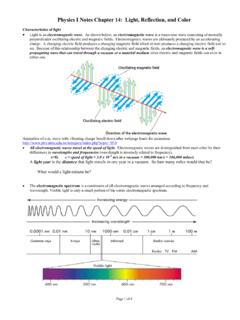
Physics I Notes Chapter 14: Light, Reflection, and Color
www.quia.comor refracted. We will focus on reflection this chapter and on refraction next chapter. When Light encounters Matter • The 3 possible “fates” to befall the energy of the light when it interacts with matter/substances: 1. Reflected – Reflection of the light bounces the energy back into the same medium that it came from. 2.

Reflection and Refraction - UTSA
www.utsa.edureflection. Refraction The most common example of refraction is the bending of light on passing from air to a liquid, which causes submerged objects to appear displaced from their actual positions. Refraction is also the reason that prisms separate white light into its constituent colors. Refraction is commonly explained in terms