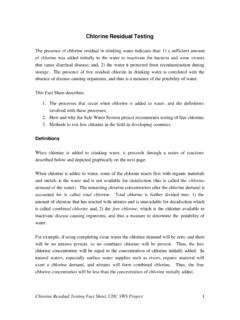
Chlorine Residual Testing
Chlorine Residual Testing Fact Sheet, CDC SWS Project 6 3. Digital Colorimeters Digital colorimeters are the most accurate way to measure free chlorine and/or total chlorine residual in the field in developing countries. hese colorimeters use theT following method: 1) addition of DPD tablets or powder into a vial of sample water that
Download Chlorine Residual Testing

Information
Domain:
Source:
Link to this page:
Documents from same domain
School Chemistry Laboratory Safety Guide
www.cdc.govSchool Chemistry Laboratory Safety Guide. October 2006. U.S. Consumer Safety Product Commission DEPARTMENT OF HEALTH AND HUMAN SERVICES. Centers for Disease Control and Prevention
Biosafety in Microbiological and Biomedical …
www.cdc.goviii. Foreword. Biosafety in Microbiological and Biomedical Laboratories (BMBL) quickly became the cornerstone of biosafety practice and policy in the United States upon first
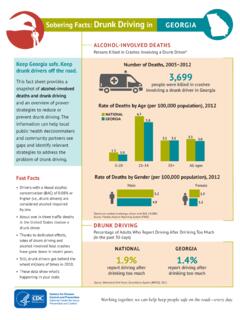
Sobering Facts: Drunk Driving in Georgia
www.cdc.govSobering Facts: Drunk Driving in GEORGIA Keep Georgia safe. Keep drunk drivers off the road. This fact sheet provides a snapshot of alcohol-involved deaths and drunk driving
ALCOHOLS III 1402
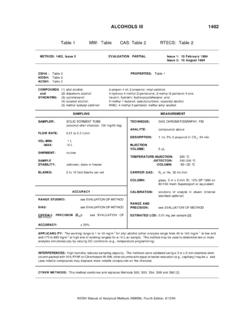
www.cdc.govALCOHOLS III: METHOD 1402, Issue 2, dated 15 August 1994 - Page 3 of 4 a. Remove and discard back sorbent section of a media blank sampler. b. Inject a known amount of analyte or DE stock solution directly onto front sorbent section
Fast Facts
www.cdc.govAny person working outdoors is at risk of exposure to poisonous plants, such as poison ivy, poison oak, and poison sumac. When in contact with skin, the sap oil (urushiol) of

Trans Fat: The Facts
www.cdc.gov• Read the Nutrition Facts label and ingredient list to compare foods. » Choose products with 0 grams trans fat. » Check the Ingredient List to see if there is any partially hydrogenated oil in the product.

ANTIBIOTIC RESISTANCE THREATS
www.cdc.govApr 23, 2013 · 6. ANTIBIOTIC RESISTANCE THREATS IN THE UNITED STATES, 2013. Executive Summary. Antibiotic Resistance Threats in the United States, 2013. is a snapshot of the complex problem
2018 Combined Recommended Immunization …
www.cdc.govRecommended Immunization Schedule for Children and Adolescents Aged 18 Years or Younger, UNITED STATES, 2018 Approved by the Advisory Committee on …
Traveling? Make Sure You Protect Yourself from …
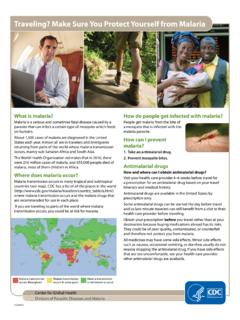
www.cdc.govCS26201 Malaria transmission occurs throughout Malaria transmission occurs in some parts Malaria transmission is not known to occur Center for Global Health
Fast Facts - Centers for Disease Control and …
www.cdc.govHeat stress, from exertion or hot environments, places workers at risk for illnesses such as heat stroke, heat exhaustion, or heat cramps. Heat Stroke
Related documents
Basic Water Treatment Math Formulas for Surface and Well …
files.nc.govRevised 9/15 CONSTANTS 1. 2.54 centimeters = 1 inch 2. 3.28 feet = 1 meter 3. 43,560 square feet = 1 acre 4. 640 acres = 1 square mile
NOP 5026 Guidance on The Use of Chlorine Materials in ...
www.ams.usda.gov(2) Chlorine materials—Except, That, residual chlorine levels in the water shall not exceed the maximum residual disinfectant limit under the Safe Drinking Water Act. (i) Calcium hypochlorite (ii) Chlorine dioxide (iii) Sodium hypochlorite . 7 CFR § 205.603 Synthetic substances allowed for use in organic livestock production.

SWIMMING POOL WATER CHEMISTRY FACT SHEET
www.co.shasta.ca.usThe hypochlorous acid left after the chlorine demand has been satisfied is referred to as the free chlorine residual. This is what we read when we test the pool for chlorine. State codes require that the free chlorine residual be at least 1.0 ppm throughout the pool at all times (1.5 ppm if stabilized chlorine is used). It is recommended that a ...
UNOFFICIAL COMPILATION OF CODES, RULES AND …
www.health.ny.govChlorine at 5.0 Degrees Celsius Table 14C CT Values (CT99.9) for 99.9 Percent Inactivation of Giardia Lamblia Cysts by Free Chlorine at 10.0 Degrees Celsius Table 14D CT Values (CT99.9) for 99.9 Percent Inactivation of Giardia Lamblia Cysts by Free Chlorine at 15.0 Degrees Celsius
Guidelines for the Use of Chlorine Bleach as a Sanitizer ...
www.ksre.k-state.eduwith residual available chlorine levels of no more than 0.5 ppm. For container cooling or general washing, residual available chlorine levels of 2 to 7 ppm are commonly used. Typical municipal water systems produce potable water with a residual available chlorine level of 0.25 to 2 ppm. Some consider-ations when using chlorine bleach as a ...
Chlorination / DeChlorination Procedures
www.pnws-awwa.org• Test chlorine residual level at a sample point within ten feet of the entry point. • Follow Engineer’s specifications on the chlorine residual level. • Take test samples at selected sites throughout the project. • Adjust the control valve to increase or decrease the amount of chlorine entering the system.
GRADE 1 - Santiago Canyon College
www.sccollege.edu12. Chlorine gas is _____ times heavier than breathing air a. 2.5 b. 20 c. 60 d. 460 13. A commonly used method to test for chlorine residual in water is called the _____ method. a. HTH b. THM c. VOC d. DPD 14. When chlorine gas is added to water the pH goes down due to a. chlorine gas producing caustic substances b. two base materials that form