
Commentary for Acceptable Solutions ... - Building Performance
6.2 Information for attending firefighters 38 6.3 Access within the building for firefighting and rescue operations 38 6.4 Firefighting facilities 38 Part 7: Prevention of fire occurring 40 7.4 Downlights 40 Appendix 1: Case Study 41 This document’s status This document is issued as guidance under section 175 of the Building Act 2004.
Download Commentary for Acceptable Solutions ... - Building Performance

Information
Domain:
Source:
Link to this page:
Documents from same domain
Building work that does not require a building consent
www.building.govt.nzGUIDANCE Building Act 2004 THIRD EDITION 2014 - AMENDED AUGUST 2017 Building work that does not require a building consent
C/AS2 - Acceptable Solution for Acceptable Solution for ...
www.building.govt.nzC/AS2 Acceptable Solution for Buildings with Sleeping (non institutional) (Risk Group SM) For New Zealand Building Code Clauses C1-C6 Protection from Fire
Earthquake geotechnical engineering practice
www.building.govt.nzEarthquake geotechnical engineering is a highly specialised field. As such the investigations for this need to be developed and carried out by an appropriately qualified and experienced geotechnical engineer or engineering geologist (referred to herein as the geotechnical professional). For the purposes of this document ‘geotechnical

E2 External Moisture
www.building.govt.nzFor single- and two-storey concrete and concrete masonry construction within specific limitations: E2/AS3. For light steel framed buildings up to 3 storeys, within specific limitations: E2/AS4. E2.3.3 Ground contact or proximity All walls, floors and structural elements in ground contact or proximity, except for buildings where external

Module 6: Earthquake resistant retaining wall design
www.building.govt.nzguidance on earthquake design aspects for retaining . structures that are not well covered in these handbooks or elsewhere. The main objective is to identify situations where seismic design of retaining structures should be considered, to provide the necessary seismic parameters, and to identify key issues relating to seismic design.
Worked Example 4 | Design of a tied-back retaining wall to ...
www.building.govt.nzDesign of a tied-back retaining wall to resist earthquake loading . Worked example to accompany MBIE Guidance on the seismic design of retaining structures for residential sites in Greater Christchurch (Version 2) November 2014 . Tied-back retaining walls were used originally as a substitute for braced retaining walls in deep excavations.
Acceptable Solutions and Verification Methods
www.building.govt.nz4.2 Sizing of downpipes 42 4.3 Installation of downpipes 42 5.0 Roof Gutters 42 5.1 Size of roof gutter 42 5.2 Materials44 5.3 Gradients44 5.4 Thermal movement 44 5.5 Overflow outlets 44 Appendix A Rainfall intensities 45 Index 47 Contents Amend 4 Dec 2000 Amend 4 …
Acceptable Solutions and Verification Methods
www.building.govt.nz4.2 Sizing of downpipes 42 4.3 Installation of downpipes 42 5.0 Roof Gutters 42 5.1 Size of roof gutter 42 5.2 Materials44 5.3 Gradients44 5.4 Thermal movement 44 5.5 Overflow outlets 44 E1/AS1 Appendix A Rainfall intensities 45 Acceptable Solution E1/AS2 52 1.0 AS/NZS 3500.3 Stormwater Dec 2000 drainage52 Index 56 Contents Amend 4

Constructing Cavities - Building Performance
www.building.govt.nzTable 23 (’Properties of roof underlays and building wraps‘). Install the wall underlay directly over the framing. Install the cavity battens directly over the wall underlay as described in Cavity battens on page 9. No additional wall underlay is needed between the wall cladding and the cavity battens except in the following situations.
Earthquake geotechnical engineering practice
www.building.govt.nz2 Site and liquefaction considerations 2.1 Site characterisation One of the initial steps in the design of ground improvement is to develop a geotechnical model for the site which fits within the wider regional geology and geomorphology. This starts from review of …
Related documents
Cybernetics and Second-Order Cybernetics
pespmc1.vub.ac.beCybernetics is the science that studies the abstract principles of organization in complex systems. It is concerned not so much with what systems consist of, but how they function. Cybernetics focuses on how systems use information, models, and control actions to steer towards and maintain their goals, while counteracting various disturbances.

Effective pedagogy in mathematics
www.ibe.unesco.orgBuilding on students’ thinking, page 11 4. Worthwhile mathematical tasks, page 13 5. ... Collectively, the principles found in this booklet are informed by a belief that mathematics pedagogy must: ... By modelling the practice of evaluating ideas, they encourage their ...

Mathematics: Principles and practice
education.gov.scotBuilding the Curriculum 1 Mathematics equips us with many of the skills required for life, learning and work. ... information can be found in the numeracy principles and practice paper. ... • modelling and scaffolding the development of mathematical thinking skills

Health and wellbeing: responsibility of all
education.gov.scotHealth and wellbeing is structured into six organisers: • Mental, emotional, social and physical wellbeing • Planning for choices and changes • Physical education, physical activity and sport • Food and health • Substance misuse • Relationships, sexual health and parenthood Those in blue are the responsibility of all. (Physical activity and sport at early and first levels.)
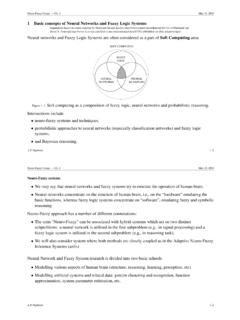
1 Basic concepts of Neural Networks and Fuzzy Logic ...
users.monash.eduModelling information processing in actual brain systems, e.g. auditory tract. ... Schwartz and Jessel, Principles of Neural Science Most neurons in the vertebrate nervous system have several main features ... Simplied functions of these very complex in their nature building blocks of a neuron are as follow: The synapses are elementary signal ...

Modelling and Simulation Concepts
www.cs.mcgill.ca2 The modelling and simulation process 6 Figure 7: Measurement data A number of Information Sources (either explicit in the form of data/model/knowledge bases or implicit in the user’s mind) are used during the process: 1. A Priori Knowledge: in deductive modelling, one starts from general principles Œsuch as mass, energy, momentum conservation laws and constraintsŒ …

Principles of Strategic Planning - Dr. Hamid Doost …
www.fh-mittelstand.dePrinciples of Strategic Planning . By: Dr. Hamid Doost Mohammadian . 01. Auflage (2017) ©2017 Fachhochschule des Mittelstands GmbH, Bielefeld. Alle Rechte vorbehalten. Nachdruck, auch auszugsweise, sowie Verbreitung durch Film, Funk, Fernsehen und Internet, durch fotomechanische Wiedergabe, Tonträger und

Information management according to BS EN ISO 19650 ...
www.ukbimalliance.orgthe fundamental principles of building information modelling (BIM) according to BS EN ISO 19650 Parts 1 and 2. These are referred to in the rest of this guidance as the ISO 19650 series, ISO 19650 Part 1 or ISO 19650 Part 2.1 Both parts were published in 2018. The ISO 19650 series