
Communications in the Incident Command System
Incident Command System By Dan Hawkins SEARCH Introduction Communications is an inseparable component of modern command and control systems. In the United States, the Incident Command System (ICS) has evolved during the past 30 years from its military roots to serve domestic emergen-cy response needs, including communica-tions.
Download Communications in the Incident Command System

Information
Domain:
Source:
Link to this page:
Documents from same domain
School Chemistry Laboratory Safety Guide
www.cdc.govSchool Chemistry Laboratory Safety Guide. October 2006. U.S. Consumer Safety Product Commission DEPARTMENT OF HEALTH AND HUMAN SERVICES. Centers for Disease Control and Prevention

Biosafety in Microbiological and Biomedical …
www.cdc.goviii. Foreword. Biosafety in Microbiological and Biomedical Laboratories (BMBL) quickly became the cornerstone of biosafety practice and policy in the United States upon first
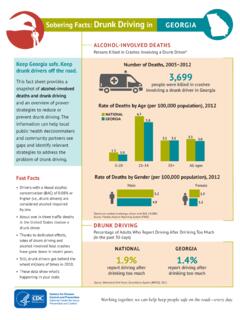
Sobering Facts: Drunk Driving in Georgia
www.cdc.govSobering Facts: Drunk Driving in GEORGIA Keep Georgia safe. Keep drunk drivers off the road. This fact sheet provides a snapshot of alcohol-involved deaths and drunk driving
ALCOHOLS III 1402
www.cdc.govALCOHOLS III: METHOD 1402, Issue 2, dated 15 August 1994 - Page 3 of 4 a. Remove and discard back sorbent section of a media blank sampler. b. Inject a known amount of analyte or DE stock solution directly onto front sorbent section
Fast Facts
www.cdc.govAny person working outdoors is at risk of exposure to poisonous plants, such as poison ivy, poison oak, and poison sumac. When in contact with skin, the sap oil (urushiol) of

Trans Fat: The Facts
www.cdc.gov• Read the Nutrition Facts label and ingredient list to compare foods. » Choose products with 0 grams trans fat. » Check the Ingredient List to see if there is any partially hydrogenated oil in the product.

ANTIBIOTIC RESISTANCE THREATS
www.cdc.govApr 23, 2013 · 6. ANTIBIOTIC RESISTANCE THREATS IN THE UNITED STATES, 2013. Executive Summary. Antibiotic Resistance Threats in the United States, 2013. is a snapshot of the complex problem
Chlorine Residual Testing
www.cdc.govChlorine Residual Testing Fact Sheet, CDC SWS Project 4 Methods to Test Free Chlorine in the Field in Developing Countries There are three main methods to test free chlorine residual in drinking water in the field
2018 Combined Recommended Immunization …
www.cdc.govRecommended Immunization Schedule for Children and Adolescents Aged 18 Years or Younger, UNITED STATES, 2018 Approved by the Advisory Committee on …

Traveling? Make Sure You Protect Yourself from …
www.cdc.govCS26201 Malaria transmission occurs throughout Malaria transmission occurs in some parts Malaria transmission is not known to occur Center for Global Health
Related documents

Incident Command - GOV.UK
assets.publishing.service.gov.ukThe Incident Command System is the recognised “nationwide safe and effective system for managing operations”.1 It presents the key elements of effective incident command in three functional areas; these are: Organisation on the Incident Ground – this gives the Incident Commander a recognised system from which to work when organising and ...
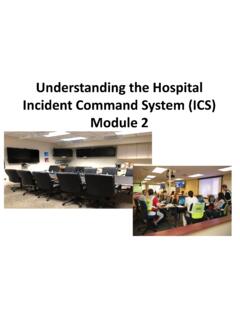
Understanding the Hospital Incident Command System
files.asprtracie.hhs.govHICS Command Staff • Incident Commander: Every incident will have an incident commander. Typically, they are the most senior person on duty at the time of the incident and have the authority to make decisions for the organization and provide overall direction for the HIMT. The first person responding to the incident fills the role of

Firescope California Incident Command System Publication
firescope.caloes.ca.govThe purpose of the Incident Command System (ICS) is to provide for a systematic development of a complete, functional command organization designed to allow for single or multi-agency use, which increases the effectiveness of command and firefighter safety. The National Incident Management System (NIMS) identifies concepts and principles that ...

National Incident Management System Incident Command …
training.fema.govThe National Incident Management System (NIMS) Incident Command System (ICS) Forms Booklet, FEMA 502-2, is designed to assist emergency response personnel in the use of ICS and corresponding documentation during incident operations. This booklet is a companion document to the NIMS ICS Field Operations Guide (FOG), FEMA 502-1, which

IS-0100.c: An Introduction to the Incident Command System ...
training.fema.govThe Incident Command System, or ICS, helps ensure integration of our response efforts. ICS is a standardized, on-scene, all-hazards approach to incident management. ICS allows all responders to adopt an integrated organizational structure that matches
What Is the Incident Command System (ICS) - SEAPRO
www.seapro.orgWhat Is the Incident Command System (ICS)? This section provides a basic overview (directly below) and material on concepts and principles. It is derived from training materials distributed by the Federal Emergency Management Agency (FEMA). 5-1999 ICS is the model tool for command, control, and coordination of a response and

ICS 100 – Incident Command System - USDA
www.usda.govThe Incident Command System (ICS) An incident is an occurrence, either human caused or by natural phenomena that requires action by emergency service personnel to prevent or minimize loss of life or damage to property and/or natural resources. Examples of incidents include: • Fire, both structural and wildfire • Hazardous material situations