
Computer Graphics Lecture Notes - Dynamic Graphics Project
Zooming in on an image made up of pixels The convention in these notes will follow that of OpenGL, placing the origin in the lower left corner, with that pixel being at location (0,0). Be aware that placing the origin in the upper left is another common convention.
Download Computer Graphics Lecture Notes - Dynamic Graphics Project

Information
Domain:
Source:
Link to this page:
Documents from same domain
Computer Graphics Lecture Notes - University of …
www.dgp.toronto.eduAffine transformations. An important case in the previous section is applying an affin e trans-′′ ′′ ′′ ′

Interaction Techniques for 3D Modeling on Large Displays
www.dgp.toronto.eduInteraction Techniques for 3D Modeling on Large Displays Tovi Grossman1,2, Ravin Balakrishnan1,2, Gordon Kurtenbach1,2, George Fitzmaurice1, ... 2D and 3D views, tape drawing as the primary curve and line creation technique, visual viewpoint markers, and continuous two-handed interaction.

Machine Learning and Data Mining Lecture Notes
www.dgp.toronto.eduCSC 411 / CSC D11 Acknowledgements Conventions and Notation Scalars are written with lower-case italics, e.g.,x. Column-vectors are written in bold, lower-case: x, and matrices are written in bold uppercase: B. The set of real numbers is represented by R; N-dimensional Euclidean space is writtenRN. Aside:
Real-Time Fluid Dynamics for Games
www.dgp.toronto.eduIn this paper we present a simple and rapid implementation of a fluid dynamics solver for game engines. Our tools can greatly enhance games by providing realistic fluid-like effects such as swirling smoke past a moving character. The potential applications are endless. Our algorithms
Introduction to Bayesian Learning - Dynamic Graphics Project
www.dgp.toronto.edugraphics, and that Bayesian machine learning can provide powerful tools. I will attempt to address some of the common concerns of this approach, and discuss the pros and cons of Bayesian modeling, and briefly discuss the relation to non-Bayesian machine learning. I will also provide a brief tutorial on probabilistic reasoning.

The Fundamental Principles of Animation
www.dgp.toronto.edudownward motion more and more rapidly (Ease Out), until it hits the ground. Note that this doesn’t mean slow movement. This really means keep the in between frames close to each extreme. 3. Arcs In the real world almost all action moves in an arc. When creating animation one should try to have motion follow curved paths rather than linear ones.
Stable Fluids - Dynamic Graphics Project
www.dgp.toronto.eduStable Fluids Jos Stam Alias wavefront Abstract Building animation tools for fluid-like motions is an important and challenging problem with many applications in computer graphics. The use of physics-based models for fluid flow can greatly assist in creating such tools. Physical models, unlike key frame or pro-
Related documents

User's Guide - PowerLite Home Cinema 5040UB/5040UBe
files.support.epson.com10 Introduction to Your Projector Refer to these sections to learn more about your projector and this manual. Projector Features Notations Used in the Documentation
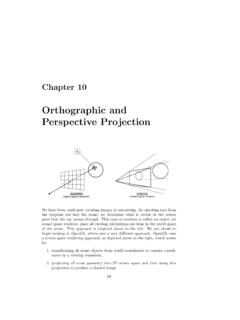
Orthographic and Perspective Projection
people.cs.clemson.eduence for processing after the projection is performed, which decouples shading and display of an image from the projection system used. The typical canon-ical view volume is a 2x2x2 cube aligned with the coordinate axes in viewing coordinates, and centered at the origin. The idea is that no matter what the
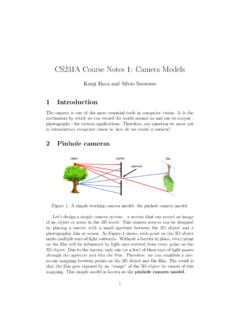
CS231A Course Notes 1: Camera Models - Stanford University
web.stanford.eduNote that the projection of the object in the image plane and the image of the object in the virtual image plane are identical up to a scale (similarity) transformation. Now, how do we use pinhole cameras? Let P = x y z T be a point on some 3D object visible to the pinhole camera. Pwill be mapped or pro-jected onto the image plane 0, resulting ...

CS231A Course Notes 3: Epipolar Geometry
web.stanford.edu2 and the image point p, we can de ne the epipolar plane. With this epipolar plane, we can then determine the epipolar lines1. By de nition, P’s projection into the second image p0must be located on the epipolar line of the second image. Thus, a basic understanding of epipolar geometry allows us to create a strong constraint between image ...
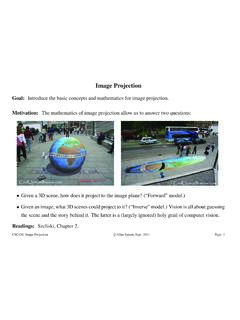
Image Projection - Department of Computer Science ...
www.cs.toronto.eduCSC420: Image Projection Notes: 9. Example: The Horizon Line As another exercise in projective geometry, we consider multiple sets of parallel lines, all of which are coplanar in 3D. We show that the images of each parallel set of lines intersect and terminate at a point on the horizon line in the image.

Epipolar (Stereo) Geometry - University of Nevada, Reno
www.cse.unr.edu-The usual equations of perspective projection define the relation between 3D points and their projections: pl = fl Zl Pl, pr = fr Zr Pr • Epipolar constraint-Giv e n pl, P can lie anywhere on the ray from Ol through pl.-The image of this ray in the right image image is the epipolar line through the corre-sponding point pr.