
Conservation Laws - MIT
42 Conservation Laws in Integral and Differential Form In most engineering applications, the physical system is governed by a set of conservation laws. For example, the gov-erning equations in gas dynamics correspond to the conservation of mass, momentum, and energy. These conservation
Download Conservation Laws - MIT

Information
Domain:
Source:
Link to this page:
Documents from same domain

Wireless Communications and Networks
web.mit.edu4 MIT Physical layer •The physical layer plays a very important role in wireless network because it has severe limitation on transmissions Uplink with respect to downlink
The Aleph - MIT
web.mit.eduThe Aleph by Jorge Luis Borges O God! ... He read me many other stanzas, each of which also won his own approval and elicited his lengthy explications.
Finite Element Method
web.mit.eduRobert Cook, Finite Element Modeling For Stress Analysis, John Wiley & Sons, 1995 Introduction to Finite Element Method, http://210.17.155.47 (in Korean)
Finite Element Analysis
web.mit.eduFinite Element Analysis David Roylance Department of Materials Science and Engineering Massachusetts Institute of Technology Cambridge, MA 02139 February 28, …

TECHNICAL & SERVICE MANUAL - MIT
web.mit.eduwhen wiring electrical shock can cause severe personal injury or death. only a qualified, experienced electrician should attempt to wire this system.
Chapter 21 Rigid Body Dynamics: Rotation and …
web.mit.eduChapter 21 Rigid Body Dynamics: Rotation and ... patience to the establishment of the laws of rotation of the solid ... general treatment of mechanics, ...
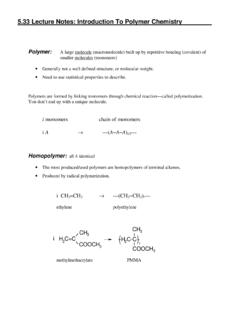
5.33 Lecture Notes: Introduction To Polymer …
web.mit.edu5.33 Lecture Notes: Introduction To Polymer Chemistry Polymer: A large molecule (macromolecule) built up by repetitive bonding (covalent) of smaller molecules (monomers) • Generally not a well defined structure, or molecular weight.
UNDERSTANDING, FINDING, & ELIMINATING …
web.mit.edua Senior Member of the Institute of Electrical and Electronic Engineers. CEDIA EST016 UNDERSTANDING, ... GROUNDING, AC POWER, AND SAFETY ...
PRESENTED AT THE 2004 AMERICAN CONTROL …
web.mit.eduPRESENTED AT THE 2004 AMERICAN CONTROL CONFERENCE 1 Internal and External Op-Amp Compensation: A Control-Centric Tutorial ... circuit operational …
Frank and Lillian Gilbreth and the Manufacture and ...
web.mit.eduFrank and Lillian Gilbreth and the Manufacture ... time study, despite its ... publicizing micro-motion study as an advance over time study and as an
Related documents
Basic Equations of Fluid Flow
chemicalengineeringdocuments.weebly.comBasic Equations of Fluid Flow By Farhan Ahmad farhanahmad@uet.edu.pk Department of Chemical Engineering, University of Engineering & Technology Lahore ... Apply Law Of Conservation Of Mass On This Small Volume Element y z x Equation of Continuity . 12

WRITING CHEMICAL EQUATIONS
chymist.combalanced so that it conforms to the Law of Conservation of Matter. That is, there must be the same number of atoms of each element on the right hand side of the equation as there are on the left hand side. If the number of atoms of each element in the equation above are counted, it is observed that there are 1 atom of Fe
THE DIFFERENTIAL EQUATIONS OF FLOW
www.columbia.eduThese equations are very useful when detailed information on a flow system is required, such as the velocity, temperature and concentration profiles. The differential equations of flow are derived by considering a differential volume element of fluid and describing mathematically a) the conservation of mass of fluid entering and leaving the control
Chapter 2 Governing Equations of Fluid Dynamics
eng.auburn.eduThese integral forms of the governing equations can be manipulated to indirectly obtain partial differential equations. The equations so obtained from the finite control volume fixed in space (left side of Fig. 2.1a), in either integral or partial differential form, are called the conservation form of the governing equations.
The Shallow Water Equations
users.oden.utexas.edu1 Derive the Navier-Stokes equations from the conservation laws. 2 Ensemble average the Navier-Stokes equations to account for the turbulent nature of ocean ow. See [1, 3, 4] for details. 3 Specify boundary conditions for the Navier-Stokes equations for a water column. 4 Use the BCs to integrate the Navier-Stokes equations over depth.

Conservation Equations of Fluid Dynamics
www.iist.ac.inConservation Equations of Fluid Dynamics A. Salih Department of Aerospace Engineering Indian Institute of Space Science and Technology, Thiruvananthapuram { February 2011 {This is a summary of conservation equations (continuity, Navier{Stokes, and energy) that govern the ow of a Newtonian uid.
Derivation of the Navier–Stokes equations - Wikipedia, the ...
www.math.ucdavis.eduThe most elemental form of the Navier–Stokes equations is obtained when the conservation relation is applied to momentum. Writing momentum as gives: where is a dyad, a special case of tensor product, which results in a second rank tensor; the divergence of a second rank tensor is again a vector (a first rank tensor)[1]. Noting that a body ...

Chapter 7 First-order Differential Equations
www.sjsu.eduHow differential equations are derived? They are derived from the three fundamental laws of physics of which most engineering analyses involve. These laws are: (1) The law of conservation of mass, (2) The law of conservation of energy, and (3) The law of conservation of momentum.