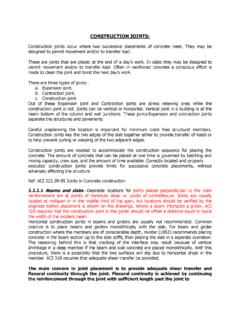
Construction Joints - Structural Engineers
Locate construction joints at high points in the floor away from drains. Where durability is critical, use fewer joints by allowing larger floor pours. Consider using waterstop at some or all joint locations. ACI requirements for construction joint design Because construction joints are most likely to reduce shear strength, they should be located
Download Construction Joints - Structural Engineers

Information
Domain:
Source:
Link to this page:
Documents from same domain
:DIFFERENT TYPES OF BRIDGES AND ITS SUITABILITY: A …
www.sefindia.org• Semi through bridges The semi-through bridge has its deck midway and the deck load is transmitted to the girder through the web of the girder.
Offshore Structural Design - Structural Engineers
www.sefindia.orgplanning, designing and constructing fixed offshore platforms The structural offshore code, Regulations of a major certifying authority. – DnV: Rules for the classification of fixed offshor e installations. – AISC: Specification for the design, fabrication an …
Types of Retaining Walls - Structural Engineers
www.sefindia.orgRetaining walls are structure used to retain soil, rock or other materials in a vertical condition. Hence they provide a lateral support to vertical slopes of soil that would otherwise collapse into a more natural shape. Most common materials used for retaining walls are:
SEISMIC DESIGN AND STEEL CONNECTION DETAILING
www.sefindia.orgDETAILING MICHAEL L.COCHRAN S.E. Introduction: Building Codes The three typical model building codes used in the United States have now merged as a single model building code: the International Building Code, commonly referred to as the IBC. The first published code edition was the 2000 IBC which has been
REINFORCEMENT HANDBOOK - Structural Engineers
www.sefindia.orgAug 02, 2012 · The Reinforcement Handbook provides information about the use of steel reinforcement when embedded in ‘plain’ concrete, in normal reinforced concrete or in prestressed concrete. Other information includes guidance on some applicable Australian Standards, design and construction tolerances, fabrication of reinforcement and tabulated

DESIGN OF HYDRO POWER PLANT
www.sefindia.orgThe backbone of most power generation system is the generator. An electric generator is “any machine that converts mechanical energy into electricity for transmission and distribution.” The generator works by spinning a rotor that is turned by a turbine. The rotor is a …
Design of confinement reinforcement for RC columns
www.sefindia.orgReinforced concrete columns are the main load bearing elements of any structure. They support the beams and ... the transverse reinforcement of columns and detail them ... required area of rectangular hoops, as given in equation 2.4 of ACI code is based on the equation for spirals

DUCTILITY REQUIREMENTS FOR BUILDINGS
www.sefindia.orgthe brittle failure as result of inelastic deformation can be avoided only if the concrete is made to behave in a ductile manner so that the member can absorb and dissipate large amount of energy. Hence in the case of reinforced concrete members subjected to inelastic deformation, not only strength but also ductility plays vital role in the design.
FLOOR DIAPHRAGMS.
www.sefindia.orgquite satisfactory, because usually diaphragm flexibility affects neither overall structural stiffness (and hence natural period) nor the distribution of forces within a structure. Moreover, during a major earthquake, in ductile structures where the diaphragms are designed to remain essentially elastic, the superstructure
Structural Design of Raft Foundation
www.sefindia.orgThis foundation will be done for a storage 5 story building. The raft will be used for economical consideration. The justification of using raft foundation will be discussed in columns loads section 3.2.0. The raft foundation is a kind of combined footing that may cover the entire area under the
Related documents

Structural Steel Sub-Grades JR, J0 & J2 Does It Matter?
www.chunwo.comstructural steel grades and sub-grades are specified using a different system to designate different steel quality. ... A steel of high strength and low ductility is brittle. Brittle fracture (see figures below) can occur in steel ... problem is mitigated by specifying steel and …
Specification for Structural Joints Using ASTM A325 or ...
www.boltcouncil.orgAssembly of Structural Joints Using High Tensile Steel Bolts, was published in January 1951. Since that time the Council has published fifteen successive editions. Each was developed through the deliberations and approval of the full Council membership and based upon past successful usage, advances in the state of knowledge and changes in

POCKET GUIDE BRICK AND CMU CONSTRUCTION
www.masonryinstitute.comC 5: Specification for Quicklime for Structural Purposes C 51: Definition of Terms Relating to Lime and Limestone C 91: Specification for Masonry Cement C 109: Test Method for Compressive Strength of Hydraulic Cement Mortars (Using 2-in. or [50-mm] Cube Specimens) Mortar and Grout 9

IS 456 (2000): Plain and Reinforced Concrete - Code of ...
law.resource.org13.4 ConstructionJointsandCold Joints 13.5 Curing 13.6 Supervision 14 CONCRETING UNDER SPECIALCosornoss 14.1 WorkinExtreme Weather Conditions 14.2 Under-WaterConcreting 15 SAMPLING AND STRENGTH OFDESIGNED CONCRETEMIX 15.1 General 15.2 Frequencyof Sampling IS.3 TestSpecimen 15.4 TestResultsof Sample 16 ACCEPTANCE CRITERIA 17 …