Coping with a Traumatic Event
There are many things you can do to cope with traumatic events. • Understand that your symptoms may be normal, especially right after the trauma. • Keep to your usual routine. • Take the time to resolve day-to-day conflicts so they do not add to your stress. • Do not shy away from situations, people and places that remind you of the trauma.
Download Coping with a Traumatic Event

Information
Domain:
Source:
Link to this page:
Documents from same domain
School Chemistry Laboratory Safety Guide
www.cdc.govSchool Chemistry Laboratory Safety Guide. October 2006. U.S. Consumer Safety Product Commission DEPARTMENT OF HEALTH AND HUMAN SERVICES. Centers for Disease Control and Prevention
Biosafety in Microbiological and Biomedical …
www.cdc.goviii. Foreword. Biosafety in Microbiological and Biomedical Laboratories (BMBL) quickly became the cornerstone of biosafety practice and policy in the United States upon first
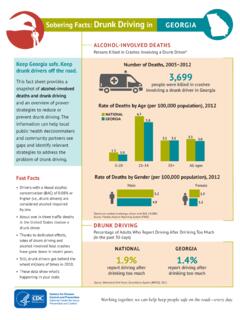
Sobering Facts: Drunk Driving in Georgia
www.cdc.govSobering Facts: Drunk Driving in GEORGIA Keep Georgia safe. Keep drunk drivers off the road. This fact sheet provides a snapshot of alcohol-involved deaths and drunk driving
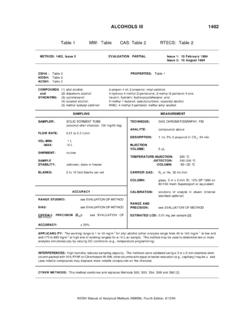
ALCOHOLS III 1402
www.cdc.govALCOHOLS III: METHOD 1402, Issue 2, dated 15 August 1994 - Page 3 of 4 a. Remove and discard back sorbent section of a media blank sampler. b. Inject a known amount of analyte or DE stock solution directly onto front sorbent section
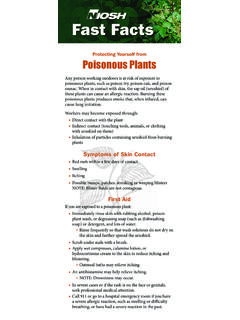
Fast Facts
www.cdc.govAny person working outdoors is at risk of exposure to poisonous plants, such as poison ivy, poison oak, and poison sumac. When in contact with skin, the sap oil (urushiol) of
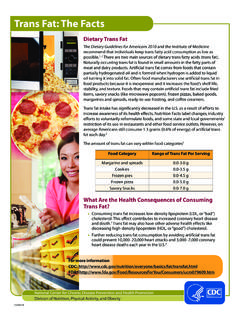
Trans Fat: The Facts
www.cdc.gov• Read the Nutrition Facts label and ingredient list to compare foods. » Choose products with 0 grams trans fat. » Check the Ingredient List to see if there is any partially hydrogenated oil in the product.
ANTIBIOTIC RESISTANCE THREATS
www.cdc.govApr 23, 2013 · 6. ANTIBIOTIC RESISTANCE THREATS IN THE UNITED STATES, 2013. Executive Summary. Antibiotic Resistance Threats in the United States, 2013. is a snapshot of the complex problem
Chlorine Residual Testing
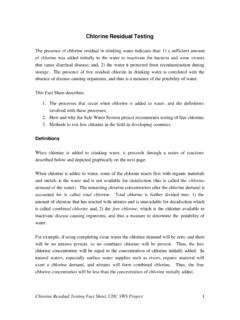
www.cdc.govChlorine Residual Testing Fact Sheet, CDC SWS Project 4 Methods to Test Free Chlorine in the Field in Developing Countries There are three main methods to test free chlorine residual in drinking water in the field
2018 Combined Recommended Immunization …
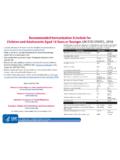
www.cdc.govRecommended Immunization Schedule for Children and Adolescents Aged 18 Years or Younger, UNITED STATES, 2018 Approved by the Advisory Committee on …
Traveling? Make Sure You Protect Yourself from …
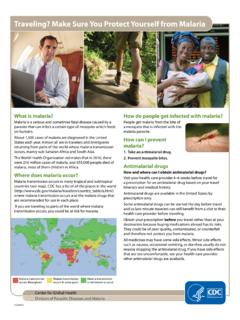
www.cdc.govCS26201 Malaria transmission occurs throughout Malaria transmission occurs in some parts Malaria transmission is not known to occur Center for Global Health
Related documents
WHAT IS ECONOMICS?
www.swlearning.comgoals of our society? We want a high standard of living for our citizens, clean air, safe streets, good schools, and more. What is holding us back from accomplishing all of these goals in a way that would satisfy everyone? You already know the an-swer: scarcity. In society’s case, the problem is a scarcity of resources—the things we use to

KS3 Science Revision Worksheets Special Edition
cbscience.weebly.com4) If living organisms did not R _ _ _ _ _ _ _ _ they would soon become extinct (die out). 5) The kidneys E _ _ _ _ _ _ a waste chemical called urea. Exercise 2 - A motor car moves but it is not living. Complete the two lists below to show which processes it does and does not show.

Living and Non-Living Activity Guide
www.nps.govclassify living and non-living things. Method By classifying things found in a classroom, students will learn to identify living versus non-living things. Background Living things have very specific characteristics. All living things need FOOD, water, reproduce, grow, move, breathe, adapt or respond to their environment, and produce

OW O ANTS MALS UNIT 7: Your Environment NEED CH OTHER?
www.alaska.edu2nd grade sequence #4: Living Things (Animals) B. Understand the needs of animals. C. Understands how we classify animals. D. Understands how animals grow and change. E. Uses scientific processes and inquiry to directly support the concepts of living things. 3rd grade sequence #4: Living Things (Animals)

Academic Standards for Science and Technology
www.stateboard.education.pa.govLiving things are made of the same components as all other matter, involve the same kinds of transformations of energy and move using the same basic kinds of forces as described in chemistry and physics standards. ... classifying, inferring, predicting, measuring, computing, estimating, communicating, using space/time relationships, defining ...

Name Score Classification
www.warrencountyschools.orgRules you need to follow when classifying g Know what is being classified. Make many observations about the things being classified. Classifyy things based on your observations. Group the most similar things together. When grouping living things, place the most similar organisms in the same species.

Answer Key Unit 1 Diversity of Living Things
earlhaig.caUnit 1 Diversity of Living Things Unit Preparation Questions (Assessing Readiness) (Student textbook pages 4–7) 1. d 2. e 3. c 4. a. Photosynthesis is the process that producers, such as plants, algae, and some bacteria, use to chemically convert carbon from carbon dioxide into glucose using light energy from the Sun. Oxygen is also

Attitudes to dementia
www.bsa.natcen.ac.uk800,000 people living with dementia, with the number predicted to double by 2040 (Department of Health, 2015). Although there is currently no known cure for dementia, there is a rapidly growing evidence base on risk reduction and protective factors which states that healthy living behaviours, such as not