
Deep Image Prior - CVF Open Access
mation contained within the activations of deep neural net-works. For this, we consider the “natural pre-image” tech-nique of [21], whose goal is to characterize the invariants learned by a deep network by inverting it on the set of nat-ural images. …
Download Deep Image Prior - CVF Open Access

Information
Domain:
Source:
Link to this page:
Documents from same domain
What Have We Learned From Deep Representations for …
openaccess.thecvf.comwhat these powerful models actually have learned. In this paper we shed light on deep spatiotemporal net-works by visualizing what excites the learned models us-ing activation maximization by backpropagating on the in-put. We are the first to visualize the hierarchical features
Finding Tiny Faces in the Wild With Generative Adversarial ...
openaccess.thecvf.comfaces, which are unfriendly for the face classifier. Toward-s this end, we design a refinement sub-network to recover some detailed information. In the discriminator network, the basic GAN [17, 12, 8] is trained to distinguish the real and fake high resolution images. To classify faces or non-
Squeeze-and-Excitation Networks - openaccess.thecvf.com
openaccess.thecvf.comSqueeze-and-Excitation Networks Jie Hu1∗ Li Shen2∗ Gang Sun1 hujie@momenta.ai lishen@robots.ox.ac.uk sungang@momenta.ai 1 Momenta 2 Department of Engineering Science, University of Oxford Abstract Convolutional neural networks are built upon the con-
RegularFace: Deep Face Recognition via Exclusive ...
openaccess.thecvf.comRegularFace: Deep Face Recognition via Exclusive Regularization Kai Zhao Jingyi Xu Ming-Ming Cheng ∗ TKLNDST, CS, Nankai University kaiz.xyz@gmail.com cmm@nankai.edu.cn
Protecting World Leaders Against Deep Fakes
openaccess.thecvf.comProtecting World Leaders Against Deep Fakes Shruti Agarwal and Hany Farid University of California, Berkeley Berkeley CA, USA {shrutiagarwal, hfarid}@berkeley.edu
Auto-DeepLab: Hierarchical Neural Architecture Search for ...
openaccess.thecvf.comAuto-DeepLab: Hierarchical Neural Architecture Search for Semantic Image Segmentation Chenxi Liu1∗, Liang-Chieh Chen 2, Florian Schroff2, Hartwig Adam2, Wei Hua2, Alan Yuille1, Li Fei-Fei3 1Johns Hopkins University 2Google 3Stanford University Abstract Recently, NeuralArchitectureSearch(NAS)hassuccess-
PointNet: Deep Learning on Point Sets ... - CVF Open Access
openaccess.thecvf.comPointNet: Deep Learning on Point Sets for 3D Classification and Segmentation Charles R. Qi* Hao Su* Kaichun Mo Leonidas J. Guibas Stanford University
Frustum PointNets for 3D Object Detection From RGB-D Data
openaccess.thecvf.comFrustum PointNets for 3D Object Detection from RGB-D Data Charles R. Qi1∗ Wei Liu2 Chenxia Wu2 Hao Su3 Leonidas J. Guibas1 1Stanford University 2Nuro, Inc. 3UC San Diego Abstract In this work, we study 3D object detection from RGB-D data in both indoor and outdoor scenes.
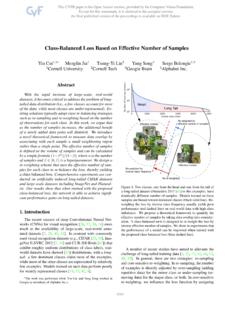
Class-Balanced Loss Based on Effective Number of Samples
openaccess.thecvf.comand large-scale datasets including ImageNet and iNatural-ist. Our results show that when trained with the proposed class-balanced loss, the network is able to achieve signifi-cant performance gains on long-tailed datasets. 1. Introduction The recent success of deep Convolutional Neural Net-works (CNNs) for visual recognition [26, 37, 38, 16] owes
ESRGAN: Enhanced Super-Resolution Generative Adversarial ...
openaccess.thecvf.comESRGAN: EnhancedSuper-Resolution Generative Adversarial Networks Xintao Wang 1, Ke Yu , Shixiang Wu2, Jinjin Gu3, Yihao Liu4, Chao Dong 2, Yu Qiao , and Chen Change Loy5 1 CUHK-SenseTime Joint Lab, The Chinese University of Hong Kong 2 Shenzhen Institutes of Advanced Technology, Chinese Academy of Sciences 3 The Chinese University of Hong Kong, …
Related documents

Learning Deep Features for Discriminative Localization
cnnlocalization.csail.mit.eduweights of the output layer on to the convolutional feature maps, a technique we call class activation mapping. As illustrated in Fig. 2, global average pooling outputs the spatial average of the feature map of each unit at the last convolutional layer. A weighted sum of these values is used to generate the final output. Similarly, we compute a
Image Style Transfer Using Convolutional Neural Networks
www.cv-foundation.orgcent advance of Deep Convolutional Neural Networks [18] ... tent in generic feature representations that generalise across datasets [6] and even to other visual information processing tasks [19, 4, 2, 9, 23], including texture recognition [5] and ... ij is the activation of the ith filter at position j in layer l.
Siamese Neural Networks for One-shot Image Recognition
www.cs.cmu.edubetween the twin feature vectors h 1 and h 2 combined with a sigmoid activation, which maps onto the interval [0;1]. Thus a cross-entropy objective is a natural choice for train-ing the network. Note that in LeCun et al., they directly learned the similarity metric, which was implictly defined by the energy loss, whereas we fix the metric as ...

SuperPoint: Self-Supervised Interest Point Detection and ...
openaccess.thecvf.comlearning problem, and the Scale-Invariant Feature Trans-form, or SIFT [15], is still probably the most well-known traditional local feature descriptor in computer vision. Our SuperPoint architecture is inspired by recent ad-vances in applying deep learning to interest point detection and descriptor learning. At the ability to match image sub-
Squeeze-and-Excitation Networks
openaccess.thecvf.comSqueeze-and-Excitation Networks Jie Hu1∗ Li Shen2∗ Gang Sun1 hujie@momenta.ai lishen@robots.ox.ac.uk sungang@momenta.ai 1 Momenta 2 Department of Engineering Science, University of Oxford Abstract Convolutional neural networks are built upon the con-

DeCAF: A Deep Convolutional Activation Feature for …
proceedings.mlr.pressDeCAF: A Deep Convolutional Activation Feature for Generic Visual Recognition (a) LLC (b) GIST (c) DeCAF 1 (d) DeCAF 6 Figure 1. This figure shows several t-SNE feature visualizations on the ILSVRC-2012 validation set. (a) LLC , (b) GIST, and features derived from our CNN: (c) DeCAF 1, the first pooling layer, and (d) DeCAF
![ABSTRACT arXiv:1409.1556v6 [cs.CV] 10 Apr 2015](/cache/preview/d/2/a/9/a/d/7/f/thumb-d2a9ad7f8b909a1967014d58c0440543.jpg)
ABSTRACT arXiv:1409.1556v6 [cs.CV] 10 Apr 2015
arxiv.orgarXiv:1409.1556v6 [cs.CV] 10 Apr 2015 Published as a conference paper at ICLR 2015 VERY DEEP CONVOLUTIONAL NETWORKS FOR LARGE-SCALE IMAGE RECOGNITION Karen Simonyan∗ & Andrew Zisserman+ Visual Geometry Group, Department of Engineering Science, University of Oxford

SuperPoint: Self-Supervised Interest Point Detection and ...
arxiv.orgcoder consists of convolutional layers, spatial downsam-pling via pooling and non-linear activation functions. Our encoder uses three max-pooling layers, letting us define H c = H=8 and W c = W=8 for an image sized H W. We refer to the pixels in the lower dimensional output as “cells,” where three 2 2 non-overlapping max pooling op-
Delving Deep into Rectifiers: Surpassing Human-Level ...
www.cv-foundation.orgmethod for deep rectifier networks (Sec. 2.2). 2.1. Parametric Rectifiers We show that replacing the parameter-free ReLU by a learned activation unit improves classification accuracy2. Definition. Formally, we define an activation function: f(yi)= yi, if yi > 0 aiyi, if yi ≤ 0. (1) Here yi is the input of the nonlinear activation f on ...