Developmental Sequence in Small Groups'
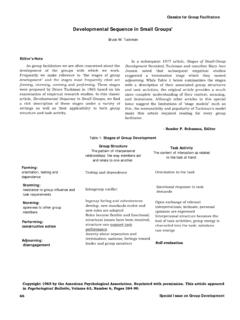
Bruce W. Tuckman Editor's Note As group facilitators we are often concerned about the development of the groups with which we work. Frequently we make reference to "the stages of group development" and the stages most frequently cited are forming, storming, norming and performing. These stages were proposed by Bruce Tuckman in 1965 based on his
Download Developmental Sequence in Small Groups'

Information
Domain:
Source:
Link to this page:
Documents from same domain
Mindfulness and Interpersonal Communication
www.communicationcache.comMindfulness and Interpersonal Communication Judee K. Burgoon* University of Arizona Charles R. Berger University of California at Davis Vincent R. Waldron
The Role of Transportation in the Persuasiveness of …
www.communicationcache.com702 GREEN AND BROCK of transportation is that parts of the world of origin become inaccessible. In other words, the reader loses access to some
Managing a virtual workplace. - Communication …
www.communicationcache.comTitle: Managing a virtual workplace. Created Date: 5/24/2001 7:58:46 PM
The Bases of Social Power - Communication Cache
www.communicationcache.comThe Bases of Social Power 261 SOCIAL POWER The strength of power of O/P in some sys tem a is defined as the maximum potential ability of O to influence P in a.
Author(s): Richard M. Emerson Source: Annual …
www.communicationcache.comSocial Exchange Theory Author(s): Richard M. Emerson Source: Annual Review of Sociology, Vol. 2 (1976), pp. 335-362 Published by: Annual Reviews
Gender and leadership? Leadership and gender? A …
www.communicationcache.comGender and leadership? Leadership and gender? A journey through the landscape of theories Steven H. Appelbaum John Molson School of Business, Concordia University, 1455 de Maisonneuve
RESISTANCE TO CHANGE: THE REST OF THE STORY
www.communicationcache.comreality (see also Goss, 1996, and Watzlawick, 1990). Change agents take actions consistent with the net presentation, reifying and objecti- ...

HANDBOOK of PSYCHOLOGY - Communication …
www.communicationcache.comviii Handbook of Psychology Preface and for persons outside of psychology seeking informa-tion about psychological matters, the Handbook volumes serve as a reference source for expanding their knowledge
Ron Fisher, Ph.D., International Peace and Conflict ...
www.communicationcache.com1 Sources of Conflict and Methods of Conflict Resolution Ron Fisher, Ph.D., International Peace and Conflict Resolution School of International Service
Attitude Change: Persuasion and Social Influence
www.communicationcache.comATTITUDE CHANGE 541 change can be motivated by normative concerns for (a) ensuring the coherence and favorable evaluation of the self, and (b) ensuring satisfactory relations …
Related documents
The Punctuated-Tuckman: Towards a New Group …
files.eric.ed.govTuckman Model In 1965, Bruce Tuckman published an article dealing with the stages of group development. In total, he analyzed 50 articles dealing with group development from three types of groups: therapy groups, training groups, and laboratory groups. Tuckman postulated that four general stages of group development could be identified within
Stages of Small-Group Development Revisited
faculty.wiu.eduTuckman’s second stage, “storming,” has for the most part been eliminated. Although Lacoursiere’s group demonstrated anger and hostility toward an outside force, Spitz and Sadock’s group appeared only to touch on themes of anger and discontent in their group discussions. It …
GROUP DEVELOPMENT THEORY
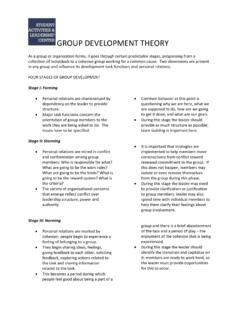
www.sdsmt.eduGROUP DEVELOPMENT THEORY As a group or organization forms, it goes through certain predictable stages, progressing from a collection of individuals to a …
Stages of Group Development
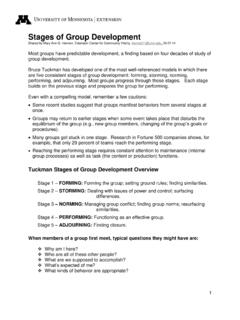
www.actonalz.orgBruce Tuckman has developed one of the most well-referenced models in which there are five consistent stages of group development: forming, storming, norming, performing, and adjourning. Most groups progress through these stages. Each stage builds on the previous stage and prepares the group for performing.
5 Stages of Group Development
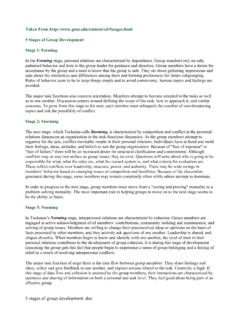
med.fsu.eduTuckman’s final stage, Adjourning, involves the termination of task behaviors and disengagement from relationships. A planned conclusion usually includes recognition for participation and achievement and an opportunity for members to say personal goodbyes. Concluding a group can create some apprehension - in effect, a minor crisis.
Study on Theory of Group Development; Groups and Teams
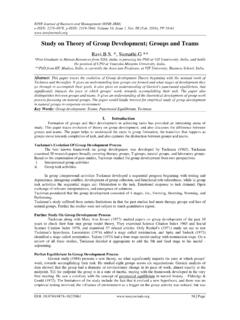
iosrjournals.orgTuckman postulated that the group development consisted of 4 stages, viz., Forming, Storming, Norming, and Performing. Tuckman‟s study suffered from certain limitations in that the past studies had more therapy groups and less of natural groups. Further the studies were not subject to much quantitative rigour.
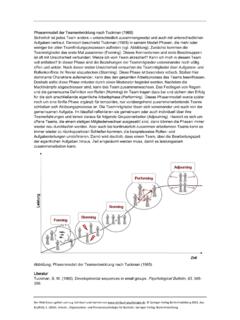
Phasenmodell der Teamentwicklung nach Tuckman (1965)
lehrbuch-psychologie.springer.comPhasenmodell der Teamentwicklung nach Tuckman (1965) Sicherlich ist jedes Team anders – unterschiedlich zusammengesetzt und auch mit unterschiedlichen Aufgaben vertraut. Dennoch beschreibt Tuckman (1965) in seinem Modell Phasen, die mehr oder weniger bei allen Teamfindungsprozessen auftreten (vgl. Abbildung). Zunächst kommen die
Unit 9: Team Building in Business
qualifications.pearson.comTo introduce Tuckman’s theory of team development you can introduce the ‘stage coach game’. In groups, learners discuss a handout on Tuckman’s stages of group development and group behaviours. Learners then attempt to correctly classify the behaviours.
Collaborative Learning Techniques - Bates College
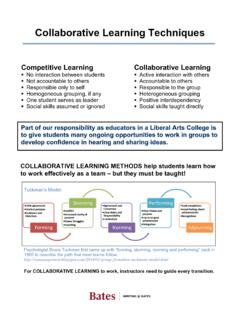
www.bates.eduTuckman’s Model: For COLLABORATIVE LEARNING to work, instructors need to guide every transition. Some Examples of Collaborative Learning Techniques: Think/Write, Pair, Share: The think/write, pair, share strategy is a cooperative
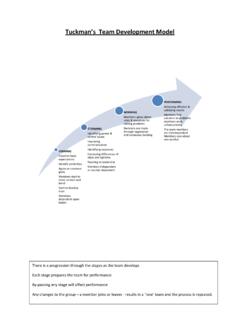
Tuckman’s Team Development Model
www.gla.ac.ukTuckman’s Team Development Model Each stage prepares the team for performance By FORMING Establish basic expectations Identify similarities Agree on common goals Members start to make contact and bond Start to develop trust Members dependent upon leader STORMING Identifying power & control issues Improving communication Identifying resources