DRI - USDA
vii PANEL ON THE DEFINITION OF DIETARY FIBER JOANNE R. LUPTON (Chair), Faculty of Nutrition, Texas A&M University, College Station GEORGE C. FAHEY, Department of Animal Sciences, University of Illinois at Urbana-Champaign DAVID J.A. JENKINS, Department of Nutritional Sciences, University of Toronto, Ontario
Download DRI - USDA

Information
Domain:
Source:
Link to this page:
Documents from same domain
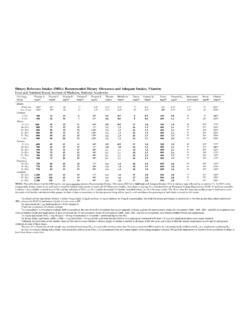
2. RDA and AIs.Vitamin and Elements - USDA
nal.usda.govj I t is aum ed thw ome nll cg400 µ f rup pl l gn y, ce on period—the critical time for formation of the neural tube. SOURCES: Dietary Reference Intakes for Calcium, Phosphorous, Magnesium, Vitamin D, and Fluoride (1997); Dietary Reference Intakes for Thiamin, Riboflavin, Niacin, Vitamin B6, Folate, Vitamin B12, Pantothenic Acid, Biotin, and Choline (1998); Dietary Reference …
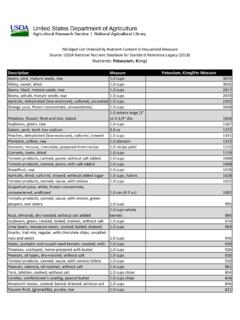
Nutrients: Potassium, K(mg) - USDA
nal.usda.govMilk, nonfat, fluid, protein fortified, with added vitamin A and vitamin D (fat free and skim) 1.0 cups 448 Pork, fresh, shoulder, whole, separable lean and fat, cooked, roasted 1.0 cups, diced 444 Fish, tuna, skipjack, fresh, cooked, dry heat 3.0 oz 444 Orange juice, chilled, includes from concentrate, with added calcium and vitamin D 1.0 cups 443
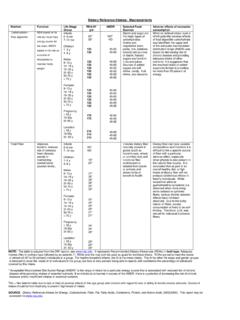
Dietary Reference Intakes: Macronutrients - USDA
nal.usda.gov50-70 y > 70 y Females 9−13 y 14−18 y 19−30 y 31-50 y 50-70 y > 70 y Pregnancy ≤ 18 y 19-30y 31-50 y Lactation ≤ 18 y 19-30y 31−50 y 60* 95* 130 130 130 ... isolated from plants or animals and benefit to health Dietary fiber can have variable compositions and therefore it is

Dietary DRI Reference Intakes - USDA
nal.usda.govDietary Reference Intakes: The Essential Guide to Nutrient Requirements ... findings, conclusions, or recommendations expressed in this publication are those of the author(s) and do not necessarily reflect the view of the organizations or agencies ... date that requires it to advise the federal government on scientific and technical matters.

GMOs 101: Your Basic Questions Answered - USDA
nal.usda.govIn 2018,4 GMO soybeans made up 94% of all soybeans planted, GMO cotton made up 94% of all cotton planted, and 92% of corn planted was GMO corn. Most GMO crops are used in food for animals like cows, chickens, and fish. They are also used to make ingredients that are then used in food products like cereal, snack chips, and vegetable oils.

Nutrients: Protein (g) - USDA
nal.usda.govVeal, shank (fore and hind), separable lean and fat, cooked, braised 3.0 oz 26.81 Turkey, drumstick, from whole bird, meat only, raw 4.0 oz 26.74
Related documents

El aparato digestivo y su funcionamiento
www.niddk.nih.govprovengan de carbohidratos. Algunos de los alimentos ricos en carbohidratos son el pan, las papas, los frijoles o guisantes secos, el arroz, la pasta, las frutas y los vegetales. Muchos de estos alimentos contienen al mismo tiempo fécula y fibra. Los carbohidratos digeribles (fécula y azúcar) se descomponen en moléculas más sencillas

MINISTERIO DE SALUD TABLAS PERUANAS DE …
www.ins.gob.pe– Cuando se cuenta con el dato de fibra dietaria, se consideran los carbohidratos disponibles. – Cuando no se tiene el dato de fibra dietaria, se consideran los carbohidratos totales. Agua: representa el contenido de agua de cada alimento, obtenido por método gravimétrico, luego de ser sometido a la acción de 105 ºC.

Índice Glucémico y Carga Glucémica - UW Family Medicine ...
www.fammed.wisc.eduefecto de ese alimento sobre los niveles de azúcar en la sangre. Los niveles de azúcar en la sangre aumentan después de comer alimentos que contienen carbohidratos (azúcares y almidones). Los distintos alimentos que contienen carbohidratos afectan de manera diferente a los niveles de azúcar en la sangre. El índice glucémico compara la ...
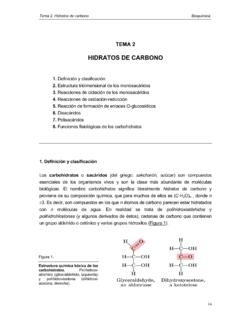
HIDRATOS DE CARBONO - UHU
uhu.esLas unidades básicas de los carbohidratos son los monosacáridos, no hidrolizables en unidades más pequeñas. La glucosa es el monosacárido más abundante; tiene 6 átomos de carbono y es el combustible principal para la mayoría de los organismos. Los oligosacáridos contienen de dos a diez unidades de monosacáridos unidas covalentemente.

LA MATERIA ORGÁNICA DEL SUELO. PAPEL DE LOS …
www.ugr.eshecha de compuestos tales como los carbohidratos, ligninas y proteínas. Los microorganismos descomponen la materia orgánica en dióxido de carbono y los residuos más resistentes en humus. Durante el proceso de descomposición los microbios pueden atrapar nitrógeno del suelo. La materia orgánica y el humus almacenan muchos nutrientes del suelo.