EE364a Homework 3 solutions - Stanford Engineering …
All feasible solutions are optimal. • The problem is feasible, and c is not in the range of AT (ˆc 6= 0). The problem is unbounded (p⋆ = −∞). To verify this, note that x = x 0 −tˆcis feasible for all t; as t goes to infinity, the objective value decreases unboundedly. In summary, p⋆ = +∞ b ∈ R(A) λTb c = ATλ for some λ
Download EE364a Homework 3 solutions - Stanford Engineering …

Information
Domain:
Source:
Link to this page:
Documents from same domain
Probability Theory Review for Machine Learning
see.stanford.eduProbability Theory Review for Machine Learning Samuel Ieong November 6, 2006 1 Basic Concepts Broadly speaking, probability theory is the mathematical study of uncertainty.

Lecture 3 Linear Equations and Matrices
see.stanford.eduso multiplication by matrix inverse solves a set of linear equations some comments: • x = A−1b makes solving set of 100 linear equations in 100 variables look simple, but the notation is hiding alot of work!
Much of this handout was written by Justin Manus and ...
see.stanford.eduDownloading Eclipse Much of this handout was written by Justin Manus and Brandon Burr. This quarter we’ll be using Stanford’s customized version of Eclipse to build our programs. Eclipse is an enormously popular industrial strength Java environment with many, many features. Fortunately, Eclipse is also open source—anyone is free to change

cvx Users’ Guide - Stanford Engineering Everywhere
see.stanford.edu1.2 What is disciplined convex programming? Disciplined convex programming is a methodology for constructing convex optimiza-tion problems proposed by Michael Grant, Stephen Boyd, and …

CS229 Lecture notes - Stanford Engineering Everywhere
see.stanford.eduwe decide to approximate y as a linear function of x: hθ(x) = θ0 +θ1x1 +θ2x2 Here, the θi’s are the parameters (also called weights) parameterizing the space of linear functions mapping from X to Y. When there is no risk of confusion, we will drop the θ …

CS 229, Public Course Problem Set #1 Solutions: Supervised ...
see.stanford.edu2. Locally-weighted logistic regression In this problem you will implement a locally-weighted version of logistic regression, where we weight different training examples differently according to the query point. The locally-weighted logistic regression problem is to maximize ℓ(θ) = − λ 2 θTθ + Xm i=1 w(i) h y(i) logh θ(x (i))+(1−y ...
Lecture 5 Least-squares - Stanford Engineering Everywhere
see.stanford.eduLeast-squares (approximate) solution • assume A is full rank, skinny • to find xls, we’ll minimize norm of residual squared, krk2 = xTATAx−2yTAx+yTy • set gradient w.r.t. x to zero: ∇xkrk2 = 2ATAx−2ATy = 0 • yields the normal equations: ATAx = ATy • assumptions imply ATA invertible, so we have xls = (ATA)−1ATy. . . a very famous formula
Convex Optimization — Boyd & Vandenberghe 3. Convex …
see.stanford.edu2. for twice differentiable functions, show ∇2f(x) 0 3. show that f is obtained from simple convex functions by operations that preserve convexity • nonnegative weighted sum • composition with affine function • pointwise maximum and supremum • composition • minimization • perspective Convex functions 3–13

Lecture 15 Symmetric matrices, quadratic forms, matrix ...
see.stanford.edu• rotate by QT • diagonal real scale (‘dilation’) by Λ • rotate back by Q decomposition A = Xn i=1 λiqiq T i expresses A as linear combination of 1-dimensional projections Symmetric matrices, quadratic forms, matrix norm, and SVD 15–5

Lecture 13 Linear dynamical systems with inputs & outputs
see.stanford.edu• output is state: y = x • unit resistors, unit capacitors • step response matrix shows delay to each node Linear dynamical systems with inputs & outputs 13–14. system is
Related documents
SOLUTIONS: Homework Assignment 2 - University of Georgia
cobweb.cs.uga.eduNOTE: All homework answers need to be word-processed or typed. Hand-writing only applies to gure or table drawings. A hard copy of answers should be received in classroom or in the instructor’s o ce by 5:00pm on the due date. Policy on late homework answers is given in the syllabus. Email submission will not be accepted unless a such a ...
Economics 181: International Trade Homework # 4 Solutions
eml.berkeley.eduNov 21, 2006 · Homework # 4 Solutions Ricardo Cavazos and Robert Santillano University of California, Berkeley Due: November 21, 2006 1. The nation of Bermuda is “small” and assumed to be unable to affect world prices. It imports strawberries at the price of 10 dollars per box. The Domestic Supply and Domestic Demand curves for boxes are: S = 60+20P D ...

Homework 4 - Solutions - University of California, Berkeley
inst.eecs.berkeley.eduEE C128 / ME C134 Spring 2014 HW4 - Solutions UC Berkeley Homework 4 - Solutions Note: Each part of each problem is worth 3 points and the homework is worth a total of 42 points. 1. State Space Representation To Transfer Function Find the transfer function and poles of the system represented in state space below. x_ = 2 6 4 8 4 1 3 2 0 5 7 9 3 ...

Homework 6 - Solutions - University of California, Berkeley
inst.eecs.berkeley.eduEE C128 / ME C134 Spring 2014 HW6 - Solutions UC Berkeley (g)No. Root Locus is always symmetric about the real axis. (h)Yes. 8. Sketching Root Loci (6 points) Sketch the general shape of the root locus for each of the open-loop pole-zero plots shown below. Please print out this page and attach it with your solutions to other problems.
SOLUTIONS FOR HOMEWORK SECTION 6.4 AND 6.5 …
people.math.umass.eduSOLUTIONS FOR HOMEWORK SECTION 6.4 AND 6.5 Problem 1: For each of the following functions do the following: (i) Write the function as a piecewise function and sketch its graph, (ii) Write the function as a combination of terms of the form u a(t)k(t a) and compute the Laplace transform (a) f(t) = t(1 u
Homework 5 Solutions - New Jersey Institute of Technology
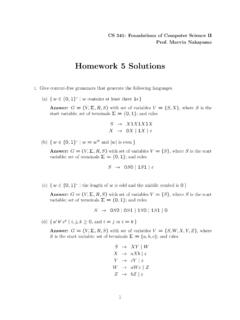
web.njit.eduNoweachofthevariablesS1 canbeusedtoderiveastringwi ∈A,i.e.,fromthe ithS1,wegetS1 ⇒∗ w i.Thus, S2 ⇒∗ S 1S1 ···S1 ntimes ⇒∗ w 1w2···wn ∈A ∗ since each wi ∈ A.Therefore, we end up with a string in A∗.Toconvince ourselves that the productions applied to the various separate S1 terms do not interfereinundesiredways,weneedonlythinkoftheparsetree.
Solutions for homework assignment #4 - Texas A&M …
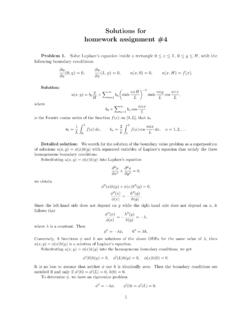
www.math.tamu.eduSolutions for homework assignment #4 Problem 1. Solve Laplace’s equation inside a rectangle 0 ≤ x ≤ L, 0 ≤ y ≤ H, with the following boundary conditions: ∂u ∂x ... of solutions u(r,θ) = h(r)φ(θ) with separated variables of Laplace’s equation that satisfy the three