Engine Heat Transfer - MIT
engines are often governed by cold start requirement • SI engine octane requirement: Heat transfer influences inlet mixture temperature, chamber , cylinder head, liner, piston and valve temperatures, and therefore end-gas temperatures, which affect knock. Heat transfer also affects build up of in-cylinder deposit which affects knock. 4
Download Engine Heat Transfer - MIT

Information
Domain:
Source:
Link to this page:
Documents from same domain

Wireless Communications and Networks
web.mit.edu4 MIT Physical layer •The physical layer plays a very important role in wireless network because it has severe limitation on transmissions Uplink with respect to downlink

The Aleph - MIT
web.mit.eduThe Aleph by Jorge Luis Borges O God! ... He read me many other stanzas, each of which also won his own approval and elicited his lengthy explications.
Finite Element Method
web.mit.eduRobert Cook, Finite Element Modeling For Stress Analysis, John Wiley & Sons, 1995 Introduction to Finite Element Method, http://210.17.155.47 (in Korean)
Finite Element Analysis
web.mit.eduFinite Element Analysis David Roylance Department of Materials Science and Engineering Massachusetts Institute of Technology Cambridge, MA 02139 February 28, …

TECHNICAL & SERVICE MANUAL - MIT
web.mit.eduwhen wiring electrical shock can cause severe personal injury or death. only a qualified, experienced electrician should attempt to wire this system.
Chapter 21 Rigid Body Dynamics: Rotation and …
web.mit.eduChapter 21 Rigid Body Dynamics: Rotation and ... patience to the establishment of the laws of rotation of the solid ... general treatment of mechanics, ...
5.33 Lecture Notes: Introduction To Polymer …
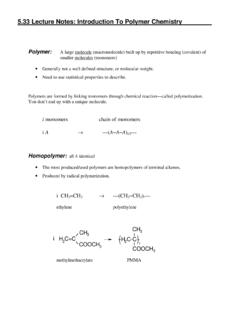
web.mit.edu5.33 Lecture Notes: Introduction To Polymer Chemistry Polymer: A large molecule (macromolecule) built up by repetitive bonding (covalent) of smaller molecules (monomers) • Generally not a well defined structure, or molecular weight.

UNDERSTANDING, FINDING, & ELIMINATING …
web.mit.edua Senior Member of the Institute of Electrical and Electronic Engineers. CEDIA EST016 UNDERSTANDING, ... GROUNDING, AC POWER, AND SAFETY ...
PRESENTED AT THE 2004 AMERICAN CONTROL …
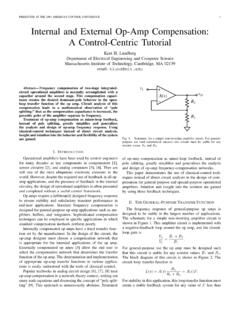
web.mit.eduPRESENTED AT THE 2004 AMERICAN CONTROL CONFERENCE 1 Internal and External Op-Amp Compensation: A Control-Centric Tutorial ... circuit operational …

Frank and Lillian Gilbreth and the Manufacture and ...
web.mit.eduFrank and Lillian Gilbreth and the Manufacture ... time study, despite its ... publicizing micro-motion study as an advance over time study and as an
Related documents

Temperature and Heat Temperature, Heat, and Expansion
phys.unm.eduHeat never spontaneously flows from a cold object to a hotter object. –Heat can be made to flow in the opposite direction, but only by doing work on the system or by adding energy from another source. Heat Engines Heat = disordered energy – random thermal motion Alternative statement of 2nd law: –No device is possible whose sole

Chapter 19. Heat Engines and Refrigerators
physics.gsu.eduHeat Engines • A heat engine is any closed-cycle device that extracts heat from a hot reservoir, does useful work, and exhausts heat to a cold reservoir. • A closed-cycle device is one that periodically returns to its initial conditions, repeating the same process over

LECTURE- 2 TWO STROKE AND FOUR STROKE ENGINES, …
www.eagri.orgTWO STROKE AND FOUR STROKE ENGINES, WORKING PRINCIPLES, APPLICATIONS - TYPES, POWER AND EFFICIENCY Heat engine is a machine for converting heat, developed by burning fuel into useful work. It can be said that heat engine is equipment which generates thermal energy and transforms it into mechanical energy. CLASSIFICATION OF HEAT …
BASIC HEAT TRANSFER AND SOME APPLICATIONS IN …
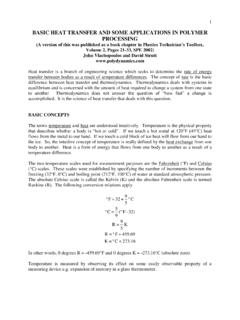
www.polydynamics.comThe efficiency of heat engines is higher if the heat source has higher temperature. However, all such actual devices have low efficiencies (e.g. combustion engines for cars, no more than 35%). In other words, only about 1/3 of the energy in gasoline goes to useful work (motion of the car). The rest is wasted due to thermodynamic implications.

Heat Exchanger Fundamentals
d6s74no67skb0.cloudfront.netheat exchangers are not widely used because of the inability to reliably seal the large gaskets between each of the plates. Because of this problem, plate type heat exchangers have only been used in small, low pressure applications such as on oil coolers for engines. However, new improvements in gasket design and overall heat exchanger

Combined Heat and Power Technology Fact Sheets Series ...
www.energy.govCombined Heat and Power Technology Fact Sheet Series Reciprocating Engines. Reciprocating internal combustion engines are a mature tech-nology used for power generation, transportation, and many other purposes. Worldwide production of reciprocating internal combustion engines exceeds 200 million units per year. 1. For

Specific Heat and Heat Capacity Worksheet
www.npsd.k12.nj.usengines. What is the specific heat of titanium in J/g°C if it takes 89.7 J to raise the temperature of a 33.0g block by 5.20°C? What is the molar heat capacity of titanium in J/mol °C? 12. When 25 mL of 1.0M H 2SO 4 is added to 50 mL of 1.0 M NaOH at 25oC in a calorimeter,

Hydrogen Fuel - Energy
www1.eere.energy.govHeat engines, such as internal combustion engines and turbines, convert chemical en-ergy into heat by way of combustion and use that heat to do useful work. The optimum (or “Carnot”) thermody-namic efficiency of a heat engine is known to be: