ENGINEERING THERMODYNAMICS
Intended as an introductory textbook for “applied” or engineering thermodynamics, or for use as an up-to-date reference for practicing engineers, this book provides extensive in-text, solved examples to cover the basic properties of thermodynamics.
Download ENGINEERING THERMODYNAMICS

Information
Domain:
Source:
Link to this page:
Documents from same domain

(Pressure of Saturated Liquid in a Tank)
uowa.edu.iqExample 12–6 / Determine the temperature of water at a state of P = 0.5 MPa and h = 2890 kJ/kg. Solution: The temperature of water at a specified state is to be determined. Analysis: At 0.5 MPa, the enthalpy of saturated water vapor is hg = 2748.1 kJ/kg. Since h > h g, as shown in ( Fig. 12- 6 ) , we again have superheated vapor. Under

Introduction to semiconductor
uowa.edu.iqThose intrinsic semiconductors to which some suitable impurity or doping agent or doping has been added in extremely small amounts (about 1 part in 108) are called extrinsic or impurity semiconductors. Depending on the type of doping material used, extrinsic semiconductors can be sub-divided into two classes: (i) N-type semiconductors and
Related documents
Chapter 20: Entropy and the Second Law of Thermodynamics
astro1.panet.utoledo.eduThe Second Law of Thermodynamics For the free expansion, we have ΔS > 0. It is an irreversible process in a closed system. For the reversible isothermal process, for the gas ΔS > 0 for expansion and ΔS < 0 for compression. However, the gas itself is not a closed system. It is only a closed system if we include both the gas and the reservoir.
Thermodynamics - NJCTL
content.njctl.orgMay 07, 2012 · (A) First Law of Thermodynamics (B) Second Law of Thermodynamics (C) Mechanical equivalent of heat (D) Zeroth Law of Thermodynamics (E) Thermal expansion of solids 2. An aluminum plate has a circular hole. If the temperature of the plate increases, what happens to the size of the hole? (A) Increases (B) Decreases (C) Stays the same
Handout 7. Entropy
micro.stanford.eduThe composition law states that we should be able to quantify the uncertainty at each step and add them together. The uncertainty in 1st step is simply S(A) = S(p 1; ;p n). The uncertainty in 2nd step depends on the outcome of the 1st step. When basket k is selected, let the uncertainty of 2nd step be S(BjA k).
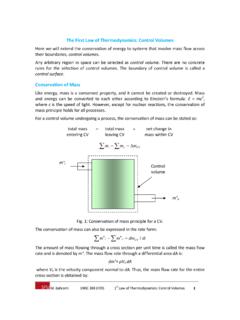
First Law of Thermodynamics Control Volumes
www.sfu.cast Law of Thermodynamics: Control Volumes 2 m V dA (kg/s) A n Assuming one‐dimensional flow, a uniform (averaged or bulk) velocity can be defined: m°= ρ V A (kg/s) where V (m/s) is the fluid velocity normal to the cross sectional area. The volume of the
UNIT 61: ENGINEERING THERMODYNAMICS
www.freestudy.co.uk2. THE FIRST LAW OF THERMODYNAMICS When you have completed section two, you should be able to explain and use the following terms. The First Law of Thermodynamics. Closed systems. The Non-Flow Energy Equation. Open systems. The Steady Flow Energy Equation. 2.1 THERMODYNAMIC SYSTEMS
THERMODYNAMICS
ncert.nic.inThermodynamics is not concerned about how and at what rate these energy transformations are carried out, but is based on initial and final states of a system undergoing the change. Laws of thermodynamics apply only when a system is in equilibrium or moves from one equilibrium state to another equilibrium state. Macroscopic properties like
Thermodynamics - Basic Concepts
durhamcollege.caIdeal Gas Law This law combines the relationships between p, V, T and mass, and gives a number to the constant! The ideal gas law is: pV = nRT , where n is the number of moles, and R is universal gas constant. The value of R depends on the units involved, but is usually stated with S.I. units as: R = 8.314 J/mol·K .
Chapter 5 The Second Law of Thermodynamics - CPP
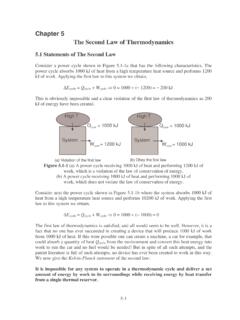
www.cpp.edulaw to this system we obtain, DE cycle = Q cycle + W cycle 0 = 1000 + (- 1000) = 0 The first law of thermodynamics is satisfied, and all would seem to be well. However, it is a fact that no one has ever succeeded in creating a device that will produce 1000 kJ of work from 1000 kJ of heat.
Chapter 1: Basic Concepts of Thermodynamics
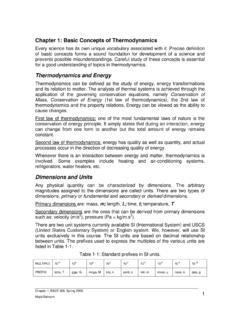
www.mhtl.uwaterloo.caFirst law of thermodynamics: one of the most fundamental laws of nature is the conservation of energy principle. It simply states that during an interaction, energy can change from one form to another but the total amount of energy remains constant. Second law of thermodynamics: energy has quality as well as quantity, and actual processes occur ...
THERMODYNAMICS PRACTICE PROBLEMS 1.
faculty.utrgv.eduTitle: Topic VIII - Page 6 Author: Gregg Wagener Created Date: 6/4/2001 12:10:18 PM