
Experiment 12: Simple Harmonic Motion
One example of a harmonic oscillator is a spring that obeys Hooke’s Law (F = −kx). The period of an ideal, massless spring is related to the spring constant, k (or spring stiffness), and the mass of the object, m, that it moves: T = 2π m k The other harmonic oscillator modeled in this experi-ment is the ideal simple pendulum, whose period is
Download Experiment 12: Simple Harmonic Motion

Information
Domain:
Source:
Link to this page:
Documents from same domain
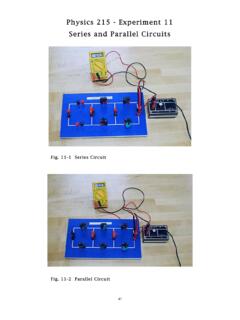
Physics 215 - Experiment 11 Series and Parallel …
www.phy.olemiss.eduPhysics 215 - Experiment 11 Series and Parallel Circuits 43 + V - Advance Reading Urone, Chapter 20, sections 20-1 & 20-4. Appendix B Computers and Software

Experiment 16: Series and Parallel Circuits
www.phy.olemiss.eduExperiment 16: Series and Parallel Circuits 85 Advance Reading Text: Resistors in series, parallel, combination. LabManual: AppendixC Appendix??-DMM Objective The objective of this lab is to study circuits with re-

Experiment 26 Reflection and Refraction
www.phy.olemiss.eduReflection and Refraction Advanced Reading: (Serway) Chapter 35, sections 35-4, ... Objective: The object of this experiment is to study the laws of reflection and refraction. Theory: The Law of Reflection states that the angle of incident ray equals the ... The Law of Refraction (Snell's Law) relates how a ray of light will behave when passing ...
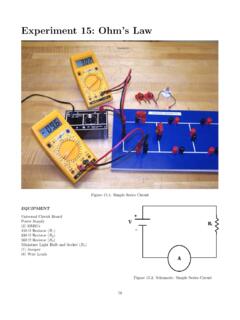
Experiment 15: Ohm’s Law - University of Mississippi
www.phy.olemiss.eduOhm’s Law states that the current, I, that flows in a circuit is directly proportional to the voltage, V, across the circuit and inversely proportional to the resistance,

Experiment 10: Archimedes’ Principle
www.phy.olemiss.edu54 Experiment 10: Archimedes’ Principle Advance Reading Text: Archimedes’ principle, buoyant force, density Objective The objective of this lab is to investigate the buoyant force acting on a variety of objects, the density of the objects, and the density of our tap water. Theory

Introduction to the Dobsonian Telescopes
www.phy.olemiss.eduIntroduction to the Dobsonian Telescopes One type of telescope that students in the astronomy class frequently use is a 10 - inch Dobsonian telescope. These telescopes are medium-size, as amateur telescopes go (the amateur rage would be 4 to 20 inches in …

Experiment 24 The Oscilloscope - University of Mississippi
www.phy.olemiss.eduExperiment 24 The Oscilloscope Advanced Reading: (Physics by Randall Knight) Chapter 15, section 15-1. You need to understand what is meant by wavelength, frequency, period and root mean square

Seebeck and Peltier Effects - Department of Physics and ...
www.phy.olemiss.edu1. Create two junctions between two different materials (as shown in Figure 1, above) by twisting wires firmly together. As shown in the diagram, you'll need one length of the first material, and two lengths of the second material. 2. Set your voltmeter to …
Experiment 15: Ohm’s Law
www.phy.olemiss.eduof about 100⌦. Once the voltage of a de-vice and your skin’s resistance are known, we can estimate the current that will flow through your body. Current E↵ect 0.001 A Can be felt 0.005 A Is painful 0.010 A Causes involuntary muscle contractions (spasms) 0.015 A Causes loss of muscle control 0.070 A If through the heart, causes serious
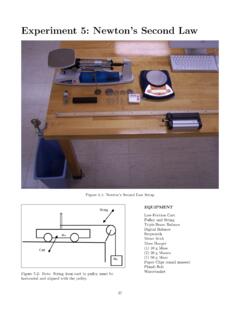
Experiment 5: Newton’s Second Law
www.phy.olemiss.edu1. State Newton’s First and Second Laws (qualitative explanations). (20 pts) 2. How is tension applied to the cart in this experiment? (15 pts) 3. How is friction compensated for in this experiment? (15 pts) 4. Should the acceleration determined in Step 5 (or any part of this experiment) be greater than, less than, or equal to the ...
Related documents
Chapter 14. Oscillations - Physics & Astronomy
physics.gsu.eduSimple Harmonic Motion A system can oscillate in many ways, but we will be especially interested in the smooth sinusoidal oscillation ... natural frequency of the oscillator. • Suppose that this system is subjected to a periodic external force of frequency fext. This frequency

Solving the Simple Harmonic Oscillator
scipp.ucsc.eduSolving the Simple Harmonic Oscillator 1. The harmonic oscillator solution: displacement as a function of time We wish to solve the equation of motion for the simple harmonic oscillator: d2x dt2 = − k m x, (1) where k is the spring constant and m is the mass of the oscillating body that is attached to the spring.
5. The Schrodinger equation
websites.umich.eduThe harmonic oscillator ... This allows us to write the energy balance equation as: E = K+V(x) = 1 2 m[v(t)]2+ 1 2 k[x(t)]2 = 1 2 mv2 0cos 2ωt+ 1 2 kx2 0sin 2ωt, (5.13) = 1 2 mv2 0 = 1 2 kx2 0. (5.14) Since hsin2()i = hcos2()i = 1 2 we can also write: hKi = hVi = E 2. (5.15) This means that the spring is a machine that equipartitions the ...
Chapter 5 Harmonic Oscillator and Coherent States
homepage.univie.ac.atHarmonic Oscillator and Coherent States 5.1 Harmonic Oscillator In this chapter we will study the features of one of the most important potentials in physics, it’s the harmonic oscillator potential which is included now in the Hamiltonian V(x) = m!2 2 x2: (5.1) There are two possible ways to solve the corresponding time independent Schr odinger
9. Harmonic Oscillator - MIT OpenCourseWare
ocw.mit.edu9.1.1 Classical harmonic oscillator and h.o. model A classical h.o. is described by a potential energy V = 1kx2. If the system has a finite energy E, the motion is bound 2 by two values ±x0, such that V(x0) = E. The equation of motion is given by mdx2 dx2 = −kxand the kinetic energy is of course T= 1mx˙2 = p 2 2 2m. The energy is constant ...

Simple Harmonic Motion - University of Oklahoma
www.nhn.ou.eduThe simple harmonic oscillator is an example of conservation of mechanical energy. When the spring is stretched it has only potential energy U = (1/2)kx2 = (1/2)kA2 where A is the maximum amplitude. When the spring is unstretched, it has only kinetic energy K = (1/2)mv2 = (1/2)mv 0

Harmonic Oscillator Physics - Reed College
www.reed.eduHarmonic Oscillator Physics Lecture 9 Physics 342 Quantum Mechanics I Friday, February 12th, 2010 For the harmonic oscillator potential in the time-independent Schr odinger equation: 1 2m ~2 d2 (x) dx2 + m2!2 x2 (x) = E (x); (9.1) we found a ground state 0(x) = Ae m!x2 2~ (9.2) with energy E 0 = 1 2 ~!. Using the raising and lowering operators ...
AN2867 Application note
www.st.comThe harmonic oscillator family can be divided into two main sub-families: negative-resistance oscillators positive-feedback oscillators. These two sub-families of oscillators are similar for what concerns the output waveform. They deliver an oscillating waveform at the desired frequency. This waveform is typically