
Experiment 12: Simple Harmonic Motion
gravity that acts perpendicular to the pendulum arm: F = −mgsinθ. For small angles, this force is directly proportional to displacement because sinθ ≈ θ. To verify this, convert 20 to radians, then compute the sine of the angle. (5 pts) θ = sinθ = % Diff …
Download Experiment 12: Simple Harmonic Motion

Information
Domain:
Source:
Link to this page:
Documents from same domain
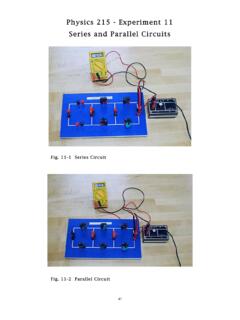
Physics 215 - Experiment 11 Series and Parallel …
www.phy.olemiss.eduPhysics 215 - Experiment 11 Series and Parallel Circuits 43 + V - Advance Reading Urone, Chapter 20, sections 20-1 & 20-4. Appendix B Computers and Software

Experiment 16: Series and Parallel Circuits
www.phy.olemiss.eduExperiment 16: Series and Parallel Circuits 85 Advance Reading Text: Resistors in series, parallel, combination. LabManual: AppendixC Appendix??-DMM Objective The objective of this lab is to study circuits with re-

Experiment 26 Reflection and Refraction
www.phy.olemiss.eduReflection and Refraction Advanced Reading: (Serway) Chapter 35, sections 35-4, ... Objective: The object of this experiment is to study the laws of reflection and refraction. Theory: The Law of Reflection states that the angle of incident ray equals the ... The Law of Refraction (Snell's Law) relates how a ray of light will behave when passing ...
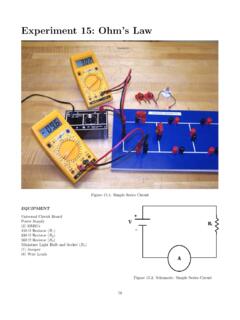
Experiment 15: Ohm’s Law - University of Mississippi
www.phy.olemiss.eduOhm’s Law states that the current, I, that flows in a circuit is directly proportional to the voltage, V, across the circuit and inversely proportional to the resistance,

Experiment 10: Archimedes’ Principle
www.phy.olemiss.edu54 Experiment 10: Archimedes’ Principle Advance Reading Text: Archimedes’ principle, buoyant force, density Objective The objective of this lab is to investigate the buoyant force acting on a variety of objects, the density of the objects, and the density of our tap water. Theory

Introduction to the Dobsonian Telescopes
www.phy.olemiss.eduIntroduction to the Dobsonian Telescopes One type of telescope that students in the astronomy class frequently use is a 10 - inch Dobsonian telescope. These telescopes are medium-size, as amateur telescopes go (the amateur rage would be 4 to 20 inches in …

Experiment 24 The Oscilloscope - University of Mississippi
www.phy.olemiss.eduExperiment 24 The Oscilloscope Advanced Reading: (Physics by Randall Knight) Chapter 15, section 15-1. You need to understand what is meant by wavelength, frequency, period and root mean square

Seebeck and Peltier Effects - Department of Physics and ...
www.phy.olemiss.edu1. Create two junctions between two different materials (as shown in Figure 1, above) by twisting wires firmly together. As shown in the diagram, you'll need one length of the first material, and two lengths of the second material. 2. Set your voltmeter to …
Experiment 15: Ohm’s Law
www.phy.olemiss.eduof about 100⌦. Once the voltage of a de-vice and your skin’s resistance are known, we can estimate the current that will flow through your body. Current E↵ect 0.001 A Can be felt 0.005 A Is painful 0.010 A Causes involuntary muscle contractions (spasms) 0.015 A Causes loss of muscle control 0.070 A If through the heart, causes serious
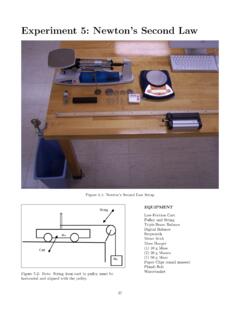
Experiment 5: Newton’s Second Law
www.phy.olemiss.edu1. State Newton’s First and Second Laws (qualitative explanations). (20 pts) 2. How is tension applied to the cart in this experiment? (15 pts) 3. How is friction compensated for in this experiment? (15 pts) 4. Should the acceleration determined in Step 5 (or any part of this experiment) be greater than, less than, or equal to the ...
Related documents

Map Patterns and Finding the Strike and Dip from a Mapped ...
websites.pmc.ucsc.eduShallow slopes increase the ap-parent thickness observed on the map. Steeper slopes show an apparent thickness closer to the true thickness (with the vertical cross-section on the side of the block showing the true ... not perpendicular to strike, but you know the strike and can observe the apparent dip, you can determine the true dip.

Graphing Linear Equations - St. Francis Preparatory School
www.sfponline.orgIV. Parallel and Perpendicular Lines: A. Parallel Lines * Do not intersect * Have same slopes For the given line, find a line that is parallel and passes through the given point and graph Given Line: Parallel: Given Line: Parallel: 7) y = ⅓ x + 4 (6,1) 8) y = 4x – 5 (2,13)