
Extraction Technologies for
Medicinal plants are the richest bioresource of drugs for tra-ditional systems of medicine, modern medicines, nutraceuticals, food sup-plements, folk medicines, pharmaceutical intermediates and chemical enti-ties for synthetic drugs. Aromatic plants are a source of fragrances, fl avors,
Download Extraction Technologies for

Information
Domain:
Source:
Link to this page:
Documents from same domain
A practical guidebook
www.unido.orgComplying with ISO 17025 is a guidebook written to assist testing and calibration laboratories set up a quality management system that conforms to ISO 17025:2005, the international standard for laboratory quality systems. Compliance with this standard provides a globally accepted basis for laboratory accreditation. The standard specifies the

(CEM
www.unido.orgInterested parties may submit an Expression of Interest (EOI) containing the following: Completed application form (see Appendix 1) Supporting documents describing relevant work (if desired) Interested participants should have relevant …

MONDAY TUESDAY WEDNESDAY THURSDAY FRIDAY
www.unido.orgST PLENARY MEETING Opening of the session UNIDO 55th Anniversary Keynote address by Director General Statements by Heads of State and Government General Debate GENERAL COMMITTEE ND PLENARY MEETING Thematic event Women as levers of change for a sustainable industry during COVID-19 and beyond: UNIDO

Small-scale Fruit and Vegetable Processing and Products
www.unido.org2. It is a reference manual to assist these entrepreneurs to continue to improve the technical aspects of their businesses after training. 3. It is a reference manual that outlines practices and procedures for the production of safe, high quality fruit and vegetable-based processed products and for development of

MODÈLE DE MÉMORANDUM D’ACCORD DE COOPÉRATION …
www.unido.org- 2 - Article premier (Objectif) 1. Les Partenaires conviennent de coopérer étroitement et de se consulter sur les questions d’intérêt mutuel afin d’atteindre leurs objectifs communs, qui sont notamment les suivants:

THE IMPORTANCE OF MANUFACTURING IN ECONOMIC …
www.unido.orgplaying a less important role due to its weakened ability to boost economic growth. If both (A) and (B) are rejected, we could conclude that the importance of manufacturing in developing countries’ economic growth has not changed. In that case, we could claim that
INTRODUCTION TO TREATMENT OF TANNERY EFFLUENTS
www.unido.orgReverse osmosis (RO): principle, diagram, photo of a small RO unit Annex 12. Schematic view of constructed wetland – reed beds Annex 13. Aerated static composting pile ... Before turning to treatment itself, it is important to bear in mind the following: • The design of an effluent treatment plant (ETP) is always tailored to the ...

Module18 - unido.org
www.unido.orgAppliance standards Building standards Efficiency programmes 15% of annual electricity use in California in 2003 FigureII. Totalelectricitysales,percapita,intheUnitedStatesandCalifornia between1960and2001 0 2,000 4,000 6,000 8,000 10,000 12,000 14,000 1 9 6 0 2 4 6 8 7 8 9 2 0 0 0 2 0 0 2 2 0 0 4 Year K W h United States California

Practical Guide for Implementing an Energy Management …
www.unido.organagement system.3.4.1 Roles, responsibility and authorityThe successful implementation of an energy management system will require the co. mitment and efort of sta at every level of the …
Related documents

The Best 100 Philippine Medicinal Plants
www.map-abcdf.com.phMedicinal Plants: Philippines’ Natural Living Treasures •Around 1,500 medicinal plants from more than 13,500 plant species in the Philippines of which more than 3,500 are considered indigenous •Only 120 medicinal plants (12.5%) have been scientifically validated for safety and efficacy •Only 10 medicinal plants have been promoted by
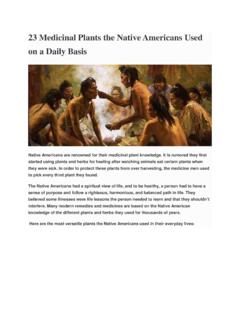
23 Medicinal Plants the Native Americans Used on a Daily Basis
efotg.sc.egov.usda.gov23 Medicinal Plants the Native Americans Used on a Daily Basis Native Americans are renowned for their medicinal plant knowledge. It is rumored they first started using plants and herbs for healing after watching animals eat certain plants when they were sick. In order to protect these plants from over harvesting, the medicine men used

EDIBLE AND MEDICINAL PLANTS - LostWays Community
lostwayscommunity.comEDIBLE PLANTS Acacia Acacia farnesiana Description: Acacia is a spreading, usually short tree with spines and alternate compound leaves. Its individual leaflets are small. Its flowers are ball-shaped, bright yellow, and very
Medicinal Plants of North America
vetmed.tamu.eduLong history of use as a medicinal plants by many Native Americans including the Blackfeet, Menominee, Ojibwa, Winnebago and others. Used for skin infections and minor wounds infections caused by dental caries and gingivitis excessive flatulence
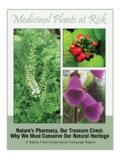
Medicinal Plants at Risk - Center for Biological Diversity
www.biologicaldiversity.orgMEDICINAL PLANTS AT RISK NATURE’S PHARMACY, OUR TREASURE CHEST drugs, at least 118 are based on natural sources: 74 percent come from plants, 18 percent from fungi, 5 percent from bacteria, and 3 percent from vertebrate species such as snakes or frogs (Ecology Society of America, 1997). The life-saving benefits of this treasure trove are
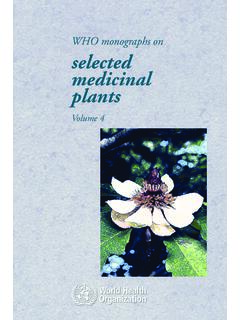
WHO monographs on selected medicinal plants
www.who.intgraphs on medicinal plants commonly used in NIS have been completed and will be published soon. Based on the NIS countries model, in the fu-ture, WHO would like to cooperate with more countries or regions to develop their monographs on commonly used medicinal plants. Preparation of monographs for volume 4 Selection of medicinal plants

WHO published Volume 1 of the medicinal plants, containing ...
www.who.intmedicinal plants, containing 28 monographs, in 1999, and Volume 2 including 30 monographs in 2002. This third volume contains an additional collection of 32 monographs describing the quality control and use of selected medicinal plants. Each monograph contains two parts, the first of …