
FINITE ELEMENT METHOD - IIST
Direct Approach to Finite Element Method 2.1 Introduction The direct approach is related to the “direct stiffness method” of structural analysis and it is the easiest to understand when meeting FEM for the first time. The main advantage of this approach is that you can get a feel of basic techniques and the essential concept involved in
Download FINITE ELEMENT METHOD - IIST

Information
Domain:
Source:
Link to this page:
Documents from same domain

FORMAT FOR PREPARATION OF PROJECT REPORT
www.iist.ac.inFORMAT FOR PREPARING THE INTERNSHIP PROJECT REPORT ... 3.1 Cover Page & Title Page – A specimen copy of the Cover page & Title page of the ... as per the format in Appendix 2. The certificate shall carry the supervisor‟s signature and HoD's signature fro projects done in IIST and signatures of equivalent people if it is done outside IIST.

Conservation Equations of Fluid Dynamics
www.iist.ac.inConservation Equations of Fluid Dynamics A. Salih Department of Aerospace Engineering Indian Institute of Space Science and Technology, Thiruvananthapuram { February 2011 {This is a summary of conservation equations (continuity, Navier{Stokes, and energy) that govern the ow of a Newtonian uid.

Delta Function and Heaviside Function - IIST
www.iist.ac.inIf the delta function is acting at the origin, i.e., if a =0, the regularized delta function defined by (15) becomes δε(x)= 1 2ε 1+cos πx ε if −ε<x <ε, 0 otherwise. (17) Another example of regularized delta function is a sequence of bell-shaped pulses defined as δk(x−a)= 1 k √ 2π e− 1 2(x−a k) 2 (18) where k is a parameter.

Streamfunction-Vorticity Formulation
www.iist.ac.inThe relation connecting the streamfunction and vorticity (6) is listed below: ¶2y ¶x2 ¶2y ¶y2 = w (15) Equations (14) and (15) form the system PDEs for streamfunction-vorticity formulation.

Method of Characteristics - Home | IIST
www.iist.ac.inThe method of characteristics is a technique for solving hyperbolic partial differential equa-tions (PDE). Typically the method applies to first-order equations, although it is valid for any 3. hyperbolic-type PDEs. The method involves the determination of special curves, called char-

Kelvin–Helmholtz Instability - IIST
www.iist.ac.inkinematic boundary condition which states that the interface moves up and down with a velocity ... complex wave speed. Note that hˆ is the original amplitude of the interface displacement and is a constant. It speci es the size of all perturbed quantities. When c

FORMAT FOR PREPARATION OF PROJECT REPORT
www.iist.ac.in3.2 Bonafide Certificate – The Bonafide Certificate shall be in double line spacing Times New Roman using Font Style and Font Size 14, as per the format in Appendix 2. The certificate shall carry the supervisor‟s signature and HoD's signature fro projects done in IIST and signatures of equivalent people if it is done outside IIST.
Tridiagonal Matrix Algorithm - Indian Institute of Space ...
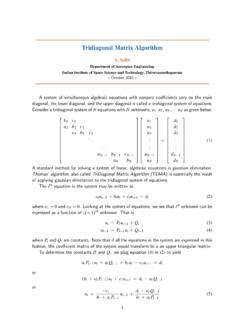
www.iist.ac.inThomas’ algorithm, also called TriDiagonal Matrix Algorithm (TDMA) is essentially the result of applying gaussian elimination to the tridiagonal system of equations. The ith equation in the system may be written as a iu i 1 + b iu i + c iu i+1 = d i (2) where a 1 =0 and c N =0. Looking at the system of equations, we see that ith unknown can be

Second-Order Wave Equation - Indian Institute of Space ...
www.iist.ac.inthe domain is infinite. In this method, a canonical form of the wave equation (3) is first obtained using a suitable transformation. The canonical form enable us to easily integrate the equation to obtain the general solution. Below we give a brief description of the solution method. We can factor the linear differential operators of (3) to ...
Related documents
Finite Element Method - MIT - Massachusetts Institute of ...
web.mit.edu16.810 (16.682) 14 Brief History - The term finite element was first coined by clough in 1960. In the early 1960s, engineers used the method for approximate solutions of problems

Chapter 2 – Introduction to the Stiffness (Displacement ...
www.ce.memphis.eduThe Stiffness (Displacement) Method 1.Select Element Type-Consider the linear spring shown below. The spring is of length L and is subjected to a nodal tensile force, T directed along the x-axis. f1x 2x f Note: Assumed sign conventions The Stiffness (Displacement) Method 2.Select a Displacement Function-A displacement function u(x) is assumed ...
Introduction to the Finite Element Method
csml.berkeley.eduContents 1 Introduction to the Finite Element Method 1 1.1 Historical perspective: the origins of the finite element method . . . . . . . . 1 1.2 Introductory ...
FINITE ELEMENT ANALYSIS OF STRESSES IN BEAM …
upcommons.upc.eduFinite element analysis of stresses in beam structures 7 3 FINITE ELEMENT METHOD In order to solve the elastic problem, the finite element method will be used with modelling and discretization of the object under study. One- and two-dimensional elements are needed, so the basics of both are going to be described [16].
Speech Recognition Using Deep Learning Algorithms
cs229.stanford.eduIntroduction Automatic speech recognition, translating of spoken words into text, is still a challenging task due ... After the cosine transform the first element represents the average of the log-energy of the frequency bins. This is sometimes replaced by ... A HMM is a stochastic finite state automatonbuilt from a

Introduction to Finite Element Analysis for University ...
www.mscsoftware.com• The Finite Element Method (FEM) is a numerical approximation method. It is a method of investigating the behavior of complex structures by breaking them down into smaller, simpler pieces. • These smaller pieces of structure are called elements. The elements are connected to each other at the nodes. • The assembly of elements and nodes ...

Objectives 4 Perceptron Learning Rule
hagan.okstate.educontribution was the introduction of a learning rule for training perceptron networks to solve pattern recognition problems [Rose58]. ... terns into a finite number of classes. This is especially useful in such appli- ... th element of the network output vector as pa 1 AA n AA W AA b R x 1 S x R S x 1 S x 1 S x 1 Input RSAA AA AA a = hardlim
Finite Volume Method: A Crash introduction
www.wolfdynamics.comFinite Volume Method: A Crash introduction Profile assumptions using Taylor expansions around point P (in space) and point t (in time) • Hereafter we are going to assume that the discretization practice is at least second order accurate in space and time. • As consequence of the previous requirement, all dependent variables are assumed
Introduction to Finite Element Analysis in Solid Mechanics
www.brown.edu2.1 Introduction The finite element method (FEM) is a computer technique for solving partial differential equations. One application is to predict the deformation and stress fields within solid bodies subjected to external forces.