FINITE ELEMENT METHOD - IIST
1.2. FINITE ELEMENT METHOD 5 1.2 Finite Element Method As mentioned earlier, the finite element method is a very versatile numerical technique and is a general purpose tool to solve any type of physical problems. It can be used to solve both field problems (governed by differential equations) and non-field problems.
Download FINITE ELEMENT METHOD - IIST

Information
Domain:
Source:
Link to this page:
Documents from same domain

FORMAT FOR PREPARATION OF PROJECT REPORT
www.iist.ac.inFORMAT FOR PREPARING THE INTERNSHIP PROJECT REPORT ... 3.1 Cover Page & Title Page – A specimen copy of the Cover page & Title page of the ... as per the format in Appendix 2. The certificate shall carry the supervisor‟s signature and HoD's signature fro projects done in IIST and signatures of equivalent people if it is done outside IIST.

Conservation Equations of Fluid Dynamics
www.iist.ac.inConservation Equations of Fluid Dynamics A. Salih Department of Aerospace Engineering Indian Institute of Space Science and Technology, Thiruvananthapuram { February 2011 {This is a summary of conservation equations (continuity, Navier{Stokes, and energy) that govern the ow of a Newtonian uid.

Delta Function and Heaviside Function - IIST
www.iist.ac.inIf the delta function is acting at the origin, i.e., if a =0, the regularized delta function defined by (15) becomes δε(x)= 1 2ε 1+cos πx ε if −ε<x <ε, 0 otherwise. (17) Another example of regularized delta function is a sequence of bell-shaped pulses defined as δk(x−a)= 1 k √ 2π e− 1 2(x−a k) 2 (18) where k is a parameter.

Streamfunction-Vorticity Formulation
www.iist.ac.inThe relation connecting the streamfunction and vorticity (6) is listed below: ¶2y ¶x2 ¶2y ¶y2 = w (15) Equations (14) and (15) form the system PDEs for streamfunction-vorticity formulation.

Method of Characteristics - Home | IIST
www.iist.ac.inThe method of characteristics is a technique for solving hyperbolic partial differential equa-tions (PDE). Typically the method applies to first-order equations, although it is valid for any 3. hyperbolic-type PDEs. The method involves the determination of special curves, called char-

Kelvin–Helmholtz Instability - IIST
www.iist.ac.inkinematic boundary condition which states that the interface moves up and down with a velocity ... complex wave speed. Note that hˆ is the original amplitude of the interface displacement and is a constant. It speci es the size of all perturbed quantities. When c

FORMAT FOR PREPARATION OF PROJECT REPORT
www.iist.ac.in3.2 Bonafide Certificate – The Bonafide Certificate shall be in double line spacing Times New Roman using Font Style and Font Size 14, as per the format in Appendix 2. The certificate shall carry the supervisor‟s signature and HoD's signature fro projects done in IIST and signatures of equivalent people if it is done outside IIST.
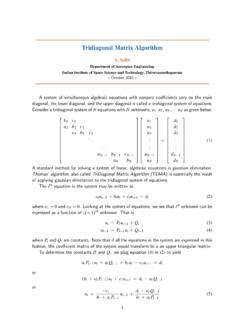
Tridiagonal Matrix Algorithm - Indian Institute of Space ...
www.iist.ac.inThomas’ algorithm, also called TriDiagonal Matrix Algorithm (TDMA) is essentially the result of applying gaussian elimination to the tridiagonal system of equations. The ith equation in the system may be written as a iu i 1 + b iu i + c iu i+1 = d i (2) where a 1 =0 and c N =0. Looking at the system of equations, we see that ith unknown can be

Second-Order Wave Equation - Indian Institute of Space ...
www.iist.ac.inthe domain is infinite. In this method, a canonical form of the wave equation (3) is first obtained using a suitable transformation. The canonical form enable us to easily integrate the equation to obtain the general solution. Below we give a brief description of the solution method. We can factor the linear differential operators of (3) to ...
Related documents
The Finite Element Method: Its Basis and Fundamentals
yjs.jxust.edu.cnThe Finite Element Method: Its Basis and Fundamentals Sixth edition O.C. Zienkiewicz,CBE,FRS UNESCO Professor of Numerical Methods in Engineering International Centre for Numerical Methods in Engineering,Barcelona Previously Director of the Institute for Numerical Methods in Engineering University ofWales,Swansea R.L.Taylor J.Z. Zhu

Introduction to Finite Element Modeling
lwlin.me.berkeley.eduThe finite element method (FEM) is the dominant discretization technique in structural mechanics. The basic concept in the physical interpretation of the FEM is the subdivision of the mathematical model into disjoint (non -overlapping) components of simple geometry called finite elements or elements for short. The response of each element is
Fundamentals of Finite Element Methods
pdhonline.comFinite Element Method is a powerful engineering analysis tool, and has been widely used in engineering since it was introduced in the 1950s. This course presents the basic theory and simple application of Finite Element Method (FEM) along with common FEM terminology. The
Meshing for the Finite Element Method
people.sc.fsu.eduThe name " nite element method" is meant to suggest the technique we apply to all problems. That is, we look at the geometry, the shape of a region, and immediately imagine it broken down into smaller subregions. The idea is that we are going to use a simple approximation method, but the errors in this approximation method become
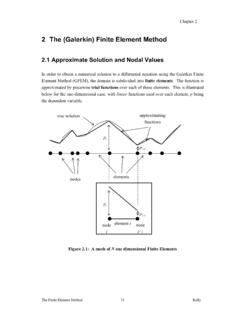
2 The (Galerkin) Finite Element Method - Auckland
pkel015.connect.amazon.auckland.ac.nzThe Finite Element Method Kelly 35 (3) choose the order of interpolation (e.g. linear, quadratic, etc.) and corresponding shape functions Ni ,i 1 m, with trial function m i i i p p x N x p 1 ~() (4) evaluate all integrals over each element, either exactly or numerically, to set up a system of equations in the unknown pi ’s
Chapter 3 Classical Variational Methods and the Finite ...
vtechworks.lib.vt.edufinite element method. 3.3.1 The Rayleigh-Ritz Method Before delving into the Rayleigh-Ritz method, a short historical perspective (summarized from Meirovitch (1997)) is in order. The method was first used by Lord Rayleigh in 1870 (Gould, 1995) to solve the vibration problem of organ pipes closed on one end and open at the other.
Programing the Finite Element Method with Matlab
www.math.purdue.eduPrograming the Finite Element Method with Matlab Jack Chessa 3rd October 2002 1 Introduction The goal of this document is to give a very brief overview and direction in the writing of nite element code using Matlab. It is assumed that the reader has a basic familiarity with the theory of the nite element method,