FLUID MECHANICS TUTORIAL 9 COMPRESSIBLE FLOW
You should already be familiar with the theory of work laws in closed systems. You should know that the area under a pressure-volume diagram for a reversible expansion or compression gives the work done during the process. In thermodynamics there are two forms of energy transfer, work (W) and heat (Q). By
Download FLUID MECHANICS TUTORIAL 9 COMPRESSIBLE FLOW

Information
Domain:
Source:
Link to this page:
Documents from same domain
UNIT 22: PROGRAMMABLE LOGIC CONTROLLERS …
www.freestudy.co.ukD.J.DUNN 1 UNIT 22: PROGRAMMABLE LOGIC CONTROLLERS Unit code: A/601/1625 QCF level: 4 Credit value: 15 TUTORIAL – OUTCOME 2 Part 2 This work covers part of outcome 2 of the Edexcel standard module.
UNIT 22: PROGRAMMABLE LOGIC CONTROLLERS …
www.freestudy.co.ukD.J.DUNN 2 1. INTRODUCTION Programming a PLC is helped by various aids such as LOGIC CIRCUITS, LADDER DIAGRAMS, TRUTH TABLES and …
INTRODUCTION TO BEAMS - FREE STUDY
www.freestudy.co.uk© D.J.DUNN freestudy.co.uk 2 1 TYPES OF BEAMS A beam is a structure, which is loaded transversely (sideways). The loads may be …
EDEXCEL NATIONAL CERTIFICATE/DIPLOMA …
www.freestudy.co.uk© d.j.dunn www.freestudy.co.uk 1 edexcel national certificate/diploma further mechanical principles and applications unit 11 - nqf level 3 outcome 3 - rotating systems
EDEXCEL NATIONAL CERTIFICATE UNIT 10: …
www.freestudy.co.uk© d.j.dunn www.freestudy.co.uk 1 edexcel national certificate unit 10: properties and applications of engineering materials nqf level 3 outcome 1 - tutorial 1
INSTRUMENTATION AND CONTROL TUTORIAL 2 - …
www.freestudy.co.ukINSTRUMENTATION AND CONTROL TUTORIAL 2 – ELECTRIC ACTUATORS This is a stand alone tutorial on electric motors and actuators. The tutorial is of interest to
UNIT 61: ENGINEERING THERMODYNAMICS - FREE …
www.freestudy.co.uk© D.J.Dunn www.freestudy.co.uk 1 UNIT 61: ENGINEERING THERMODYNAMICS Unit code: D/601/1410 QCF level: 5 Credit value: 15 OUTCOME 4 STEAM AND GAS TURBINE POWER PLANT
Unit 24: Applications of Pneumatics and Hydraulics
www.freestudy.co.uk© D.J.DUNN 2 DIRECTIONAL VALVES 1. INTRODUCTION Valves are necessary to control the pressure, flow rate and direction of the fluid. Hydraulic valves are made
DYNAMICS TUTORIAL DAMPED VIBRATIONS Exam …
www.freestudy.co.ukSOLID MECHANICS DYNAMICS TUTORIAL – DAMPED VIBRATIONS This work covers elements of the syllabus for the Engineering Council Exam D225 – Dynamics of Mechanical Systems, C105 Mechanical and
SOLID MECHANICS DYNAMICS TUTORIAL …
www.freestudy.co.uk1.2 FREE VIBRATIONS- EXAMPLES A free vibration is one that occurs naturally with no energy being added to the vibrating system. The vibration is started by some input of energy but the vibrations die away with time as the energy
Related documents
HEAT AND MASS TRANSFER - UPM
webserver.dmt.upm.es• A temperature increase in a closed system is not necessarily due to a heat input; it can be due to a work input (e.g. ∆E=mc∆T=W for Q=0 in (1)), either with dissipation (e.g. internal stirring), or without (isentropic compression). • The First Law (1) shows that, for a steady state without work exchange,the heat loss by a system
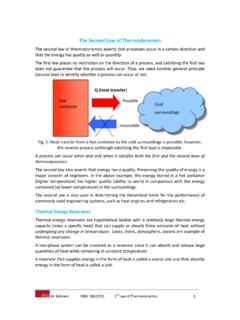
Second Law of Thermodynamics - Simon Fraser University
www.sfu.caThe second law of thermodynamics asserts that processes occur in a certain direction and that the ... commonly used engineering systems, such as heat engines and refrigerators etc. ... (closed system).
UNIT 61: ENGINEERING THERMODYNAMICS
www.freestudy.co.uk2. THE FIRST LAW OF THERMODYNAMICS When you have completed section two, you should be able to explain and use the following terms. The First Law of Thermodynamics. Closed systems. The Non-Flow Energy Equation. Open systems. The Steady Flow Energy Equation. 2.1 THERMODYNAMIC SYSTEMS
3 CHEMICAL THERMODYNAMICS
www.geo.utexas.eduThermodynamics is the study of energy in systems, and the distribution of energy among components. In chemical systems, it is the study of chemical potential, reaction potential, reaction direction, and reaction extent 3.2.1 First Law of Thermodynamics: dU=dq + dw where U is the internal energy, q is the heat transferred to a system from the
Thermodynamics Fundamentals for Energy Conversion …
esc.fsu.eduThis law is the basis of temperature measurement. First Law of Thermodynamics: The change in internal energy of a closed system is equals to the heat added to the system (or absorbed from the environment) minus the work done by the system (or on the environment). This law is a consequence of conservation of energy.
THERMODYNAMICS
ncert.nic.in2. Closed System In a closed system, there is no exchange of matter, but exchange of energy is possible between system and the surroundings [Fig. 6.2 (b)]. The presence of reactants in a closed vessel made of conducting material e.g., copper or steel is an example of a closed system. Fig. 6.2 Open, closed and isolated systems.
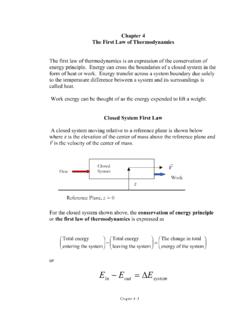
Chapter 4 The First Law of Thermodynamics
resources.saylor.orgThe First Law of Thermodynamics The first law of thermodynamics is an expression of the conservation of energy principle. Energy can cross the boundaries of a closed system in the form of heat or work. Energy transfer across a system boundary due solely to the temperature difference between a system and its surroundings is called heat.
THERMODYNAMICS, HEAT TRANSFER, AND FLUID FLOW …
sites.ntc.doe.gov1.25 STATE the Second Law of Thermodynamics. 1.26 Using the Second Law of Thermodynamics, DETERMINE the maximum possible efficiency of a system. 1.27 Given a thermodynamic system, CONDUCT an analysis using the Second Law of Thermodynamics. 1.28 Given a thermodynamic system, DESCRIBE the method used to determine: a. The …
Thermodynamics: First Law, Calorimetry, Enthalpy Calorimetry
www.chem.tamu.eduThermodynamics: First Law, Calorimetry, Enthalpy Monday, January 23 CHEM 102H T. Hughbanks Calorimetry Reactions are usually done at either constant V (in a closed container) or constant P (open to the atmosphere). In either case, we can measure q by measuring a change in T (assuming we know heat capacities). Calorimetry: constant volume
THERMODYNAMICS
www.ncert.nic.in12.3 Zeroth law of Thermodynamics 12.4 Heat, internal energy and work 12.5 First law of thermodynamics 12.6 Specific heat capacity 12.7 Thermodynamic state variables and equation of state 12.8 Thermodynamic processes 12. 9 Heat engines 12.10 Refrigerators and heat pumps 12.11 Second law of thermodynamics 12.12 Reversible and irreversible ...