
GU4204: Statistical Inference
1.1 Statistical Inference: Motivation Statistical inference is concerned with making probabilistic statements about ran-dom variables encountered in the analysis of data. Examples: means, median, variances ... Example 1.1. A company sells a …
Download GU4204: Statistical Inference

Information
Domain:
Source:
Link to this page:
Documents from same domain
Lecture 15 Introduction to Survival Analysis
www.stat.columbia.eduLecture 15 Introduction to Survival Analysis BIOST 515 February 26, 2004 BIOST 515, Lecture 15
Two-way ANOVA and ANCOVA
www.stat.columbia.eduTwo-way ANOVA and ANCOVA In this tutorial we discuss fitting two-way analysis of variance (ANOVA), as well as, analysis of covariance (ANCOVA) models in R.

Multiple Linear Regression - Columbia University
www.stat.columbia.eduMultiple Linear Regression A regression with two or more explanatory variables is called a multiple regression. Rather than modeling the …

Sample size and power calculations - Columbia …
www.stat.columbia.eduCHAPTER 20 Sample size and power calculations 20.1 Choices in the design of data collection Multilevel modeling is typically motivated by features in …

One and Two-sample t-tests - Columbia University
www.stat.columbia.eduOne and Two-sample t-tests The R function t.test() can be used to perform both one and two sample t-tests on vectors of data. The function contains a variety of options and can be called as follows:

Statistics and Research Integrity - Columbia University
www.stat.columbia.eduEuropean Science Editing 13 February 2015; 41(1) Another important challenge was receiving fewer essays from Balkan authors than expected and convincing the referees

Linear Regression - Columbia University
www.stat.columbia.eduLinear Regression In this tutorial we will explore fitting linear regression models using STATA. We will also cover ways of re-expressing variables in a …
The Twentieth-Century Reversal: How Did the …
www.stat.columbia.eduGelman: The Twentieth-Century Reversal: How Did the Republican States Switch to the Democrats and Vice Versa? 3 of, and more …

Abandon Statistical Signi cance - Department of …
www.stat.columbia.eduAbandon Statistical Signi cance Blakeley B. McShane1, David Gal2, Andrew Gelman3, Christian Robert4, and Jennifer L. Tackett1 1Northwestern University, 2University of …

Colors in R - Columbia University
www.stat.columbia.educolor name color name gray8 gray9 gray10 gray11 gray12 gray13 gray14 gray15 gray16 gray17 gray18 gray19 gray20 gray21 gray22 gray23 gray24 gray25 gray26 gray27 gray28
Related documents

The Adaptive Lasso and Its Oracle Properties
pages.cs.wisc.eduoracle properties: IdentiÞes the right subset model, {j: j = 0}= A Has the optimal estimation rate, n( () A A) d N (0, ), where is the covariance matrix knowing the true subset model. It has been argued (Fan and Li 2001; Fan and Peng 2004) that a good procedure should have these oracle properties. How-
AnIntroductionto StatisticalSignalProcessing
ee.stanford.edu4.5 Properties of expectation 195 4.6 Examples 197 4.7 Conditional expectation 206 4.8 ⋆Jointly Gaussian vectors 209 4.9 Expectation as estimation 211 4.10 ⋆Implications for linear estimation 218 4.11 Correlation and linear estimation 221 4.12 Correlation and covariance functions 228 4.13 ⋆The central limit theorem 231 4.14 Sample ...
Basic Principles of Statistical Inference
imai.fas.harvard.eduStatistical inference: Learning about what we do not observe (parameters) using what we observe (data) Without statistics:wildguess With statistics: principled guess 1 assumptions 2 formal properties 3 measure of uncertainty Kosuke Imai (Princeton) Basic Principles POL572 Spring 2016 2 / 66
An example of statistical data analysis using the R ...
www.css.cornell.edu5.Statistical computation and visualization. The analysis is carried out in the R environment for statistical computing and visualisation [16], which is an open-source dialect of the S statistical computing language. It is free, runs on most computing platforms, and contains contribu-tions from top computational statisticians.
1 Material Properties of Plastics - Wiley-VCH
application.wiley-vch.destatistical distribution [4] (Figure 1.4). By influencing the conditions of the polymer-ization process, the average molecular weight and the width of the distribution function can be controlled within certain limits. Duringthepolymerizationprocess,dependingonthetypeofpolymer,sidechains can be built to the main chain in a statistical way [5].
Thermodynamics and Statistical Mechanics
farside.ph.utexas.eduproperties of the system from a statistical treatment of the governing equations of motion. In fact, our approach has to be statistical in nature, because we lack most of the information required to specify the internal state of the system. The best we can do is to provide a few overall constraints, such as the average volume and the average ...
Theoretical Statistical Physics
www.thphys.uni-heidelberg.desion. We close with a discussion of thermodynamics, from which we see that statistical physics and thermodynamics essentially use the same formal structure, but that they complement each other in a unique manner: statistical physics focuses on the emer-gence of macroscopic properties from microscopic mechanisms, and thermodynamics

CS229T/STAT231: Statistical Learning Theory (Winter 2016)
web.stanford.eduApr 20, 2016 · statistical properties (they have the smallest possible asymptotic variance out of all estimators). But maximum likelihood is computationally intractable for most latent-variable models and requires non-convex optimization. These optimization problems are typically solved by EM, which is only guaranteed to converge to local optima. We
A Review of Statistical Distributions
people.stern.nyu.eduA Review of Statistical Distributions Every statistics book provides a listing of statistical distributions, with their properties, but browsing through these choices can be frustrating to anyone without a statistical background, for two reasons. …
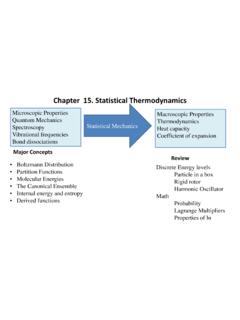
Chapter 15. Statistical Thermodynamics
www.chem.tamu.eduStatistical Thermodynamics Statistical thermodynamics provides the link between the microscopic (i.e., molecular) properties of matter and its macroscopic (i.e., bulk) properties. It provides a means of calculating thermodynamic properties from the statistical relationship between temperature and energy.