
Hearing Conservation
employers to monitor noise exposure levels in a way that accurately identifies employees exposed to noise at or above 85 decibels (dB) averaged over 8 working hours, or an 8-hour time-weighted average (TWA). Employers must monitor all employees whose noise exposure is equivalent to or greater than a noise exposure received
Download Hearing Conservation

Information
Domain:
Source:
Link to this page:
Documents from same domain
Motor Vehicles Safe Driving Practices for Employees
www.osha.govMotor Vehicles Safe Driving Practices for Employees You are your employer’s most valuable asset! The way that you drive says everything about you and your
U. S. Department of Labor Occupational Safety and …
www.osha.govU. S. Department of Labor Occupational Safety and Health Administration Notice of Alleged Safety or Health Hazards . For the General Public: This form is provided for the assistance of any complainant and is not intended to constitute the exclusive means by
Controlling Hazardous Fume and - osha.gov
www.osha.govFactSheet Controlling Hazardous Fume and Gases during Welding Welding joins materials together by melting a metal work piece along with a …
OSHA 3220-10N 2004
www.osha.govWORKER SAFETY SERIES WAREHOUSING 11 Hazards & Solutions Warehouse operations can present a wide variety of potential hazards for the worker. For warehousing establishments, the
Job Safety and Health - osha.gov
www.osha.govJob Safety and Health. IT’S THE LAW! All workers have the right to: A safe workplace. Raise a safety or health concern with your employer or OSHA, or report a work-
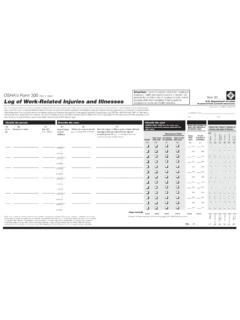
Year 20 Log of Work-Related Injuries and Illnesses
www.osha.govU.S. Department of Labor Occupational Safety and Health Administration OSHA’s Form 300 (Rev. 01/2004) Year 20__ __ Log of Work-Related Injuries and Illnesses You must record information about every work-related death and about every work-related injury or illness that involves loss of consciousness, restricted work activity or job transfer,
DEPARTMENT OF LABOR 29 CFR Part 1904
www.osha.gov2 The final rule also revises the requirements for reporting work-related fatality, injury, and illness information to OSHA. The current regulation requires employers to report …
CRANES AND DERRICKS IN CONSTRUCTION FINAL …
www.osha.govOSHA is making this document, the regulatory text, available for informational purposes only. This action does not affect the effective date of the final rule on Cranes and Derricks in Construction, which will be 90
Preventing Mold-Related Problems in the Indoor …
www.osha.govIntroduction This guide provides basic information about mold, mold sources, and building-related illnesses. Brief discussions are included on building design considerations for healthy indoor air,
HazardCommunicationGuidancefor CombustibleDusts
www.osha.govU.S.DepartmentofLabor OccupationalSafetyandHealthAdministration OSHA3371-08 2009 HazardCommunicationGuidancefor CombustibleDusts Occupational Safety and Health Act of 1970
Related documents

Using compressed air for cleaning - Oregon
osha.oregon.govEmployers and employees need to remember the rule’s three key points: 1. The compressed air must be reduced to less than 30 psi at the discharge end of the nozzle. 2. “Effective chip guarding” must prevent chips or other debris from being blown back on the worker. 3. Personal protective equipment appropriate for the cleaning task is required.

CODE OF PRACTICE MANAGING NOISE AT WORKPLACES
www.commerce.wa.gov.auemployer relating to noise management and hearing protection. SELF-EMPLOYED PERSONS’ RESPONSIBILITIES 2.11 Employers and self-employed people should take reasonable care to ensure their own safety and health in relation to workplace noise and avoid adversely affecting the hearing or safety and health of others.

Section 5 Noise at Work - Health and Safety Authority
www.hsa.ieguidance to employers on complying with the Control of Noise at Work Regulations, which form part of the Safety, Health and Welfare at Work (General Application) Regulations 2007 and the Guidelines on Hearing Checks and Audiometry under those regulations.

Health Surveillance for Noise Induced Hearing Loss
www.hse.gov.ukNoise Induced Hearing Loss • Hearing loss caused by work is a significant occupational disease • Recent research indicates 170,000 people suffer from hearing damage due to noise at work • Factors contributing to damage include the intensity of noise and length of exposure

Communicating Health and Safety Effectively
www.ohcow.on.caemployers in Ontario through clinical consultations for individuals with occupational health concerns, and prevention- ... Ensure important communications are not muffled by workplace noise Look for an opportunity to provide ‘workplace English’ lessons or …

Physical Hazards: Noise & Vibration - OHS BOK
www.ohsbok.org.auNoise and vibration are closely linked in that noise originates from a vibrating body and both noise and vibration have similar physics as they are transmitted as waves through a medium. The health impacts of noise hazards are well recognised with noise-induced hearing loss identified as a priority work-related disease for Australian workers.
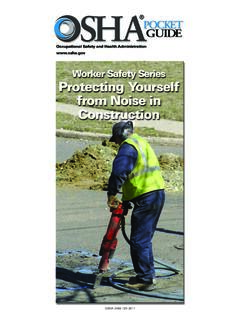
OSHA 3498-12N 2011
www.osha.govunderstand and reduce noise exposure on job sites. Employers are required to comply with safety and health standards as issued and enforced by either the Federal Occupational Safety and Health Administration (OSHA), or an OSHA-approved State Plan. In addition, Section 5(a)(1) of The Occupational Safety and HealthAct, the General Duty Clause ...