
Hip Strengthening PROTOCOL
Hip Strengthening PROTOCOL . Patient lies on their side. STRENGTH. Keep body in a straight line. Goal. B. ENING EXERCISES: L. a. t. e. r. a. l. S. l. i. d. e. s. Place theraband around both ankles. Stand with knees and hips slightly bent. Take a 6-8 inch step to the side, followed by the other foot. Repeat 10 times both directions . Frequency ...
Download Hip Strengthening PROTOCOL

Information
Domain:
Source:
Link to this page:
Documents from same domain
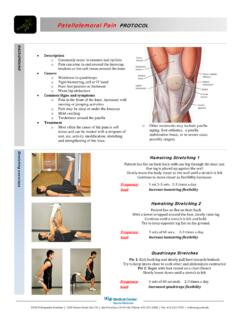
Patellofemoral Pain
sportsrehab.ucsf.eduPatellofemoral Pain PROTOCOL ` Description. o. o. possibly surgery. H. Try to keep opposite leg flat on the ground . Pic 1: BACKGROUND Stretching exercises • o Commonly occur in …
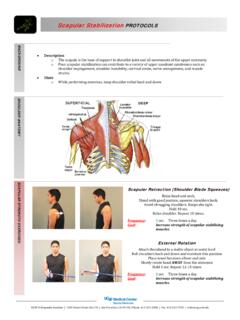
Scapular Stabilization - UCSF Sports Medicine Rehab ...
sportsrehab.ucsf.eduScapular Stabilization PROTOCOLS ` Description. muscles. STRENGTH EXERCISES: BACKGROUND • o The scapula is the base of support to shoulder joint and all movements of the upper extremity o Poor scapular stabilization can contribute to a variety of upper quadrant syndromes such as:
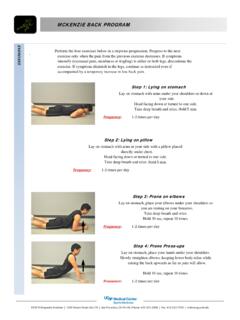
MCKENZIE BACK PROGRAM - UCSF Sports Medicine Rehab ...
sportsrehab.ucsf.eduMCKENZIE BACK PROGRAM ` intensif. Take deep breath and relax. S. raising the back upwards as far as pain will allow. EXERCISES Perform the four exercises below in a stepwise progression.

CORE STRENGTH AND STABILITY PROGRAM
sportsrehab.ucsf.eduFind Pelvic Neutral. L. GOAL. BACKGROUND. Pelvic Neutral belly button in, flatten your back. Technique: Hiss like a snake / Say the letter “S”. ‘sssssss’ A proper core contraction should prevent the towel from moving. This is your starting position for all core exercises! Dead Bugs Alt lowering one leg at a time, maintain Pelvic Neutral.
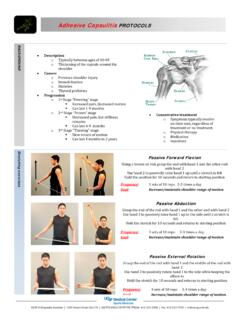
Adhesive Capsulitis PROTOCOLS
sportsrehab.ucsf.edu1st Stage “Freezing” stage Increased pain, decreased motion Can last 1-9 months o 2nd Stage “Frozen” stage Decreased pain, but stiffness Can last 4-9 months o 3rd Stage “Thawing” stage Slow return of motion Can last 5 months to 2 years P. a. …

Ankle Strengthening PROTOCOLS - UCSF Sports Medicine …
sportsrehab.ucsf.eduKeeping the knee and thigh still, rotate foot out away from the body . Frequency: 3 sets x 15 reps. 1-2 times a day. Goal: Increase ankle strength C. a. l. f. S. t. r. e. t. c. h. Stretch 1: Stand with the ball of the foot against the wall Slowly move body towards the wall until stretch is felt . Stretch 2: Stand facing a wall and step back ...
Rotator Cuff Injury PROTOCOLS - Welcome | UCSF Sports ...
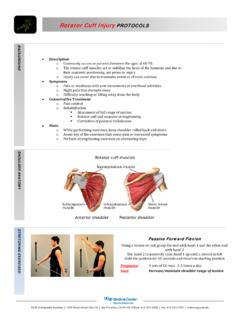
sportsrehab.ucsf.eduo Night pain that disrupts sleep o Difficulty reaching or lifting away from the body • Conservative Treatment o Pain control o Rehabilitation Attainment of full range of motion Rotator cuff and scapular strengthening Correction of postural imbalances • Hints o While performing exercises, keep shoulder rolled back and down
IT Band Syndrome PROTOCOL - UCSF Sports Medicine Rehab ...
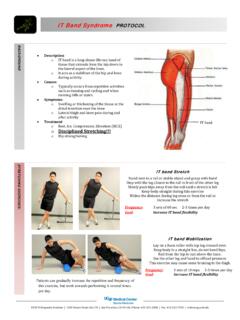
sportsrehab.ucsf.eduIT Band Syndrome PROTOCOL ` during activity. running hills or stairs. • Slowly push hips away from the rail until a stretch is felt. Frequency. Goal. Patients can gradually increase the repetition and frequency of . BACKGROUND • Description o IT band is a long-dense-fibrous band of tissue that extends from the hip down to the lateral aspect ...
Related documents

Lower Extremity Strengthening Exercises in Supine
ahc.aurorahealthcare.orgLower Extremity Strengthening Exercises in Supine, Page 2 X19572bc (Rev. 04/10) ©AHC Lower Extremity The information presented is intended for general information and educational purposes. It is not intended to replace the advice of your health care provider. Contact your health care provider if you believe you have a health problem.
Lower Extremity Strengthening Exercises – Sitting
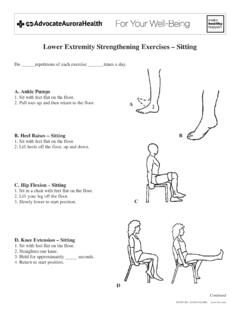
ahc.aurorahealthcare.orgLower Extremity Strengthening Exercises – Sitting. Do repetitions of each exercise times a day. A. Ankle Pumps. 1. Sit with feet flat on the floor. 2. Pull toes up and then return to the floor. A. B. Heel Raises – Sitting B. 1. Sit with feet flat on the floor. 2. Lift heels off the floor, up and down. C. Hip Flexion – Sitting. 1.
Strengthening and Optimal Movements for Painful Shoulders ...
sci.washington.eduExercises are to be performed 3 times per week. Allow one rest day between each exercise day. You may divide the exercises into groups and perform them at different times. For example, in the morning perform 1⁄ 2 the exercises and in the afternoon perform the other 1⁄2 OR one day perform 2 groups of exercises
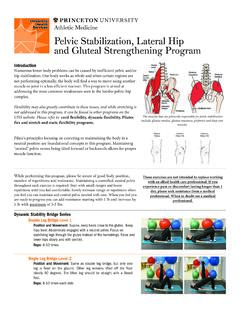
Pelvic Stabilization Hip Strengthening
uhs.princeton.eduAdvanced Lateral Hip and Gluteal Strengthening Exercises Fire Hydrants Position and Movement: On all fours, hands directly under shoulders and knees over hips. Abdominals are engaged. Lift leg up and out maintaining 90 degrees of hip flexion and knee flexion. Avoid rotating hips or arching back as you lift the leg. Goal is to lift thigh to level of
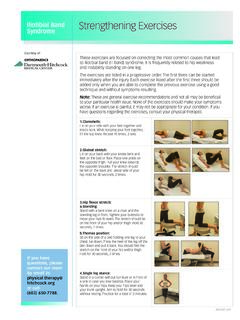
Iliotibial Band Syndrome Strengthening Exercises (IT Band)
www.dartmouth-hitchcock.orgIliotibial Band Strengthening Exercises Syndrome Courtesy of: OrthOpaedics If you have questions, please contact our team by email to physical.therapy@ hitchcock.org or call (603) 650-7788. 201307-234. 5.Standing hip motions: Practice standing on each leg. Begin
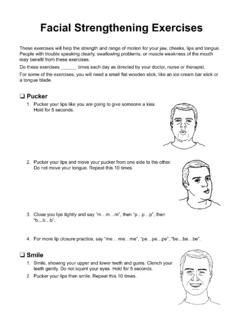
Facial Strengthening Exercises
www.healthinfotranslations.orgFacial Strengthening Exercises These exercises will help the strength and range of motion for your jaw, cheeks, lips and tongue. People with trouble speaking clearly, swallowing problems, or muscle weakness of the mouth may benefit from these exercises. Do these exercises _____ times each day as directed by your doctor, nurse or therapist.
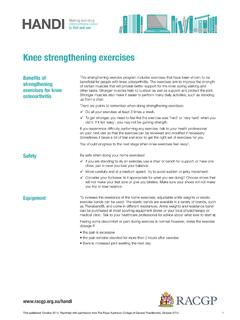
RACGP - Knee strengthening exercises
www.racgp.org.auThis strengthening exercise program includes exercises that have been shown to be beneficial for people with knee osteoarthritis. The exercises aim to improve the strength of certain muscles that will provide better support for the knee during walking and other tasks. Stronger muscles help to cushion as well as support and protect the joint.