
IMF Intermolecular Forces Worksheet
IMF – Intermolecular Forces Worksheet Indicate the strongest IMF holding together thousands of molecules of the following. Then indicate what type of bonding is holding the atoms together in one molecule of the following. NOTE – if the molecule is an ionic compound, then there is no IMF, the ions are all held together by ionic bonds.
Download IMF Intermolecular Forces Worksheet

Information
Domain:
Source:
Link to this page:
Documents from same domain

Chapter 14. CHEMICAL EQUILIBRIUM
web.gccaz.eduChapter 14. CHEMICAL EQUILIBRIUM 14.1 THE CONCEPT OF EQUILIBRIUM AND THE EQUILIBRIUM CONSTANT Many chemical reactions do not go to completion but instead attain a ...
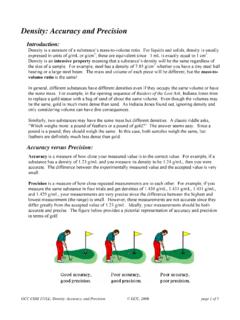
Density: Accuracy and Precision
web.gccaz.eduGCC CHM 151LL: Density: Accuracy, and Precision © GCC, 2008 page 4 of 5 glassware. ... 1. Obtain a set of 4 brass slugs and 1 aluminum slug. 2.
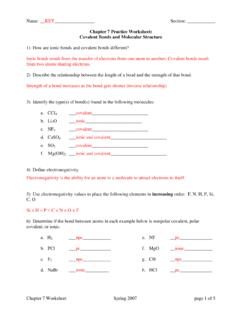
Chapter 7 Practice Worksheet: Covalent Bonds and Molecular ...
web.gccaz.eduChapter 7 Worksheet Spring 2007 page 1 of 5 Chapter 7 Practice Worksheet: Covalent Bonds and Molecular Structure 1) How are ionic bonds and covalent bonds different? ... f. Mg(OH) 2 ___ ionic and covalent _____ 4) Define electronegativity. Electronegativity is the ability for an atom in a molecule to attract electrons to itself. ...

Balancing Equations Worksheet KEY
web.gccaz.eduBalancing Equations Worksheet KEY 1. Zn (s) + 2 AgNO 3 (aq) ⇒ Zn(NO 3) 2 (aq) + 2 Ag (s) 2. N 2 (g) + 3 H 2 (g) ⇒ 2 NH 3 (g) 3. NaCl (aq) + AgC 2H 3O 2 (aq) ⇒ NaC 2H 3O 2 (aq) + AgCl (s) 4. 3 Mg(OH) 2 (aq) + 2 H 3PO 4 (aq) ⇒ 6 H 2O (l) + Mg 3(PO 4 ) 2 (aq) 5. 2 HNO 3 (aq) + Ni (s) ⇒ Ni(NO 3) 2 (aq) + H 2 (g) 6. Ba(HCO 3) 2 (s) ⇒ BaCO 3 (s) + H 2O (g) + CO
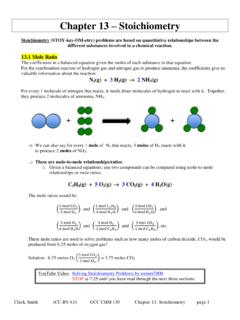
Chapter 13 Stoichiometry - Glendale Community College
web.gccaz.eduChapter 13 – Stoichiometry Stoichiometry (STOY-key-OM-etry) problems are based on quantitative relationships between the different substances involved in a chemical reaction.

Intermolecular and Ionic Forces - web.gccaz.edu
web.gccaz.eduIntermolecular and Ionic Forces ... general, intermolecular forces are much weaker than the ionic and covalent bonds that hold together the atoms and ions in a compound. ... compared in this lab. The alkane used in this activity is pentane, CH 3 CH 2 CH 2 CH 2 CH 3. Alcohols are

Marine Biology: Study Guide - web.gccaz.edu
web.gccaz.eduBIO145: Marine Biology 3 Study Guide Chapter 10 An Introduction to Ecology Ecology is the scientific study of the interactions between organisms and their environment that determine the distribution and abundance of organisms.

CHM 130LL: Electrolytes - Welcome to web.gccaz.edu
web.gccaz.edumainly in body fluids outside the cells. Human body fluids have almost the ... CHM 130LL: Electrolytes Lab . GCC CHM 130LL Spring 2016 page 2 of 7 Understanding ... This makes it possible to identify which substance is in which well (ex: A3 or C2). In your data table (on the next page), ...
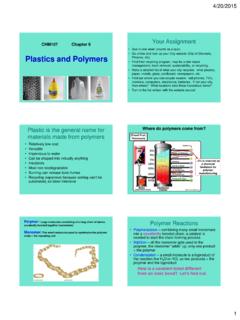
Polymers and Plastics - web.gccaz.edu
web.gccaz.edua chemical feedstock for polymer manufacturing Polymer: ... • Now back to polymers and plastics Given these monomers predict the structure of the polymer Ethylene Vinyl chloride ... recycle numbers are these plastics? • Plastic comes from oil – so less recycling means

CHM 130 Predicting Products Worksheet
web.gccaz.eduCHM 130 Predicting Products Worksheet Circle the appropriate reaction type for each, complete the reaction with products (remember to check charges for ionic compounds), include states, and finally balance each reaction.
Related documents

Ionic Compound Formula Writing Worksheet
msbunney.weebly.comIonic Compound Formula Writing Worksheet Write chemical formulas for the compounds in each box. The names are found by finding the intersection between the cations and anions. Example: The first box is the intersection between the “zinc” cation and the “chloride” anion, so you should write
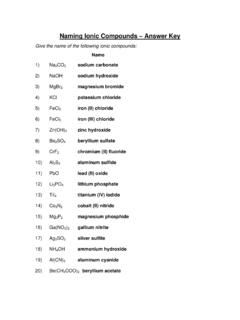
Naming Ionic Compounds – Answer Key
siemianowski.weebly.comA HYDRATE IS AN IONIC COMPOUND THAT HAS WATER TRAPPED INSIDE THE STRUCTURE OF THE COMPOUND. THIS WATER IS PHYSICALLY TRAPPED NOT CHEMICALLY BONDED. 2) Define the following terms as they relate to hydrates: Anhydrate : A HYDRATE THAT HAS HAD ALL WATER REMOVED. Dehydration: THE PROCESS OF REMOVING WATER USING HEAT.
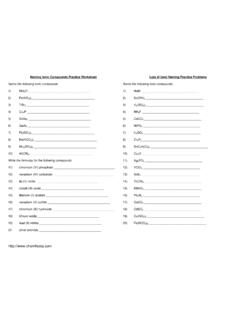
Naming Ionic Compounds Practice Worksheet
www.sfponline.orgNaming Ionic Compounds Practice Worksheet Name the following ionic compounds: 1) NH 4 Cl _____ 2) Fe(NO 3) 3 ... For each of the following questions, determine whether the compound is ionic or covalent and write the appropriate formula for it. 11) dinitrogen trioxide _____ ...

Chemical Formula Writing Worksheet Two
staff.imsa.eduChemical Formula Writing Worksheet Solutions Write chemical formulas for the compounds in each box. The names are found by finding the intersection between the cations and anions. Example: The first box is the intersection between the “zinc” cation and the “chloride” anion, so you should write “ZnCl 2”, as shown.

Naming Compounds Practice Worksheet
www.lcps.org81) Which of the following pairs of elements would most likely form a ionic compound? A) Ca and Ni B) Cu and Ar C) F and S D) Zn and K E) Na and Cl 82) Electronegativity is a concept that is useful along with other concepts in _____. A) deciding how many electrons are involved in …
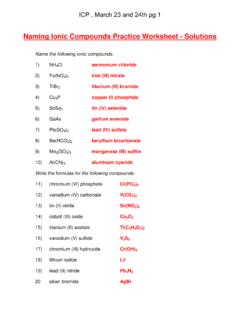
Naming Ionic Compounds Practice Worksheet - Solutions
www.hoodriver.k12.or.usNaming Ionic Compounds Practice Worksheet - Solutions Name the following ionic compounds: 1) NH4Cl ammonium chloride 2) Fe(NO3)3 iron (III) nitrate 3) TiBr3 titanium (III) bromide 4) Cu3P copper (I) phosphide 5) SnSe2 tin (IV) selenide 6) GaAs gallium arsenide
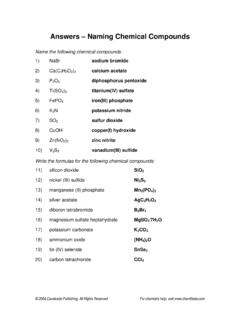
Answers – Naming Chemical Compounds
www.npsd.k12.nj.usIonic/Covalent Compound Naming Solutions . For each of the following questions, determine whether the compound is ionic or covalent and name it appropriately. 1) Na2CO3 sodium carbonate. 2) P2O5 diphosphorus pentoxide. 3) NH3 ammonia. 4) FeSO4 iron (II) sulfate. 5) SiO2 silicon dioxide. 6) GaCl3 gallium chloride. 7) CoBr2 cobalt (II) bromide. 8 ...
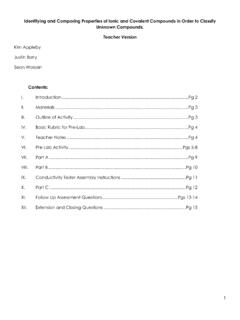
Identifying and Comparing Properties of Ionic and Covalent ...
www.sas.upenn.edua molecular compound. This aspect of the lab activity allows the student to observe the properties of both ionic and molecular compounds in solution and requires that the student interpret results to make a determination about the type of …
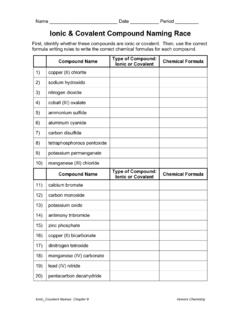
Ionic & Covalent Compound Naming Race
www.gardencity.k12.ny.usIonic & Covalent Compound Naming First, identify whether these compounds are ionic or covalent. Then, use the correct naming rules to write the correct names for each compound. Chemical Formula Type of Compound: Ionic or Covalent Compound Name 21) CdBr 2 22) Cr(Cr 2O 7) 3 23) SBr 2 24) (NH 4) 2CrO 4 25) CuO 26) Pt