Inductive Representation Learning on Large Graphs
Inductive Representation Learning on Large Graphs William L. Hamilton wleif@stanford.edu Rex Ying rexying@stanford.edu Jure Leskovec jure@cs.stanford.edu Department of Computer Science Stanford University Stanford, CA, 94305 Abstract Low-dimensional embeddings of nodes in large graphs have proved extremely
Download Inductive Representation Learning on Large Graphs

Information
Domain:
Source:
Link to this page:
Documents from same domain
Generative Adversarial Imitation Learning
proceedings.neurips.ccnetworks [8], a technique from the deep learning community that has led to recent successes in modeling distributions of natural images: our algorithm harnesses generative adversarial training to fit distributions of states and actions defining expert behavior. We test our algorithm in Section 6, where
Prototypical Networks for Few-shot Learning
proceedings.neurips.cc˚: RD!RMwith learnable parameters ˚. Each prototype is the mean vector of the embedded support points belonging to its class: c k= 1 jS kj X (x i;y i)2S k f ˚(x i) (1) Given a distance function d: R M R 
Bootstrap Your Own Latent A New Approach to Self ...
proceedings.neurips.ccmining strategies [14, 15] to retrieve the nega-tive pairs. In addition, their performance criti-cally depends on the choice of image augmenta- ... to prevent collapsing while preserving high performance. To prevent collapse, a straightforward solution …
Spatial Transformer Networks - NeurIPS
proceedings.neurips.ccConvolutional Neural Networks define an exceptionally powerful class of models, ... localisation, semantic segmentation, and action recognition tasks, amongst others. ... can take any form, such as a fully-connected network or a convolutional network, but should include a final regression layer to produce the transformation ...
Semi-supervised Learning with Deep Generative Models
proceedings.neurips.ccapproximately invariant to local perturbations along the manifold. The idea of manifold learning ... We show for the first time how variational inference can be brought to bear upon the prob- ... probabilities are formed by a non-linear transformation, with parameters , of a set of latent vari-ables z. This non-linear transformation is ...
Unsupervised Learning of Visual Features by Contrasting ...
proceedings.neurips.ccpseudo-labels to learn visual representations. This method scales to large uncurated dataset and can be used for pre-training of supervised networks [7]. However, their formulation is not principled and recently, Asano et al. [2] show how to cast the pseudo-label assignment problem as an instance of the optimal transport problem.
PyTorch: An Imperative Style, High-Performance Deep ...
proceedings.neurips.ccFacebook AI Research benoitsteiner@fb.com Lu Fang Facebook lufang@fb.com Junjie Bai Facebook jbai@fb.com Soumith Chintala Facebook AI Research soumith@gmail.com Abstract Deep learning frameworks have often focused on either usability or speed, but not both. PyTorch is a machine learning library that shows that these two goals
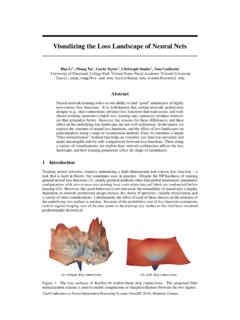
Visualizing the Loss Landscape of Neural Nets
proceedings.neurips.cctask that is hard in theory, but sometimes easy in practice. Despite the NP-hardness of training general neural loss functions [3], simple gradient methods often find global minimizers (parameter configurations with zero or near-zero training loss), even when data and labels are randomized before training [43].
InfoGAN: Interpretable Representation Learning by ...
proceedings.neurips.ccof the digit (0-9), and chose to have two additional continuous variables that represent the digit’s angle and thickness of the digit’s stroke. It would be useful if we could recover these concepts without any supervision, by simply specifying that an MNIST digit is generated by an 1-of-10 variable and two continuous variables.

Learning Structured Output Representation using Deep ...
proceedings.neurips.ccposterior inference. However, the parameters of the VAE can be estimated efficiently in the stochas-tic gradient variational Bayes (SGVB) [16] framework, where the variational lower bound of the log-likelihood is used as a surrogate objective function. The variational lower bound is written as: logp (x) = KL(q ˚(zjx)kp (zjx))+E q ˚(zjx) logq ...
Related documents

MACHINE LEARNING LABORATORY MANUAL - JNIT
www.jnit.orgInductive logic programming Inductive logic programming (ILP) is an approach to rule learning using logic programming as a uniform representation for input examples, background knowledge, and hypotheses. Given an encoding of the known background knowledge and a set of examples represented as a logical
INTRODUCTION MACHINE LEARNING
ai.stanford.edutheir internal structure to produce correct outputs for a large number of sample inputs and thus suitably constrain their input/output function to approximate the relationship implicit in the examples. It is possible that hidden among large piles of data are important rela-tionships and correlations. Machine learning methods can often be used
Graph Transformer Networks - NeurIPS
proceedings.neurips.ccremarkable success in representation learning, GNNs learn a powerful representation for given tasks and data. To improve performance or scalability, generalized convolution based on spectral convolution [4, 26], attention mechanism on neighbors [25, 33], subsampling [6, 7] and inductive representation for a large graph [14] have been studied.
Graph Representation Learning - McGill University School ...
www.cs.mcgill.calearning. We begin with a discussion of the goals of graph representation learning, as well as key methodological foundations in graph theory and network analysis. Follow-ing this, we introduce and review methods for learning node embeddings, including random-walk based methods and applications to knowledge graphs. We then provide