Interviewer Manual - complete
Major Depressive Episode / Dysthymic Disorder, Manic / Hypomanic Episode ... This determines whether a worse episode has occurred prior to the last year, and if so the whole life section for that diagnosis will be administered. In negative cases, the whole life module is automatically administered. Certain diagnoses (e.g., enuresis, tics,
Download Interviewer Manual - complete

Information
Domain:
Source:
Link to this page:
Documents from same domain

School Chemistry Laboratory Safety Guide
www.cdc.govSchool Chemistry Laboratory Safety Guide. October 2006. U.S. Consumer Safety Product Commission DEPARTMENT OF HEALTH AND HUMAN SERVICES. Centers for Disease Control and Prevention

Biosafety in Microbiological and Biomedical …
www.cdc.goviii. Foreword. Biosafety in Microbiological and Biomedical Laboratories (BMBL) quickly became the cornerstone of biosafety practice and policy in the United States upon first
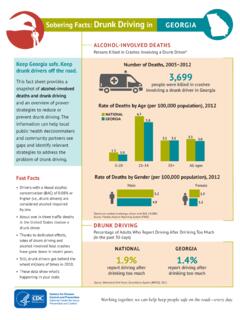
Sobering Facts: Drunk Driving in Georgia
www.cdc.govSobering Facts: Drunk Driving in GEORGIA Keep Georgia safe. Keep drunk drivers off the road. This fact sheet provides a snapshot of alcohol-involved deaths and drunk driving
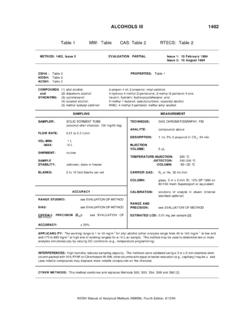
ALCOHOLS III 1402
www.cdc.govALCOHOLS III: METHOD 1402, Issue 2, dated 15 August 1994 - Page 3 of 4 a. Remove and discard back sorbent section of a media blank sampler. b. Inject a known amount of analyte or DE stock solution directly onto front sorbent section
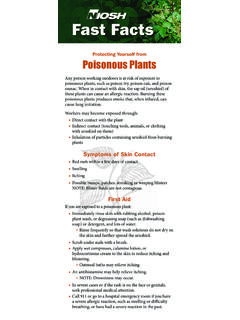
Fast Facts
www.cdc.govAny person working outdoors is at risk of exposure to poisonous plants, such as poison ivy, poison oak, and poison sumac. When in contact with skin, the sap oil (urushiol) of

Trans Fat: The Facts
www.cdc.gov• Read the Nutrition Facts label and ingredient list to compare foods. » Choose products with 0 grams trans fat. » Check the Ingredient List to see if there is any partially hydrogenated oil in the product.

ANTIBIOTIC RESISTANCE THREATS
www.cdc.govApr 23, 2013 · 6. ANTIBIOTIC RESISTANCE THREATS IN THE UNITED STATES, 2013. Executive Summary. Antibiotic Resistance Threats in the United States, 2013. is a snapshot of the complex problem
Chlorine Residual Testing
www.cdc.govChlorine Residual Testing Fact Sheet, CDC SWS Project 4 Methods to Test Free Chlorine in the Field in Developing Countries There are three main methods to test free chlorine residual in drinking water in the field
2018 Combined Recommended Immunization …
www.cdc.govRecommended Immunization Schedule for Children and Adolescents Aged 18 Years or Younger, UNITED STATES, 2018 Approved by the Advisory Committee on …

Traveling? Make Sure You Protect Yourself from …
www.cdc.govCS26201 Malaria transmission occurs throughout Malaria transmission occurs in some parts Malaria transmission is not known to occur Center for Global Health
Related documents
Depression
adaa.orgDuring the depressive phase, a person experiences the symptoms of major depression. A depressive episode is diagnosed if five or more primary depressive symptoms last most of the day, nearly every day, for a period of two weeks or longer. Signs and symptoms of a depressive episode can include the following: Lasting sad or empty mood
DSM-5 UPDATE
dsm.psychiatryonline.orgBipolar I Disorder, Current or most recent episode hypomanic [effective October 1, 2015] In partial remission . In full remission . Depressive Disorders .....3 7 . Disruptive Mood Dysregulation Disorder [effective October 1, 2016]
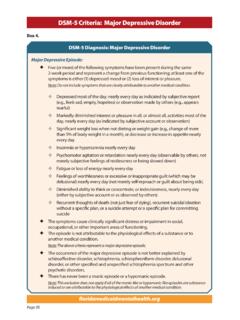
DSM-5 Criteria: Major Depressive Disorder
floridabhcenter.cbcs.usf.eduDSM-5 Criteria: Major Depressive Disorder Major Depressive Episode: F Five (or more) of the following symptoms have been present during the same 2-week period and represent a change from previous functioning; at least one of the symptoms is either (1) depressed mood or (2) loss of interest or pleasure.
Management of Major Depressive Disorder
www.bop.govdeveloped major depressive disorder can evolve subacutely over days to weeks, or more slowly after a prodromal period of anxiety and mild depression that lasts for weeks to months. Between 50–85% of persons with a single episode of major depressive disorder will suffer another episode during their lifetime.
Canadian Network for Mood and Anxiety
www.cmh.orgas first-line treatments for patients with a major depressive episode(MDE)ofmoderateorgreaterseverity(asdetermined by symptom scales and/or functional impairment), and this recommendation is unchanged. First-line treatments for indi-viduals with depression of mild severity include psychoedu-cation, self-management, and psychological …
VA/DoD Major Depressive Disorder Clinical Practice …
www.healthquality.va.gov7% of the population —had at least one major depressive episode in the past year. Women are 70% more likely than men to experience depression, and young adults aged 18–25 are 60% more likely to have depression than people aged 50 or older.

Outpatient Treatment Plan - ICANotes
www.icanotes.comMajor depressive disorder, single episode, severe without psychotic features, F32.2 (ICD -10) (Active) Anxiety disorder, unspecified, F41.9 (ICD -10) (Active) Current Medications: #1) Prozac 40 mg PO BID #2) Ambien 10 mg PO QHS PRN Problem / Needs: Problem / Need # 1: Anxiety Problem / Need # 2: Depressed Mood

Highlights for the 2020 National Survey on Drug Use and Health
www.samhsa.govIn 2020, 17.0% of adolescents aged 12 to 17 (or 4.1 million people) had a major depressive episode (MDE) in the past year, and 2.7% (or 644,000 people) had a co-occurring MDE and an SUD in the past year. In 2020, 21.0% of adults aged 18 or …