
Introduction to Hidden Markov Models
• Transition probabilities and initial probabilities are calculated from language model. • Observations and observation probabilities are as before. a m h e r s t b v f o • Here we have to determine the best sequence of hidden states, the one that most likely produced word image. • This is an application of Decoding problem.
Download Introduction to Hidden Markov Models

Information
Domain:
Source:
Link to this page:
Documents from same domain

A Survey on Combinatorial Group Testing Algorithms with ...
cse.buffalo.eduDIMACS Series in Discrete Mathematics and Theoretical Computer Science A Survey on Combinatorial Group Testing Algorithms with Applications to DNA Library Screening

Introduction to Automotive Embedded Systems
cse.buffalo.eduHiroaki Takada Automotive Embedded (Computing) Systems Embedded (Computing) Systems A computer system that is embedded into an piece of equipment or a machine to control it. Embedded systems are applied to most electric/ electronic equipment, recently.

Propositional Logic - University at Buffalo
cse.buffalo.eduThe Foundations: Logic and Proof The rules of logic specify the precise meanings of mathematical statements. It is the basis of the correct mathematical arguments, that is, the proofs. It also has important applications in computer science: to verify that computer programs produce the correct output for all possible input values.

Solution #3, CSE 191
cse.buffalo.edu• “It was sunny on Tuesday” leads to ¬R(Tue)∧¬S(Tue). • “It did not snow on Thr” leads to ¬S(Thr) Conclusion: “It rained on Thursday” leads to R(Thr) 2. Step Reason ... Use resolution to show the hypotheses ”Allen is a bad boy or Hillary is a good girl” and

Understanding IP Addressing: Everything You Ever …
cse.buffalo.eduto the early decisions that were made during its formative years. ... - The classful A, B, and C octet boundaries were easy to understand and implement, ... Problems resulted from the lack of a network class that was designed to support medium-Subnetting),).) ...
Related documents
Review of Probability Theory
cs229.stanford.eduBy using this function one can calculate the probability of any event in F.3 Figure ?? shows a sample CDF function. Properties: 2Technically speaking, not every function is not acceptable as a random variable. From a measure-theoretic perspective, random variables must be Borel-measurable functions. Intuitively, this restriction ensures that
Joint, Conditional, & Marginal Probabilities
markirwin.netJoint, Conditional, & Marginal Probabilities The three axioms for probability don’t discuss how to create probabilities for combined events such as P[A \ B] or for the likelihood of an event A given that you know event B occurs. Example: Let A be the event it rains today and B be the event that it rains tomorrow.

CS 547 Lecture 9: Conditional Probabilities and the ...
pages.cs.wisc.eduCS 547 Lecture 9: Conditional Probabilities and the Memoryless Property Daniel Myers Joint Probabilities For two events, E and F, the joint probability, written P(EF), is the the probability that both events occur. For example, let E be “the probability that a die roll is even” and F be “the probability that a die roll is greater than 3”.
Chapter 10 Joint densities - Yale University
www.stat.yale.edudescribe how one might calculate probabilities of the form Pf.X;Y/2Bgfor various sub-sets B of the plane. For example, how could one calculate PfX <Ygor PfX2 CY2 •9gor PfX CY •7g? <10.1> Definition. Say that random variables X and Y have a jointly continuous distribution with joint density function f.¢;¢/if †joint density Pf.X;Y/2BgD ZZ

Fundamentals of Probability
78bbm3rv7ks4b6i8j3cuklc1-wpengine.netdna-ssl.comYou can use your TI 83/84 Plus to calculate the Factorial Formula: 1. First input value for total number of objects. 2. Press MATH 3. Use the Arrow Keys to highlight PRB 4. Use Arrow Keys to highlight 4: ! 5. Press ENTER Fundamental Counting Principal (FCP) When repetitions are allowed and the number of ways to fill an open place is not ...
CHAPTER 2 Estimating Probabilities
www.cs.cmu.eduexample, we can calculate that the probability P(Gender =male)=0:6685 for the joint distribution in Table 1, by summing the four rows for which Gender = male. Similarly, we can calculate the probability P(Wealth = rich)=0:2393 by adding together the probabilities for the four rows cover-ing the cases for which Wealth=rich.
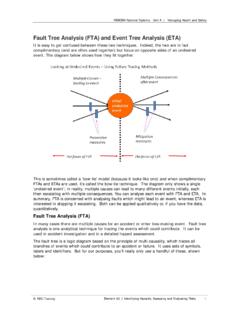
Fault Tree Analysis (FTA) and Event Tree Analysis (ETA)
www.icao.intMoving up again, we can now calculate the probability of the top event. These faults are below an AND gate, so we multiply the probabilities, giving 0.21 x 1 x 0.35 = 0.0735. The top of the fully quantified fault tree then looks like this:

1 Probability, Conditional Probability and Bayes Formula
www2.isye.gatech.eduThe multiplication rule tells us how to find probabilities for composite event (A¢B). The probability of (A¢B) is used in the general addition rule for finding the probability of (A[B). Rule Notation Definitions The conditional probability of A given B is the probability of event A, if event B occurred. P(AjB)
Conditional Probability
www3.nd.eduCalculating Conditional Probabilities (b) What is the probability that the day chosen was a Sunny day, P(S)? The sample space is still the 30 days under discussion. It was sunny on 9 + 1 = 10 of them so P(S) = 10 30 ˇ33%. (c) What is P G S? P G S = P(G\S) P(S). Hence we need to calculate P(G\S). Here the sample space is still